Jeff Duntemann's Contrapositive Diary Rotating Header Image

psychology

Anger Makes You Lose

When the emails started coming in a couple of days ago, I thought it was an urban legend. I really did. (I get a lot of those here.) I went to Snopes automatically, as I always do when someone sends me an email telling me to “forward this to everyone in your address book!” Appallingly, as a single Google search showed, this time the topic was true: Well-known British director Richard Curtis (Love, Actually; Four Weddings and a Funeral) and a global warming group of some significance have created a short film showing True AGW Believers murdering those who disagree with them…including a couple of grade-school children.

The organization is 10:10. The film is “No Pressure.” I won’t post a link to the film itself here because it has been withdrawn from its original location and reposted in lots of other places. I also hesitate because if you have anything like respect for human life you will find it hideously disturbing. Seek it out at risk of nightmares, and don’t say you weren’t warned.

Quick representative summary of a scene from the film: Smug teacher is indoctrinating a group of grade schoolers about the dangers of global warming. A couple of them refuse to buy in. Teacher then pushes a button, and the dissenting kids explode into a realistic cloud of blood and guts, splattering on the walls and on their classmates.

You think I’m kidding? Then grab your barf bag and go find the movie. You won’t have to look far. (It’s on YouTube as I write this.)

No pressure. Right. Disagree with us and we’ll kill you.

This entry is not about global warming, which I’m still researching and will discuss when I’m ready. This entry is about a theme I’ve touched on here again and again over the years: Anger makes you stupid. The level of anger-driven stupidity in this case boggles the mind. To science’s sorrow, anger is now the driving force in the global warming debate. The stupidity comes in when your anger compels you to hand a cudgel to your opponents, which they will then gleefully use to bash your head in again and again and again…forever.

This is galactic-class stupidity. The film will never go away. It will become a legend, and “no pressure” will become a meme for “wanting to kill people who disagree with you.” The Right will broaden the film’s scope and cite it repeatedly as evidence that the environmentalist left is a sort of Stalinist religion that hates humanity and advocates violence against its opponents. The whole thing will inflate far past absurdity. It will tip elections and put more Republicans in power. It will reverse years of gains on environmental issues, and will make it even more difficult to entertain rational debate on any environmental topic at all.

Small price to pay for a piece of delicious tribal poo-flinging, eh?

Bottom line: Anger makes you stupid. And when you get stupid enough, you do things that make you lose.

Odd Lots

  • From the Words I Didn’t Know Until Yesterday Department: bricoleur, a person who creates bricolage; that is, who pieces together useful things from odd bits that are just lying around. In other words, me.
  • Now, this interests me: Modkit, a GUI IDE for Arduino, with drag-and-drop “blocks” for program structures (inspired by MIT’s Scratch language for kids) and function calls. Alas, I don’t have any good way to test it (nor time to take up Arduino tinkering, as much as it appeals to me) but this is definitely headed in the right direction. I’m not sure I’d prefer it all out in the cloud, but that’s what seems to be in vogue these days.
  • Sometimes the universe is so startling that it looks fake. Like this.
  • I’m thinking that I’ll be toting an Android someday, and I was pleased to see the logo for the Android port of Firefox, called Fennec. When my father was in North Africa during WWII, he and his buddies at the AACS radio station in Mali killed time by attempting to tame the local desert fox population, generally by applying K-rations. What the fennecs thought of K-rations was not recorded, but as best I know they were not driven to extinction in the process.
  • I’d had this insight some years ago, while listening to one side of lame cellphone conversations in supermarkets (triggered, I’m guessing, by the invention of Bluetooth earclippie headsets) but evidently there’s some research behind it: Overheard “halfalogue” conversations are far more distracting than conversations heard in full. I know! Put it on speakerphone!
  • The guy who ran the UK Segway operation rode his scooter off a cliff to his unfortunate demise. Gravity’s a bitch, and overconfidence kills. (Thanks to Michael Covington for the link.)
  • Back when I was in college I saw a truck carrying uncounted cartons of head lettuce hit a low railroad viaduct and split open, and heads, well, rolled. Over in Japan, they’re working on the dressing side, with a major mayonnaise spill.
  • And from the same site, a writeup on a new Las Vegas hotel that makes significant use of solar energy, even if they didn’t actually intend to. (Did FLW have this kind of trouble?)
  • From the Gadgets I’m Sure I Will Never Use Department: In case of emergency, well

Drink Hard, Live Longer

Judging by the number of times I’ve seen links to it online yesterday and today, the liveliest Web story in recent memory is an item suggesting that heavy drinkers live longer than nondrinkers. The curve isn’t linear; moderate drinkers live longer than both heavy drinkers and nondrinkers. The WTF moment lies entirely in the correlation between nondrinking and shorter lifespans.

The science looks good here: The sample size was big enough to be trustable, and the researchers controlled for a lot of factors, including socioeconomic class, physical activity, social isolation, and so on. So we can’t write it off out of hand. But what in tarnation is going on? Is a little alcohol really good for you?

I think it may be. But let’s not get completely hung up on the alcohol. I have an intuition that what we’re seeing are not the effects of the alcohol itself, but consequences of the psychology of people who won’t touch the stuff.

I’m talking about scruples. That word is generally seen as religious jargon today, so I might better characterize it as “lifestyle panic.” There is a psychology that constantly walks on eggs, fretting at a very deep level that one false move in some direction (or many, or a multitude) will lead to early death or eternal damnation. This can be an inculcated attitude (the priests of my youth tried very hard to make us panic over “impure thoughts,” and often succeeded) but I think the underlying psychology is inborn. My mother basically died of scruples, and I’ve been fighting the tendency most of my life. If I’m “soft” on sex and divine judgment, that’s certainly a big part of the reason.

The New York Times published an article about food scruples some months back, quoting a researcher who said that “…all of these women I kept meeting…were scared to death if they didn’t eat a cup of blueberries a day they would drop dead.” This is of a piece with “fat panic,” which I see all the time. That pugnacious scientific fraud Ancel Keys has convinced hundreds of millions of people that fat will kill them, when more and more science is pointing in the other direction. Fatty acids are essential. Not eating enough fat will probably kill you a lot quicker.

My thought is this: People prone to lifestyle panic are the least likely to drink–but the most likely to live lives that are cortisol thrill rides, keeping their arteries in a continuous state of inflammation. That’ll kill you fersure if it goes on long enough.

So there’s a type of selection going on here that isn’t being adequately addressed. Some people worry constantly that they’re doing the wrong thing, no matter what it is that they’re actually doing, nor how virtuous their lives objectively are. The effect seems inborn and may not be curable. I’m not sure I buy the obvious objection, which is that alcohol makes you worry less. One reason I drink very little is that when I drink I worry that drinking will disrupt my sleep or give me headaches. It sounds weird, but becoming less inhibited does not mean worrying less. (That’s certainly been the case with me.) Inhibition and worry are two different (if perhaps related) things.

Moderate drinkers are people who are not panicked enough to avoid alcohol entirely, but still careful enough to know that too much will do permanent damage. In other words, they’re fundamentally sane. If they live the longest, well, that doesn’t surprise me at all.

How Old Am I Again?

58 today. (I checked.) However, some weeks ago, when Carol asked, “What do you want for your birthday?” I had to think a little bit to remember which one it was. Am I 57? Or 56? Oh yeah, I’m 58. Wait…not yet. 10-2=8. I think…

This isn’t a classic 50s moment. I recall the occasional mental strain of remembering how old I was back in my late 30s. Am I 36? or 37? Same deal in my early 50s. 52, 53, well, they all run together. Sometimes the remembering is easier: Nice round numbers like 50 and 55 come easily to mind. 55 had the memorable cachet of granting me senior discounts at places like Denny’s. I’m guessing that when I’m 60 I won’t have any trouble.

It was easier knowing how old I was when I was a kid. Part of it was a constant if poorly understood preverbal ache for the privileges of age; more freedom, bigger toys. When I was 10 I was desperate to be 11, and when I was 11 I was desperate to be 12. If I’d known what was waiting behind 13 I might have turned around and been happy to stay 12. I liked 12. I hated 13. And 14. And 15. And 16. 17, now…

Like them or not, the ache made sure I always knew which year I was. However, once you’re in your 20s, the things you want aren’t strongly tied to age, and a lot of the birthday magic just goes away. Besides, much of the American Dream was mine before I even turned 30: I had a cool job writing computer programs, an active SF group that met twice a month, several SF stories in print, a pretty white house around the corner from the Cleavers, a great dog who could dance on his hind legs, milk cartons full of tube sockets, and a loving wife who looked like a supermodel and was my best friend. I lived as men might choose, and mostly what I wanted for my birthday was to keep what I already had.

So far so good. I now have an amazing house with CAT5e in the walls, twice as many tube sockets, four dogs who can dance on their hind legs (though one of them still needs a little prodding) a nerd gang I can hang out with, computers stacked like cordwood, and the love of a brilliant and interesting woman who has remained my best friend past forty (count ’em!) birthdays, and was always there to keep me aimed in the right direction when the inevitable bad patches turned up.

58, heh. It is a happy birthday. Thanks to all of you who sent best wishes and wrote on my Facebook Wall. You’re all a big part of the reason I don’t mind being 58. Oh brave and always new world, that has such people in it!

There’s a Nap for That

GirlsAndDash500Wide.jpg

I finally got an appointment with a local sleep specialist last week. I’ve never been a strong sleeper, and I’ve been having intermittent problems sleeping, some of them severe, since the collapse of Coriolis 2001-2002. There’s some (small) possibility that I have apnea, even though I sleep on my side and not on my back. I’m going to go in for a sleep study later this summer (when my allergies are better) and this was the initial consult.

The specialist went through all the usual sleep disturbance stuff with me, mostly things I’d read about many times in many places. One of the first things on his list he said briefly and emphatically: “No naps!”

Carol and I about cracked up.

For two reasons, actually. First of all, telling Jeff Duntemann not to take daytime naps is like telling Jeff Duntemann not to code in C++. No problem, Doc! I’m just not built that way. I can sleep during the day only when I’m sick, drugged, or both. (No comment on C++.)

The other reason goes back to our last couple of trips to Chicago. Our niece Julie, like her (slightly) older sister Katie Beth a strong-willed little girl, decided at some point earlier this year that She Will Not Take Naps. I teased her about it several times this past winter:

“Julie! How about taking a nap!”

“No!” She clutched her favorite blanket and made Angry Face at me.

“Just a little nap?”

“No nap!”

This went on for most of an evening in Gretchen’s family room, until I decided that I was in danger of jeopardizing my relationship with the person who would someday decide the fate of my legendary tube collection, and knocked it off.

But by our next trip, winter had faded to a glorious spring, and Carol and I did a lot of chasing around in Gretchen’s back yard with Katie, Julie, and the dogs. Carol has the Kid Gene and I do not; I have no intuitive grasp of what very small girls consider fun. I spin them around and roll down the hill with them, but I’m never entirely sure what they might enjoy. And the trying is nothing if not aerobic. So at one point, a little out of breath, I just lay down on the hillside, laid my hands over my chest, and stared serenely at the very blue sky. Julie, now 2, came up to me and looked at me quizzically.

“Julie, Uncle Jeff is taking a nap.”

Without a word or even much hesitation, Julie lay down on the grass beside me and laid her hands over her chest.

Lead by example, I always say.

The Persecution Gambit

I learned a great deal about tribalism in the past few years, watching a Colorado Springs drama unfold. The former rector of Grace & St. Stephen’s cathedral downtown fomented a split in the congregation, one of the largest in Colorado. His faction quit the Episcopal Church entirely and hooked up with a crew of African Anglican bishops who collect disaffected American Episcopalians like I used to collect bus transfers. Their choice and no great loss, but the group tried to take the property (including a marvelous Gothic church building, school and offices) with them. After a two-year court battle, they were thrown off the property in April of last year, and occupancy returned to the parish group that remained loyal to the Episcopal Church. During the investigation, it came to light that the rector had allegedly been siphoning off church funds to pay for his children’s college educations, and he is now facing 20 counts of felony theft that could land him in prison for most of his remaining years.

What I found fascinating is that throughout the entire period, the man claimed to be the victim of deliberate persecution, that he was merely defending all things bright, beautiful, and virtuous, and that the Episcopal Church was trying to squash him like a bug. I boggled and boggled until my boggler was sore: Beyond the surreal notion that the Episcopal Church persecutes its opponents, anyone who read more than the shallowest accounts understood that the property had always been owned by the Diocese of Colorado and not the church community itself. (This is a matter of public record.) The more the rector yelled “persecution!” the weaker and sillier he looked—and the more scrutiny he called down on himself.

I’ve touched on this a time or two here before. Sad as it is, this sort of thing isn’t unique. Leaders caught in fibs or with their hands in the cookie jar scream “persecution” more often than you might think. I had an insight recently that explains what had seemed pretty counterintuitive to me: This technique isn’t about persuading outsiders that they’re innocent or deflecting suspicion. It’s all about rallying the base, according to primal tribal instincts that we inherited from our killer-ape ancestors. Every tribe has honest members, and when tribal leaders’ misdeeds come to light, there’s a very real risk that the honest ones will bolt the tribe. The cry of “persecution!” stirs deep feelings, implying that it’s not entirely about the leaders. The tribe itself is under attack, and the defensive poo-flinging had better begin right now, or the tribe could be crushed by its evil and hugely powerful attackers. (Even if they’re just a few noisy bloggers.)

The tactic is a gamble. It works well on the tribal foot soldiers who are basically owned by the tribe, but those loosely bound to the tribe can easily see through it. Much depends on how much flingable poo those owned by the tribe can summon. Run short of FPUs (Flingable Poo Units) and the tribe can shrink, lose power, and suffer humiliation from which recovery is not assured.

If your tribal leaders are accused of wrongdoing and respond with howls about “persecution,” odds are overwhelming that they’re guilty as charged. They’re not trying to defend themselves. They’re trying to keep the tribe’s honest members from drifting away. Don’t fall for it. You gain a lot more by tearing them down, humiliating them via brutal public honesty, and throwing them to the wolves. Never allow a dishonest leader to remain in power. The Anglican tribe in Colorado Springs is now fading away. Yours could be next.

All The Forks That We Need

eternalfork.jpgCarol and I have been married now for 33 years. Back in the summer of 1976 my mother threw us a bridal shower, and among the many gifts we received were two sets of Ecko Eterna Corsair stainless steel flatware, for a total of eight place settings. We still have them. In fact, we have been eating with them for all 33 of those years. (At left is a 33-year-old daily-driver fork. “Eterna” is fersure. ) They’re all still in the drawer.

Well, almost all of them. Flatware eventually goes missing, like protons, though with a much shorter half-life. Over the years a couple of spoons and forks have probably followed us to potlucks and never come home. I have no better explanation. When I was a toddler I used to drop flatware down the cold air return, which I know because when I was 14 I helped my father tear out the old sheet-metal octopus that heated our house, and found most of a place setting at the bottom of the big pipe. As an adult I have no such excuse. I only know that we run out of clean forks before we run out of clean tablespoons.

I got irritated enough recently by our fork shortage to look on eBay, where I scored three Ecko Corsair forks for $10–and five spoons for $12. The forks were unused, and when I got them, washed them, and dropped them in the drawer, it struck me that there wasn’t much difference in appearance between the brand-new Corsair forks and the forks that have been faithfully stabbing our steaks for 33 years now. We have a full drawer of flatware again, and all the forks that we need. Better still, if we ever need more, we know where to find them.

I had an insight when the forks arrived that Carol and I are not and will probably never again be in the market for new-build stainless steel flatware. Why should we be? Our set works perfectly, and still looks like new. Spare parts are available, cheap. This isn’t good news…if you make flatware.

And I also wonder if our auto industry is in trouble at least in part because cars are lasting longer and people are trading them in far less often. I got my first car in 1970 when I started college. It was a bare-bones 1968 Chevelle 300, and even at two years old the door panels were growing significant rust spots. By 1974 the body was mostly rot and the engine disintegrating, and rather than pony up for a valve and ring job, I dumped it and bought a brand-new Honda Civic. The Civic lasted until 1982, when its brake cylinders started going out repeatedly. I had a Datsun pickup for a year and decided I didn’t like pickups; I traded it for a 1984 Chrysler minivan, which I owned uneventfully until 1995. That year I traded the old minivan in on the newest version of the same minivan–and we still have it, a little tired but entirely functional. The Toyota 4Runner that we bought in 2001 will flip over 100,000 miles today or tomorrow, and has never given us a lick of trouble. No rust, no wiggles, no funny noises, no problemo nada. I expect to be driving it happily ten years from now.

Draw the curve here. Cars that used to implode after 5 years are now lasting for fifteen or more. Is it any wonder that we don’t need as many cars as we used to? A great many of our economic problems today may stem from simple overcapacity: factories cranking out stuff like it’s 1968, simply because that’s what they’ve always done and the spreadsheeters require it. (Publishing certainly has that problem, though for different reasons.) We are the victims of our own success, in that there is less work than there are workers, because we’re making better forks…and much better cars. We may not need a Big Three for making cars. A Big Two may be sufficient. (I’ll leave the eenie meenie mynie moe part to someone else, thanks.) And if that’s the case, we have to be extremely careful about protectionist economics, because the export market is all that’s left, once Americans have all the forks that they need.

Covington on Time Management

I’m short on time today (and will be for probably the next week or two) so it’s appropriate to point you to Dr. Michael Covington’s post on how he teaches time management to graduate students. Much gold to be dug here, and most of what he says applies to writing a book as well as writing a doctorial thesis. Never let a day go by without progress is one of the toughest goals to meet, but also one of the most important. Life intrudes, especially for freelance writers who have houses, spouses, kids, dogs, and day jobs. Still, you should try. Take too many “days off” and you will waste time recovering context when you return to the task. This happened to me several times while I was writing Assembly Language Step By Step, Third Edition, and the deeper the subject, the more subtle the context, and therefore the easier it is to lose. (We had several family crises in Chicago while the writing was underway, and such things are impossible to avoid. I got better at context recovery through practice, but it’s still time lost that you’ll never have again.)

Another thing that Michael alludes to is that you can’t split up a difficult writing task into widely-scattered one-hour bursts. One hour is not like every other hour, except for well-defined rotework. More to the point, there is something I call “flow,” which means that I’ve goosed my subconscious into a state of high activity, and it’s spitting words up from the depths almost exactly as quickly as I can write them down. This is more common in fiction than nonfiction, but I did find that there were moments when I was blasting away at 100 wpm+ on things like passing parameters to libc functions, because I knew the material well and had had a good night’s sleep. But once you’re in flow, it’s best to keep going until it stops, or until you run out of evening, energy, or both. If you think recovering context is hard, just try to get back into flow after any interruption more involving than a bathroom break.

And finally, the Big One, which Michael does not place in bold but which in fact should be in dayglow colors: Productive people know what not to spend time on. In other words, half the trick of time management is interruption management. When I know that a flow attack is imminent and I have a free afternoon, I turn off Skype and my cell phone, clear all the toys out of my taskbar (including email) and do absolutely nothing but make tracks on the project. Without that discipline, I would not have finished ALSBS3E; in fact, without that discipline, I’m not sure I would ever finish anything.You don’t see me post as often on Contra these days as I used to because I’m feeling better and getting more done in other areas. But that’s also the reason I gather short items into Odd Lots entries: It’s less disruptive to bookmark something and gather bookmarks into a list later on than to be constantly formatting and posting one-liners.

Assuming that you have at least basic literacy in the topic at hand, success consists of focus plus debris. Really. And so on that note, back to work.

The Impersistence of Memory, Part 4

One of the interesting questions surrounding the failures of memory that I’ve been describing is whether there’s some “motivation” for the distorted memory. Any time I see any person I know and value who’s smoking, I cringe. Dottie and Sarah were good friends who shared some context with me, so some of the concern I felt when I saw Dottie smoking may have “bled over” into memories of Sarah in a similar context.

In my readings I’ve seen examples of people who remember incidents in ways that put them in a slightly better light. For example, nobody likes to remember themselves doing stupid things, so a memory of a faux pas may be “tweaked” to be a little less faux. Memories on which your self-esteem doesn’t hang might come down through the years a little more accurately. If there is some sort of inner redactor that attempts to make our remembered lives more tolerable, one might hypothesize that memories without importance might be less vulnerable to distortion than memories of things with emotional baggage. Psychologists used to believe this, but experiments like the Challenger study blew holes in the older notion that “flashbulb memories” are more accurate than mundane memories of no great significance. So how well do insignificant memories survive?

It’s hard to tell, of course, until you come across objective documentation of some little thing that doesn’t align with what you remember of it–and insignificant things are probably the things most easily forgotten. I do have an example, though, and it’s an odd one.

Back in 1999, the editor of Kite Lines magazine asked me to write a mini-memoir of my experience as a kid flying Hi-Flier kites. I began by sitting down in a chair with a notepad and taking notes on everything I could recall about the dime-store paper kites I had flown from 1961 to 1968 or so. I went down the list, describing the commonest Hi-Flier kites and my impressions of them, including as many details as I could clearly recall.
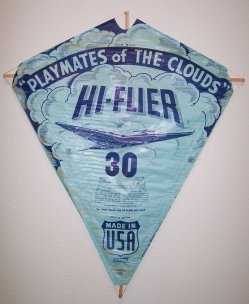
PlaymatesBlueOnBlue250Wide.jpgThe article was a great success, and after their exclusive period expired, I adapted the article to a Web article on my own site, which I have expanded over the years as new information has come to hand. In the article I described probably the most common of all Hi-Flier’s small paper diamond kites, the “Playmates of the Clouds.” (See example at left.) The three varieties of Playmates differ only in what’s immediately under the flying wing: A number, the words “Little Boy,” or nothing at all. I remembered kites with the number 30 as probably being the most common–but I remember flying Playmates with other numbers, particularly the number 94. I also clearly recall having a Playmate tagged with the number 6, and vaguely remember a number in the 40s somewhere.

After writing the Kite Lines article, I started watching for paper kites on eBay, and when the feature appeared, put a saved search on “Hi-Flier” and “paper kite.” Lots of kites have marched past the All-Seeing Eye of Ebay since 1999. I’m sure I’ve seen close to 1,000, and perhaps more. Playmates of the Clouds kites are very common, and I’ve bought a couple for use as wall art. But never in those ten years and on probably 200 Playmates kites have I seen a number other than 30.

Back in 2007 I heard from a chap who called me on it: He’s an avid collector of classic kites who has hundreds of his own and seen many more. He told me that the number 30 on Playmates of the Clouds kites indicated the size of the kite (it’s 30″ down the vertical stick) and that Hi-Flier never printed a Playmates kite with any number other than 30. I must have misrecalled.

I guess. But my memory of that magenta-on-white Playmates with a 94 on it is clear, and has some context: I had it for an unusually long time, for a paper kite. I flew it down in Blue Island at Aunt Josephine’s house on two rolls of string, out over the big railroad yard near their house, and got it back intact. I flew it for the rest of the summer, and only dumped it when I left it lying out in the rain overnight and it got soaked. It was a good kite (and a lucky one, mostly) and if it didn’t have a 94 on it, why do I remember the 94? Why not 48, or 57? Why don’t I just remember the 30?

It was never a big deal. The numbers on Playmates kites were significant to me only in that I thought they were stupid: The digits were just 2″ high, and after the kite was more than 50′ out, you couldn’t read them anymore. I assumed (with 12-year-old geek logic) that they were there to allow you to tell your kite from all the other Playmates kites in the air. Wouldn’t work. Rolls eyes. End of story.

So: The kites that I remember so clearly didn’t exist in the form that I remember them. This seems weird to me because there’s no motivation for the redaction: Remembering them differently doesn’t affect anything, and it’s a little weird that I remember small things like numbers on kites at all.

The point seems to be that we don’t always remember details well, whether the details are emotionally significant (“Where were you when Challenger exploded?”) or practically background noise (“What number was on your favorite kite?”) I’m guessing that in every life there are a staggering number of little disconnects between what we remember and what really happened, and we’re unaware of it only because we don’t generally have confirming documentation of all the little things that we remember–and mostly, we don’t care. When we notice such a disconnect, we snort, say, “heh!” and move on. No big deal.

I’ve gone on for a few days here because somebody asked me recently if I was ever going to write my autobiography, and I spent a little time thinking about it. Suppose I did: Would what I wrote bear a useful resemblance to what in fact happened? And if not, what’s the point of autobiography? How much, in fact, can we trust any kind of memoir? If memoir is read mostly as entertainment, why not just write fiction?

Perhaps we do. As best I can tell, our brains write our memories as a kind of historical fiction, drawing the broad strokes from reality and then filling in the gaps with whatever makes the best yarn. I find this troubling in a weird way, but I guess I’ll just have to get used to it: The bulk of what’s happened in my life has not only been forgotten, but was never actually remembered to begin with. If any revelation can literally be called humbling, well, that’s the one.

The Impersistence of Memory, Part 3

I had two college friends back in the early-mid 1970s; let’s call them Dottie and Sarah. I was quite close to them without getting mushy about it. (Back then it was common knowledge that I was committed to Carol and “safe,” though the term rankled me a little.) We went to a lot of the same parties, including the memorable one where a wide-eyed cheerleader type told me in slackjawed amazement: “You always talk in complete sentences!” Well, I have vivid memories of both girls smoking at one party or another. I found this appalling, because my father was dying of tobacco-induced cancer at the time, but I didn’t feel like I had enough claim on either of them to chew them out for it.

I lost track of them after 1975 or so. Dottie surfaced about ten years later, and I asked her if she had given up the coffin nails. Eyes downcast, she copped to smoking in the 70s, but said she hadn’t had one in years, and even in college only had one when the stress started to get to her. Fair enough. (And I hope it was the truth.)

I didn’t run into Sarah again until 2000. As I had with Dottie, I asked her if she’d given up smoking. She looked at me like I was a shopping-mall zombie with both arms shot off, and said a little coldly that she’d never held a lit cigarette in her entire life.

Whoa. But there’s that crystal-clear image of Sarah in 1974, leaning against somebody’s kitchen table piled high with cheese and half-empty wine bottles, holding a butt between two fingers and frowning while blowing smoke over her shoulder. The friendship had gotten very stale in 25 years, and my question did nothing to help. I dropped the subject. Still, the memory remains, as clear as ever. What the hell is going on here?

I think of Sarah and Dottie these days when the nutcase Extropians talk about uploading themselves to some sort of global Beowulf cluster. Human memory is not digital. Human memory has no checksums. Human memory comes without parity bits. Something is making me remember poor Sarah inhaling carcinogens, and whatever it is, I don’t want it to come along when I get copied into Metaspace and become one of the Players.

I’m increasingly convinced that we know less than we claim about the physical implementation of human memory, but I have a single slim clue about this particular case: One of my recurring nightmares is dreaming about Carol smoking. We’ve been together for 40 years now, and I have fair confidence that Carol has never held a lit cigarette either, but the dream images are terrifyingly real. I’m a good imaginer, and I write my stories by creating movie clips of the scenes in my head and watching them until I can describe them well. The same basic mechanism that allowed me to see (and then describe) scenes from The Cunning Blood torments me from time to time by creating scenes in which my soulmate embraces the evil that killed my father. If Carol, why not Sarah? I may have dreamed about her smoking years ago, and then over time forgot that I had seen it happen in a dream.

Michael Covington suggests that human memories get cross-linked like entries in a corrupt database, and that it’s happened to him. What I remember as Sarah smoking could be a memory of Dottie smoking, cross-linked to a memory of Sarah at a party. The two girls played similar roles in my life, and actually resembled one another in several ways. (And the parties, well, they were indistinguishable.) Most of our interactions happened 35 years ago. That’s plenty of time for analog chemical pointers to grow hair.

I have one more example to share, which in some respects is stranger than all of them. It’s one thing to forget something, and another to remember something badly. It’s truly odd to remember a person doing what a person never actually did. But in terms of pure weirdness, it’s hard to top vividly remembering an artifact that never existed at all.

Stay tuned.