Jeff Duntemann's Contrapositive Diary Rotating Header Image

ebooks

Odd Lots

  • Gizmodo has a decent overview of the jungle of Intel CPU chip families. Core, Atom, and old reliable Pentium are compared and contrasted. Good short brushup, even if you’ve been following along as best you can. (I cop to not paying as close attention to Core i7 as I should have been.) My one objection: Late-build Pentiums are not nearly as bad as the author suggests.
  • With 225 sunspotless days, 2009 just edged past 1867 in its climb up the Most Spotless Years Since 1849 hit parade. 2009 is now in position 11. Two more spotless weeks and we’ll overtake 1855 and enter the Top Ten. 2008 was a killer, now standing at #4, with 266 spotless days. Will 2009 beat that? Unlikely; there are only 77 days left in the year, and while the Sun is sleeping, the old guy isn’t dead. (He throws up a few sunspecks now and then just to keep his hand in.)
  • An article in today’s Wall Street Journal reminded me that American author/poet Stephen Vincenet Benet wrote the postarmageddon short story “By the Waters of Babylon” in 1937, before even the possibility of nuclear weapons was understood by the general public. It stands in my mind as one of the finest SF shorts of all time, and certainly one of the most prophetic. (The story’s been posted on the Web and is easily Googleable, though how legal those postings are is unclear.)
  • Very nice summary of what we know about the second-largest asteroid Pallas here. Interestingly, Pallas has its own “death star” astrobleme, which can be found on most of the smaller bodies of the solar system, suggesting that during the solar system’s formation everybody got pounded, and the biggish moons that survive just barely missed being turned to gravel. (Thanks to Frank Glover for the link.)
  • Google just clarified its plans (a little) for Google Editions, an ereader-agnostic ebook store that will offer ebooks in a universal format based on HTML. Books will be readable offline. One suspects that Google Gears will be involved, but what sort of DRM will be slathered onto the binaries is still an open question, and in a lot of people’s minds (including my own) that’s the only significant question there is.
  • From Michael Covington comes the suggestion (from one of his grad students) that if a coral snake were a resistor, it would have a value of 24 ohms at 20% tolerance. (Determining the snake’s power dissipation we leave as an exercise for the grad student.)

Odd Lots

  • Maybe I thought of it first. I don’t care. This guy did a great job. What He Said.
  • I was wrong about the Alice programming environment: There is in fact a version for Linux, though the developers admit it’s a little buggy and largely “proof-of-concept.” (Thanks to xuwande on LiveJournal for the tip.) To me, Alice looks a lot like the primordial Alto-based Smalltalk environment described in the seminal 1977 Xerox publication, Personal Dynamic Media, and I’ll install and explore the product (probably under Windows) as time allows.
  • And even though this is mostly a research project (with no promises or even strong hints that it will ever become a product) the Microsoft Courier looks mighty good to me from an ebook reader standpoint. The interface is a little busy for my tastes, but we’ll see how it goes. Maybe it would be a waste of the device to use it for nothing but reading ebooks, but I consider it my prerogative to waste whatever part of a device I don’t consider useful.
  • Maybe it’s not just me. As much as I like the Kodak EasyShare pocket cameras (Carol and I each have one) the EasyShare software is hideous and has given me nothing but trouble. This seems to be a trend. Can you imagine a new Mac app from a major vendor that still needs PowerPC emulation? Egad.
  • I guess it’s better for a church to be full of books than empty of prople, and these guys did not do a bad job.
  • Suddenly we have not one but two large sunspots visible at once, a situation not seen for over a year. Alas, I spun the dials earlier this morning, and 15 meters isn’t any livelier than it usually is here, which is to say, dead.
  • The Google Books Settlement may well be dead on legal grounds, something that doesn’t surprise me at all. What Google needs to do now is just publish an open invitation: “Anybody who holds rights to a printed work and wants the work to be posted on Google Books under the terms below, fill out this form. We’ll handle the scanning.” I’d be first in line in what I’m pretty sure would be a stampede that would sooner or later bring in all the the stubbornest skeptics. The key: I’m willing to admit that my out-of-print works aren’t worth much. 1% of a loaf is still better than no loaf at all.
  • ADDED 9/24/2009: Here’s a guy saying something that isn’t often said: Google Books is a fantastic research tool, and far from being evil, the Google Books settlement was just the first (now aborted) effort at something that simply has to be done.

Odd Lots

  • On Monday I returned the last third-pass page proofs (of a very gnarly part of the book, the partial instruction reference) and if the publisher’s schedule is to be believed, Assembly Language Step By Step, Third Edition goes on press tomorrow. Real books should be out of the bindery and in the warehouse by September 22.
  • We came within a few hours of having a sunspot-free calendar month in August, but then very late Monday night, a barely visible sunspeck showed up, ruined the run, and then immediately started to vanish. The sunspot minimum appears to be heading for a double bottom, and there are people at NASA suggesting that deeper mechanisms are changing within the sun, and we may be a long time before seeing anything like a proper sunspot peak. So much for DXCC on 10M.
  • Cory Doctorow speaks up on cloud computing, the goal of which, he says, is to allow companies to make money in a mature computing market by charging you month by month for computional facilities that you already have at home. So tell me: How many people actually collaborate in the Cloud, as a percentage of people who actually compute? I think it’s in low single digits–which suggests that the Cloud as an idea is something like 95% scam.
  • If you’re following Michael Arrington’s CrunchPad project, the CrunchPadFans blog is worth a visit every week or so. It’s a little sparse, but there hasn’t been much news generally on the long-awaited gadget in recent weeks. I intuit that it would make a jack-fine ebook reader, if software to handle the major formats is included or installable.
  • And speaking of ebook formats, Sony has announced that it will be supporting the EPUB format in its new reader products, days after Google’s announcement that it will be doing the same within its Google Books system. EPUB is a reflowable open standard not controlled by any particular firm, and if I had to finger a winner in the ebook standards wars (at least for primarily textual works) this would be it.
  • Further relevant to ebooks is a reader app I’ve been fooling with on Ubuntu: Okular, which is nominally a PDF viewer but can open and display lots of other formats, including DjVu, CHM help files, Epub, Plucker, MobiPocket, and a few others. Although it’s a KDE 4 app, I’ve had no difficulty making Okular run under GNOME. Okular on a suitable handheld Linux-enabled device could make a helluvan ebook reader.
  • And Okular led me to the KDE on Windows project, which aims to create native-code ports of KDE apps to Windows, with an installer to make it easy for non-techies. It’s early and the product doesn’t look as easy as it should be, but then again…it’s early.
  • I’ve discovered a much higher-resolution photo of the old Turtle Wax building at the Ashland/Ogden/Madison intersection in Chicago here. We would pass that building on the way to my grandfather’s house Back of the Yards back in the late 1950s, and my mother would always point out the 25-foot tall turtle on the top of it. Cool building, too, turtle or not. Gone now, alas–the turtle and the building both.

Big Brother’s Ebooks

An interesting thing happened the other day: People turned on their Kindles to discover that several books they had purchased were just…gone. Amazon had without warning or explanation reached down the devices’ Whispernet connections and wiped all traces of the books, which were by George Orwell. I’m not sure anyone has ever spelled “irony” more clearly than this.

Amazon refunded the full price of all books to all those who had purchased them, of course, or this would have been theft. (Many think, with some justification, that it was still theft.) Yea, the world of Copyright Deathwish is getting stranger all the time.

What I find intriguing is that there are two versions of the story out there:

  1. The rightsholders of the books changed their minds and decided they didn’t want ebook editions on the market, and demanded that Amazon pull them.
  2. The people who licensed the ebook editions to Amazon did not have the right to do so.

Story #1, if true, reflects badly on both Amazon and the Orwell rightsholders. Books are published under contract, and if the author/rightsholder can negate a contract simply by changing his mind, it wasn’t much of a contract. On the other hand, if Amazon won’t hold a rightsholder to the terms of a contract, Amazon isn’t much of a publisher.

Story #2, if true (and I think it’s more likely) reflects badly on copyright law as we have it here in the US. It’s entirely possible that Amazon did what it considered due diligence on the purported rightsholders and decided that they were legitimate. Alas, US copyright law makes it diabolically difficult (and in many cases, simply impossible) to determine who the legal rightsholders to a work actually are. Rights change hands all the time, especially for popular works that have been around for a few decades, and double especially works by authors now deceased. Someone who once had rights to a work may not currently have them, or the rights may have been divided by medium, or the rights may be under dispute between heirs and former licensors, or among the heirs themselves.  Michael Jackson bought the rights to the Beatles’ canon in the US years ago; those rights are now “in play,” as they say.

The core of the problem is that there is no public record of ownership for copyrights, as there is for “real” property, like land or even cars. And in today’s environment of cheap server space, there’s no reason for that to be true. It should be possible to trace ownership of IP from the date it was registered down to the current day, with a legal requirement that changes in ownership be recorded, for copyright to be enforceable. There should be no ambiguity whatsoever about who owns what works in what media, and that record should be available to the general public. As long as it is not, incidents like this will continue to occur.

Amazon has pledged that they won’t do this again, but the damage has been done, both to Amazon’s Kindle system and to the idea of copyright itself. People who bought and paid for a book in good faith had that book taken away by copyright holders without notice or explanation. It may have been legal in the narrowest sense of “legal,” but that doesn’t matter. The incident adds yet another brick to a growing edifice of public opinion seeing copyright holders as arrogant, greedy bullies who can harass individuals on little or no evidence, and take back what they’ve offered to the public on a whim. Whether the perception is true or not (and to what degree) doesn’t really matter. Copyright, especially in an era of fast pipes and massive electronic storage, operates primarily on the honor system, which requires honor on both sides, and a legal framework making it possible for that honor to flourish. No honor, no copyright–and we’re much father down that road than most people think.

Odd Lots

  • Here’s a nice, high-school physics level lab demonstration of an aluminum air battery, made from aluminum foil, aquarium charcoal, salt water, and a paper towel. A few of these in series will run a simple solid-state radio. It would be fun to figure out how to expand the concept into something a little more durable, with thicker aluminum plates, in some kind of container that will confine the messy materials and yet admit oxygen to sustain the reaction.
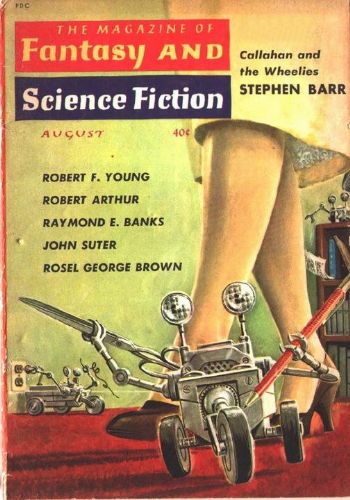
  • Damned if the photo of this beambot doesn’t remind me of the Ed Emshwiller F&SF cover for “Callahan and the Wheelies,” a 1960 story by Stephen Barr that I blatantly imitated in my own high-school fiction.
  • When I first got into computing in the midlate 1970s I had a number of CPU green cards, but was always a little puzzled that none of them were…green. (The COSMAC green card was blue, and the 8080 green card was white.) In truth, I didn’t know at the time why everybody called them “green cards,” and if you still don’t know, here’s a site where you can see the real deal. (Thanks to Richard Haley for the link.)
  • And from Richard’s own hand comes a list of instruction mnemonics that you won’t find on most green cards, of whatever color. My favorite is EMW, Emulate Maytag Washer, which the crotchety frontloading 3330 disk packs back at Xerox building 214 were very good at doing, except that they were in the spin cycle all the damned time.
  • Google Books has mounted most (if not quite all) of a fascinating book called Hi There, Boys and Girls! which is a history of local children’s TV programming in the US. The book is organized by TV markets around the country, and the Google Books version is intriguing for how much material is actually available for free. The Chicago material is available, and excellent, if not as detailed as Jack Mulqueen’s full-book treatment in The Golden Age of Chicago Children’s Television, which has a much more limited Google Books preview.
  • We are getting close to the release of Michael Arrington’s Crunchpad Internet tablet, but little or nothing has been said about the only thing I really want it for: a large-display ebook reader. It needs an SDHC slot (which I think it has) and some decent ebook software (anybody’s guess) but given those two things, it could remake the ebook biz. July is flying. Wherezit at, Mike?

Odd Lots

  • The United States has overtaken Germany as the world’s lead producer of wind energy, measured in total kilowatts. Way to go–keeping in mind that Germany still beats us all hollow with kilowatts per capita. I’m a big believer in NWS, in that order, and part of the reason N comes before W is that over the past few years, when Carol and I have passed giant wind turbines along I-80 on our way to and from Chicago, they were only turning about a third of the time. Wind energy is great, but it does not stand alone.
  • Small children should be allowed to get dirty as a way of building their immune systems. I was digging in the back yard since before I can remember, and never had much trouble with allergies. There may be a downside to our dirt- and germ-averse culture that has nothing to do with the risk of antibiotic-resistant pathogens. (With Gretchen’s approval, I think I’m going to buy our nieces a couple of garden trowels next Christmas…)
  • Few people today remember that Apple Computer was once a Pascal shop, and had a promo poster in the late 70s incorporating a classic “railroad” diagram of Pascal language syntax. Yes, the 70s really did look like that. (At least it wasn’t all done in Harvest Gold.) Thanks to Paul Santa-Maria for the link. Paul created his own version of the poster in black and white, which I hope he makes available at some point. The Waite Group sold (or gave away; not sure if it was a boom promo) a similar card in the same era, but it’s long since vanished from my collection.
  • Has anyone here ever read any of the Very Short Introduction books from Oxford University Press? Are they useful? I just ordered several, and I’m curious as to the quality of the series. I’ll report here once the books show up and I’ve had a chance to read them. There are many subjects I’m interested in sufficiently to read 150 pages on, but not 600 pages.
  • A German publisher wrote an article claiming that cheaper ebooks will put them out of business. (The article is in German; take what you can from the English summary or if you know the language, click through to the original.) The gist is that there are special costs associated with e-publishing that more than balance the special costs associated with print publishing. My take: If true, it’s only until we get up to speed. (I also think it may be true that many publishers don’t really understand all the forces that bear on how they make their money. Many things lead up to the cash-register’s beep, not all of them obvious.
  • I’m a lot less sanguine about the OLPC than I used to be, but the recent unveiling of future designs intrigues me: The next-gen OLPC will have two displays, and can be held and read portrait-style, like a book. When a keyboard is needed, rotate the device 90, and one of the two displays becomes a keyboard. Very cool, and something like that should be sold worldwide by every electronics retailer. (Their peculiar distribution mechanism will eventually be the end of them.)

Michael Arrington’s Crunchpad Gets Real

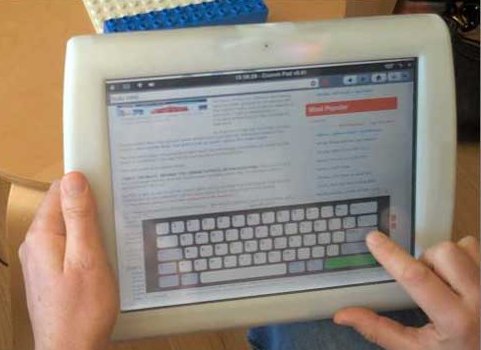
crunchpadb.jpg

I read about Michael Arrington’s concept for a low-cost Web tablet back last summer, and was intrigued. Web is useful, but the resolution on this gadget (1024 X 768) would make it ideal for reading PDF ebooks, particularly textbooks and scientific/technical nonfiction with lots of illustrations. Not every type of book can be read on a cellphone, and the sorts of ebooks that require larger displays are getting precious little respect in the gadget world.

But I learned today that the Crunchpad (as the TechCrunch crowd is now informally calling it) has reached the prototype stage. They sound like they’re aimed in the right direction, but remarkably, I see no discussion at all of the device’s usefulness as an ebook reader. (I added a comment to the entry to this effect.) It looks like it can work in portrait mode, and has an accelerometer to sense when it’s been “spun.” Ebook reader utilities are not cycle-hogs, and would add little to the burden on the CPU or SSD storage.

I’m a little queasy about on-screen touch keyboards; I would use the USB port for a “real” keyboard when one is needed. I would also add an externally-accessible SDHC card slot for loading content without waiting for the inevitably slow Wi-Fi link. But beyond that, if the thing can render PDF and CHM ebooks well, I’d buy one like a shot, and pay $300 for it without regret. This is one to keep an eye on.

Odd Lots

  • Foxit Software (which sells a line of very good PDF-related software, including the Foxit Reader, which I use daily) has announced an e-ink based ebook reader, the eSlick. The device isn’t being shipped yet, but there have been some early reactions in Wired and other places. I’m interested because Foxit is unlikely to claim (as most ebook enthusiasts do) that PDF is the spawn of the devil. Worth watching.
  • The Loopy Idea of the Month comes from two Ohio academics who have recently patented the notion of collapsing hurricanes by flying around them in supersonic aircraft and (somehow) using the sonic boom shockwaves to scramble the storm. Apart from the fact that supersonic aircraft use fuel at a prodigous rate, I still don’t quite follow the physics of how this is supposed to collapse the storm. (Thanks to Pete Albrecht for the link.)
  • Jim Strickland passed a long a detailed how-to for extracting metallic titanium from white pigment. The process is straightforward, if (as it must be) highly energetic. I think the stickier question is working the titanium after it’s been isolated. Titanium is difficult to melt and very difficult to machine. I have a piece in my curio cabinet, and I’m very glad I don’t have to make anything from it.
  • Many people sent me the latest version of the old joke that “If Programming Languages Were Religions…” most of them lamenting that my favorite language—and my favorite religion—were not included. So it goes. I’m guessing that Pascal, like Catholicism, is patient: There will be only one programming language in use in the hereafter, and it will not be C++. You’ll have to go somewhere else for that.
  • The Wall Street Journal tells me that the RIAA is abandoning its mass-lawsuit strategy of copyright enforcement. It hasn’t worked at reducing music piracy, and its sole effect was making the music industry bigshots look positively evil. One can only wonder why it took so long to figure this out, and whether the damage can ever really be undone.
  • Here’s a wry peek at what we may see come out of the Big 3 bailout. Thanks to Pete Albrecht for the link. Have you driven a Pelosi lately?
  • Also from Pete comes word that Werner Von Braun wrote SF. This actually looks pretty good—gotta love that cover!

Odd Lots

  • Sorry for the silence here; I rarely go a week without posting but a lot of things ganged up on me. Many have noticed that I'm gradually moving toward posting less often but doing longer posts. I've discovered that it doesn't take me a great deal more time to write more detailed posts than shorter ones, but not posting at all on some days allows me to concentrate more fully on other projects.
  • There is a major total lunar eclipse tomorrow night, 2/20-2/21, which will be almost perfectly positioned for viewing in the US. See the NASA page for details. And if you're not up on lunar eclipses generally, ask Mr. Eclipse.
  • Flash memory is getting bigger; a 16GB SDHC card would hold a lot of ebooks.
  • Pertinent to the above: I'm not bullish on solid-state drives based on Flash, especially if they're positioned to replace ordinary spinning-disk hard drives. Flash storage cells can change state only so many times until they cease holding a state reliably, and extra hardware is needed to “spread the wealth around” so that frequent write activity in a particular location doesn't kill cells. Flash is thus best used for things like storage of music and ebook files, where you write data rarely but read it a lot.
  • Also, Flash may evenually be superceded by nonvolatile phase-change memory. We're still a few years off, but phase-change is faster than Flash and may even replace volatile RAM. No information yet that I've found on whether the cells degrade or die after a certain number of write cycles.
  • One other ebook note: Although most early reviewers claimed that the Kindle's SD slot was limited to 2 GB cards, the truth is that the card slot is SDHC and many owners have reported success with larger cards up to 8 GB. I don't have 8 GB of ebooks yet and may not for several more years. I just don't read that fast. For people who are actively converting their print library to ebooks, however, larger cards are a very important issue.
  • This nice link to NPR came over from Don Doerres, concerning the growing hobby of watching satellites. We used to go out and freeze butt looking for Echo in the early 1960s, but these guys are calculating orbits, photographing flares (momentary bright sunlight glints off polished satellite parts) and profoundly irritating the spooks. Watch the videos. Really watch the videos.

The Revenge of the Classics

I've lived such an overstuffed life for so many years that I'd almost forgotten a psychology that was a very big part of my youth: Sniffing around for “just something to read.” I'm a very deliberate reader these days because I don't have a lot of completely uncommitted time. I have a reading buffer of 50-100 books on hand here, all of which were chosen because they touch on one of my interests or another. (My library as a whole contains somewhere around 2500 books, down from 3000 before we left Arizona.) I never have to cast about at random for just something to read.

For many people, reading is an even bigger part of their lives, believe it or not. (Maybe fewer than we'd like, but they're out there.) These people are driving the ebook industry right now, and I've noticed a phenomenon few others have commented on: the explosion of interest in out-of-copyright books by people who might not have been slobbering Dickens or Jane Austen fans in the past. At numerous sites online, people are uploading ebook versions of many classic texts. I follow Mobileread, which now has about 3,800 free ebooks online for download, the bulk of them pre-1923 works, some well-known (they have Dickens' complete works now) and some pretty obscure, like the Scottish Psalter of 1650. Mobileread is interesting because people are creating versions in the popular small-screen ebook reader formats like Ebookwise, MobiPocket and BBeB rather than raw text—nor formats used primarily on PCs, like PDF and MS Reader.

I continue to boggle at people reading Thackeray on their cellphones, but boggle or no boggle, it's being done. The classics are coming back. I can't entirely explain it, but I have some hunches:

  • Many of these ebook editions are beautifully done. The Dickens canon is the work of one man named Harry in the UK, and they include some of the nice old 19th Century woodcut illustrations plus color covers where those were available. (Oliver Twist, yes. Martin Chuzzlewit, no.) They are not shot full of OCR errors and gaps like some of the stuff I've downloaded from other places, including the venerable Project Gutenberg.
  • They are free and they are easy to get. There are no hurdles to jump, nothing to sign up for, no money to lay out, and no DRM to drop sand in the gears of the experience.
  • There are no ethical issues involved in obtaining them or passing them on. I still think people are basically honest, and they do consider the rights of copyright holders.
  • They're classics because they have withstood the test of time. They're good.

The classics have always been available in bookstores, of course, at prices comparable to those of newly published books. But if you're shopping for something to read on the train going in to work because it's a dead hour coming and going, it's hard to beat free, especially if free is easy and involves no pokes from the conscience.

What we're seeing here might as well be called open-source literature. It's being done by volunteer labor, including people who are drawing new artwork and contributing it without copyright claims. It's significant because people writing new ebooks have to take into account that the total available number of reader-hours in the audience is finite, and the friction involved in obtaining and reading the classics is now approaching zero. Like Linux, it will take a while yet for the well-formatted library of classic ebooks to mature, but like Linux, they will eventually become a competitive force to reckon with.

And wow, dare we hope that the premodern will put a fat boot up the ass of the postmodern? A lot of those “dead white males” must be grinning about now.