Jeff Duntemann's Contrapositive Diary Rotating Header Image

ebooks

Ebooks: Wholesale/Retail vs. Commission

I’m guessing that by now, most of you have heard of Amazon’s little dustup with Macmillan, one of the world’s largest book publishers. As long as Kindle was the only significant online retailer for ebooks, Macmillan accepted Amazon’s sales terms, which set a ceiling of $9.99 on most ebook prices, at Amazon’s option. But the instant Apple popped up as a second significant ebook retailer, Macmillan cut a better deal with Apple, and demanded that Amazon match Apple’s terms, which include a higher price ceiling. Amazon responded by refusing to sell Macmillan’s titles.

Amazon caved yesterday, and agreed to reinstate Macmillan’s books at Macmillan’s higher prices. People posting in the comments sections of some news sites seem puzzled that a more competitive market would raise prices for consumers, but that’s just the way truly free markets work. Until Apple showed up with their iPad, Amazon had a monopsony relationship with ebook publishers, rather like WalMart has (still) a monopsony relationship with a multitude of small-to-middling goods manufacturers and wholesalers. In a competitive retail market, neither monopoly (one seller, many buyers) nor monopsony (one buyer, many sellers) dominate. There are lots of buyers and lots of sellers, and we quickly find out what the “real” price of a product is, as manufacturers and retailers jockey for the greatest market share among consumers.

That’s not, however, what I find interesting about the recent conflict. Look closer, and you’ll see two fundamentally different approaches to selling a product to consumers: Amazon is selling on the conventional wholesale/retail model, and Apple is selling on an agency model. Amazon wants to buy ebooks from publishers at a wholesale price and make money on the margin between that wholesale price and a retail price that it controls. This allows it to create occasional “loss leaders” to generate traffic, as conventional goods retailers have done as long as anyone remembers. Apple, by contrast, wants to sell ebooks at prices set by their publishers, and take a percentage of every sale.

Publishers like the agency model since it gives them more control over pricing, and does not train the public to expect all ebook prices to be $10 or less. How much better the agency model is for publishers and authors is unclear, and depends in part on how fungible you think books are, which is a very weird business that I’m still thinking about. It may also depend on how many players can participate on the publisher side. A B&M bookstore can only contain and manage so many physical books, and publishers play lots of dicey scarcity games to get more shelf space than their competitors. (“Stock our whole frontlist and we’ll give you an extra 2 points’ margin…”) An online ebook store’s capacity is essentially unlimited, and any number of publishers can play. If there are a million publishers and 999,900 of them sell products at lower prices than you do, your control of pricing is less than it was in the era when it was tough to get your books into stores and a relatively few large publishers dominated the market.

Nor does it end there. If you look even closer, Apple’s model starts to look familiar in another sense: It starts to look like a publisher paying authors a royalty. The royalty rate is insanely high by historical standards (70% or thereabouts) but there are no atoms to push and protect. Without atoms getting in the way, being a publisher becomes an entirely different challenge, and the difference between conventional publishing and self-publishing implodes to the process of contracting for services you need with people who have the skills you don’t have. As experience in that process becomes more common, being Macmillan gradually becomes less and less important. I wonder whether Macmillan understands that.

Most of all we need to remember: The ebook business is still in its infancy. Everything remains in play. The readers can only get better. People are doing weird things that seem to work, like giving away your older ebooks to develop a market for your newer ebooks. Lots more ideas will be tried, new technologies will appear, and older technologies will change and improve. Maybe Amazon’s crazy action against Macmillan had to happen, just to show everybody that such things won’t work. (Sure, it was obvious…in hindsight.)

Me, I’m with Apple…for now. Why? Because Apple’s business model smells more like a free market than Amazon’s–and more like a game I can compete in. That could change, and much of that decision will hinge on the nature of Apple’s ebook DRM. (We don’t know all the details yet.) Kindle’s DRM is mandatory–whether I as a publisher want it or not. In a sense, its purpose is not to protect the publishers or the authors from piracy so much as to protect Amazon from a freer market, in which consumers can move their books from device to device at will. Apple could adopt that same strategy, leaving us with two paranoid and incompatible ebook retailers and readers. Hey, that’s nothing that another five or six major ebook retailers couldn’t fix, and they’ll happen. Give ’em time.

Odd Lots

  • The iPad’s ebook store is evidently US-only, less likely because of copyright laws themselves (as many are claiming) than because a lot of books are licensed to publishers by country, and if an author did not contract a book for distribution in Asia (for example) it can’t legally be sold in Asia. Some authors think this will allow them to contract separately by country or language and make more money…when in fact it only means that people outside the US will have yet another reason to steal the damned book. The only way to reduce content piracy is this: Sell it cheap, sell it easy, sell it everywhere. Anything else is wishful thinking.
  • Here’s a great short piece by nanotech guru Eric Drexler on why tokamaks won’t ever be widely used in commercial power generation. My favorite line in the whole thing: “…[the Sun] puts out less power per unit mass than a good compost pile.” Fortunately for us, the Sun is a little bigger than a compost pile. (Thanks to Frank Glover for the link.)
  • When I finally worked up the courage to go to the Meetup Web page for the Paranormal Erotic Romance Book Club of Colorado Springs, I discovered that one of the topics they list for the group is “New in Town.” I belonged to the New In Town Meetup for awhile in 2003, and I’m guessing that that’s why I got the email mentioned in yesterday’s entry. Lesson: Never ascribe to vampires what can be explained by simple spamming.
  • And while we’re talking weird emails, I got one the other day thanking me for using Minitab statistical software…which I had never heard of until I opened the message.
  • If you ever had the urge to click on a cloud formation, this is the kite for you. (Thanks to Michael Covington for the link.)

Daywander

(“Daywander” is a new category I’m trying out. The idea is something less crisp than Odd Lots but still a collection of different things I thought about or did during the day. It may not work out, and if it doesn’t I won’t miss it overmuch.)

So. We have an iPad. It’s not like it was a surprise, and in broad strokes it was pretty much what everybody thought it would be. I’m very glad that Apple anointed the ePub format for ebooks…the last thing anybody needs is a new proprietary text container. Now we need to know if the Jobs Gang can face down Big Books over prices and DRM. News items I’ve seen recently indicate that books from the iPad store will be allowed to cost more than books on the Kindle, and I’m good with that. I routinely pass on supposed “bestsellers” because they don’t smell like they’re worth $25 to me. The market can decide…and the publishers need to learn that lesson. The bigger question is how much access small publishers will have to the Apple store. One of my goals for 2010 is to get some of my titles onto the Kindle to see how they do. Anybody can be on the Kindle, and the price of goods can be $0.00. I haven’t seen an indication…yet…whether free books will be available in the Apple store, or whether other stores will be accessible, or how difficult it will be for one-person publishers to get in on the action.

And for that matter, is there an SD card socket, so I can drop in the ebooks I already have?

As an ebook reader it looks socko; finally, color and enough resolution to display technical books with figures and detailed art. How well you’ll be able to read the screen outside is another big question that ebook freaks will obsess about. Not me…when I’m outside I’m enjoying the outside for being the outside.(Books to me are an inside thing.) The iPad display isn’t e-ink…but it could be. Why not two displays? Frontside for inside, backside for outside. Apple could do that blindfolded. The thing already costs $500 minimum. Another $75 for a second display wouldn’t kill it.

Hardware, mon dieu. I tried and failed to tweak the Intel driver for the SX280 this afternoon, as suggested by my sister’s friend Chris Meredith on my LiveJournal mirror, and described in this eye-crossing article. Bits don’t scare me, and I follow directions well, but the machine failed to present the tweaked 1600X900 resolution as an option. Hardware can be stubborn sometimes.

Getting away from hardware for the nonce, it’s been revealed that the late Pope John Paul II beat himself with a belt and slept naked on the floor to move himself toward spiritual perfection. The Jesuits were big on this, and did this well into the 1950s: Each Jebbie had a little whip called “the discipline,” and was to use it on himself every night, presumably for the same reason. (Garry Wills wrote about this in his excellent book, Why I Am a Catholic.) What has never been clear to me is why hurting yourself has anything to do with spiritual perfection. (This is especially puzzling given JPII’s ecstatic writings about the holiness of the human body…so holy that we apparently must beat it up, mortify it, make it bleed. I guess.) Sorry. Don’t buy it. What “mortification of the flesh” really is is a powerful temptation to pride: People who hurt themselves and deny themselves can never quite hide the smugness that seems to come with the territory. My take? Real saints help others. Hurting yourself does not help others. Get real.

And in other news from the God side of things, this past Sunday’s Old Testament reading contained orders from the Hebrew Scribe Ezra, in the Book of Nehemiah, Chapter 8: “Eat fat, and drink sweet wine…” Hey, Ez! Got it covered!

Odd Lots

  • Here’s a nice detailed article about how Linux treats hard disks and how Linux partitioning works.
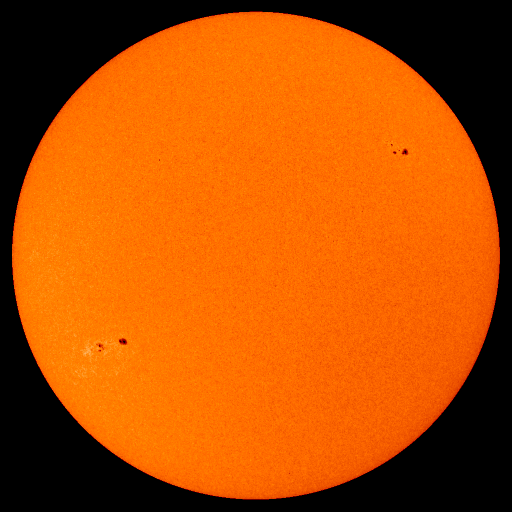
  • We now have two major sunspots on the visible face of the Sun. I don’t remember the last time I saw that. (Most of the specks we’ve been giving sunspot numbers to in the last couple of years don’t count, in my book.)
  • The New York Times has finally shone their light on an ebook marketing technique that Baen Books pioneered years ago. (Thanks to Pete Albrecht for the link.)
  • Version 4.0 of the FastStone Image Viewer is out, and well-worth having. It’s the best image browser I’ve ever used, and if you have to sort an SD card full of digital photos and cull marginal shots quickly, there’s nothing like it. Make sure you get the portable version; it lacks nothing and doesn’t make any changes to your system. Freeware. Highly recommended.
  • Rich Rostrom sent a pointer to a fascinating article on Moscow’s stray dogs. They’re going feral, but it’s a peculiar sort of urban feral that considers humans and all their gadgetry to be just another part of the landscape. They’ve learned how to ride the subway, for pete’s sake!
  • I’d read in a number of places that faces judged as beautiful are generally “average” faces, without a lot of distinguishing characteristics. Because I could never quite get a grip on what an “average” face would be, I always took the notion with a grain of salt. But this site, assuming it really is creating a “facial average” from a gallery of headshots, suggests that there’s something to it. Start with two faces, then add faces one by one, and see if the average face doesn’t become more beautiful (and distinctly ambisexual) as you go. It did for me.
  • Here’s a short interview with Bob Silverberg, describing his writing life during the Golden Age of Pulps. A million words a year…
  • Cracking ice in the surface of a frozen lake sounds like a blaster battle.
  • From the That-Certainly-Has-To-Count-For-Something Department: Behold the world’s largest disco ball.

Kompozer Explained, in Recto-Verso

While checking to see if Kaz (Fabien Cazenave) has released Kompozer v0.8 (not yet!) I ran across a very nice free user guide to Kompozer written by Charles Cooke and released under Creative Commons. I’ve been using Kompozer for a couple of years now for all my new Web content, and although definitely unfinished, what’s there works very well. I figured it out by beating my head against it, but Cooke’s manual will obviate a lot of the beating if you’re coming to it for the first time. (The document is available in both English and German.)

And in downloading the PDF, I ran across a term I hadn’t seen in quite awhile: recto-verso. Most people use the term “mirror margins” these days, and that’s pretty much what it means: You lay out a book so that the wide margin is alternatively left and right on the printed sheet. Page 1 has the wide margin on the left, page 2 has the wide margin on the right, page 3 on the left, and so on. What this allows you to do is print the book on both sides of the sheet, so that the wide margins all end up on the left and form the “gutter” through which you punch the book for binding.

If you lay the book out in 2-page spreads, how this works is obvious, and most desktop-publishing templates for duplexed material take it into account. If you’re laying it out as single pages in something like MS Word, you have to specify “Mirror Margins” in the File | Page Setup menu and give yourself some space in the Gutter field. Cooke’s book is also available with wide margins on the left of every page, for printing on one side of the sheet only. The two versions are separate PDFs available from the same Web page; make sure you download the correct one.

One interesting thing about Cooke’s guides is that the PDFs are in color, with color highlighting, pale blue tips boxes, full-color screen shots, and colored arrows on screen shots to point out UI features. I guess it makes sense; almost everyone I know has a color laser by now, and I bought my first only about a month ago. I duplexed the recto-verso PDF, and made myself a duo-tang manual. I have quibbles with the layout, in that he packs way too much material on each page…but then again, with the cost of color laser and inkjet ink, printing only 61 pages is a lot cheaper than printing 150.

This was the first significant duplexed color job I’ve run on my new HP Color LaserJet CP1518ni. My one gripe is that there’s no fold-down single-sheet/duplexing tray in the front of the printer, as there is on the LJ2100 line. You can feed single sheets through a slot in the front of the printer, but for duplexing a stack, you have to pull the main paper tray and place the stack in the tray after you run the first side.

I guess that’s a nuisance, but the quality of the printing is very good, and in as dense a layout as Cooke hands us, the use of color does help a little.

Recommended.

Authors Get 70% Royalty from Kindle Sales

Wow. This is big: Amazon just opened up an option for Kindle author/publishers under which royalty rates are 70%. (Some analysis here; ignore Jeff Bezos’ open mouth.) We’re now closing in on the sort of royalty structure that reflects the realities of ebook economics: No paper, no ink, no physical warehousing. (Server space is way cheaper than maintaining pallet loads of print books out in meatspace somewhere. Trust me on that one!)

To qualfy for the new royalty rate, author/publishers (funny how the two are now blurring together!) must satisfy a few requirements:

  • Ebooks must list for between $2.99 and $9.99
  • The ebook list price must be at least 20% below the cover price for the printed book.
  • The ebook is made available everywhere that the author/publisher has rights.
  • Author/publishers must agree to accept the full list of Kindle features–current and to come–without quibbles, pointedly including text-to-speech.
  • Although Kindle won’t demand an exclusive, an ebook’s price at the Kindle store must be at or below the price at other ebook retailers from which the ebook is available.
  • The 70% rate applies to in-copyright works only. Reprints of public domain material do not qualify.

It’s no secret what’s going on here: Apple’s not-quite-top-secret tablet is really a game-changer ebook reader, and having seen how Apple basically created and still rules the market for individual music tracks, Amazon wants to make sure it retains its hard-won early lead in ebook retailing. This is certainly the reasoning behind Point #4, which basically prevents author/publishers from cutting sweeter deals with other ebook stores like Nook and whatever retail mechanism Apple eventually puts together.

If I hadn’t had to update my assembly book, my SF titles would be available for the Kindle by now, and this makes the effort all the more urgent. Looks like I have a lot to do this year–and maybe now I can expect a little more money in the bargain.

Odd Lots

  • So here, on the eve of the end of a year I’d just as soon forget, the last Odd Lots of 2009. Carol’s in Chicago and I’m staying home tonight with a lapful of dogs and a good book, which on this occasion will be Brian Fagan’s The Long Summer, his history of the Holocene Warm Period. Carol will be back on Saturday. Getting tired of meat. May have some mashed potatoes tonight.
  • The Christmas tree is no longer taking water, and I perceive that’s it’s begun to dry out. We brought it home on December 10, so it has been standing guard in our living room for three weeks. This may be a new record for us. We’ve had trees stand (a little) longer, but their final two weeks were a rain of needles.
  • The day after Carol and I showed Carol’s mom our Christmas tree via Skype video call, this Zits strip was published. (Thanks to Roy Harvey for letting me know–I read Zits but generally in the newspaper, and not every day.)
  • 2009 is ending with 260 sunspotless days. 2008 had 266, and December was the most active month of the year, so we’re guessing that the Long Solar Minimum is mostly over. Can 15M skip be far behind?
  • Ray Kurzweil has announced a new ebook software reader package called Blio. Not a lot of detail and no software to download yet, but it’s going to be a free product, with versions for both mobile devices and the desktop. Introduction will be at CES next week.
  • The ebook technology to watch in 2010 is Qualcomm’s Mirasol, which promises color without sacrificing battery life or readability. Looks good, but what we need much worse are larger displays and higher resolution.
  • Once again, Bruce Schneier nails it: The bulk of our antiterrorist strategies rely on magical thinking. This is not the way to win; alas, magical thinking appears to be a pervasive part of modern culture, and I’m not talking about Harry Potter.
  • Recent discussions of digital media piracy reminded me of the 2005 article in Wired describing the media piracy “scene” ecosystem (topsites, couriers, races, etc.) and how it works. Big Media may be paranoid, but that doesn’t mean that no one is out to get them.
  • Pete Albrecht photographed two UFOs flying in formation (big animated GIF) while taking a long-exposure shot of M42, the Orion Nebula, through his big Meade telescope. Nothing spooky or alien about it, but before you click on the explanation (in his December 28 entry) think for a second and see if you can figure it out on your own.
  • From the Words I Didn’t Know Until Yesterday Department: murse, more often called a “man bag,” which is basically a purse carried by a guy.
  • Ditto above: prepper , a person who prepares for the end of the world by stockpiling peanut butter etc. They called themselves survivalists until survivalism became equated in the public mind with psychos packing machine guns; watch for the word to vanish when 2012 ends but the Earth is still here. (Thanks to Pete Albrecht for the link.)

10,000 Pirated Ebooks

Ebook-related items have been gathering in my notefile lately, and this is a good time to begin spilling them out where we can all see them. The triggering incident was a note from the Jolly Pirate, telling me that one of my SF stories was present in a zipfile pirate ebook anthology that he had downloaded via BitTorrent. That people are passing around pirated versions of my stories is old news. “Drumlin Boiler” was posted on the P2P networks a few months after it was published in Asimov’s in 2002, and my better-known shorts have popped up regularly since then. No, what induced a double-take was the name of the pirate anthology: “10,000 SciFi and Fantasy Ebooks.”

10,000? You gotta be kidding!

But I’m not. Jolly sent me the 550K TOC text file, which is 9,700 lines long, with one title per line. Not all are book length, and many, in fact, are short stories. Still, the majority of all book-length SF titles I’ve read in the last thirty years are in there, and so was “Borovsky’s Hollow Woman,” albeit not under my byline. (I wrote the story with Nancy Kress, who is listed as sole author.) The only significant authors I looked for but did not find were George O. Smith and Charles Platt. (One howler: Bored of the Rings is said to be by J. R. R. Tolkien. Urrrrp.)

The collection is 4 GB in size. The Jolly Pirate said that he had downloaded it in just under three hours. He attached the file for “Borovsky’s Hollow Woman,” which was a plain but accurate 57K PDF. Intriguingly, the date given under the title is January 28, 2002. The damned thing has evidently been kicking around for at least seven years, if perhaps not in its full 4 GB glory. This suggests that the anthology is not entirely ebook piracy but mostly print book piracy. (“Borovsky” was never released in ebook form.)

Some short comments:

  • I verified the existence of the anthology from the Pirate Bay search engine. It really does exist. (So, evidently, does the Pirate Bay, which surprised me a little, considering recent efforts to take them down.)
  • 10,000 ebooks do not take a great deal of space by today’s standards. (Admittedly, better files with cover scans would be larger.) No one will think twice about a 4 GB download for size reasons, when 750 GB drives are going for $69.95.
  • The PDF is ugly. The lines are far too wide for easy readability and (since this is not a tagged PDF) not reflowable. That said, I did not find a single OCR error.
  • The Windows pathname of the text file from which the PDF was generated is shown at the top of every page. The pathname includes the full name of some clueless Dutch guy, from whose Mijn Documenten folder the file came. Ebook piracy clearly belongs to the common people, not some elite cabal skilfully dodging the **AA.
  • I’ve used a scanner to rip a couple of print books (plus ten years of Carl & Jerry print stories) and it is horrible hard work. However, the anthology demonstrates that if print is a form of inadvertent DRM (which I have long thought) it is not a particularly strong one. After all, as Bruce Schneier has said about DRM systems generally, they only have to be broken once.

This last item is key. A printed book is a worst-case challenge for an ebook pirate. Compared to cutting off the binding and making sure the paper pages all feed straight through the scanner ADF and then fixing the inevitable OCR errors, stripping out an ebook’s DRM is trivial. If ebook piracy is not yet a big deal, it isn’t because it’s difficult. It’s still because reading ebooks is borderline painful. I may not be typical, but if I can buy a used copy of a recent hardcover of interest for $10 or less, I’ll choose the hardcover rather than an ebook at any price. Sooner or later the readers will catch up to paper, and by then, well, we may see a 4 TB file called “10,000,000 EBooks About Everything” on the file-sharing networks, and it won’t even take an objectionable chunk of our 80 TB hard drives.

You think I’m kidding? Let’s compare notes in five or six years.

So Much for the Arrington Crunchpad

Damn. Like, well, damn. Michael Arrington just announced that, probably no more than a week or two before shipping boxed product, the Crunchpad is dead. I rarely post two entries on the same day, but I happened on this just a few minutes ago, and it’s important enough not to hold until tomorrow. The problem seems to have come out of nowhere and is shaped something like this: The CEO of Fusion Garage, the firm tasked with manufacturing the Crunchpad device, just popped up in Arrington’s inbox and basically said, We don’t need you anymore and will be making and selling the device ourselves. WTF? And WDHTHIA? Barlennan?

What happened probably happens a lot in certain tech partnerships between small and roughly equal entities: One who thought they held more of the cards wanted a bigger cut of the take than the original agreement gave them. And because both Arrington’s group and Fusion Garage have joint ownership of the various pieces of IP involved, neither can just move ahead and release the product on their own. (Why Fusion Garage doesn’t recognize this is obscure.) Unless this is an extremely clever way to simply kill the project without admitting technical failure (a possibility, but not something I’d expect out of Michael Arrington) the project may be dead on legal grounds.

Or maybe it really was the problematic 12″ capacitive touchscreen that has given these guys pure hell from the outset. Doesn’t matter. I had high hopes for the gadget, which (screw the Web!) would have been a spectacular ebook reader. I dislike the physically small, low-res e-ink readers we now have, because they don’t display technical art well, nor color at all. Comics people have the same gripes, albeit for a different kind of art. There’s no physical law saying that all ebook readers must be the same color-and-resolution-limited, coat-pocketable thing. Books are different.

Again, if the fail was really technical, and all this huggermugger a smokescreen, we won’t see anything out of the ashes. But I do hope that if we’re just seeing tantrums here, something can be worked out.

(Still, is it just me…or did Arrington fold perhaps a little too quickly?)

More here later if I can find it.

Odd Lots

  • Here’s a great graphic strongly suggesting that the much-denied Medieval Warm Period really existed, and was indeed a global phenomenon. (For further evidence, read The Little Ice Age, which predates the worst of the current Global Warming hatefest and thus may be considered reasonably reliable.)
  • I had not heard this before: The imminent Nook ebook reader from Barnes & Noble will have a Wi-Fi connection, allowing owners to browse free ebook previews that are only accessible through store hotspots. This gives people a reason to come into physical stores, Nooks in hand, spend time, drink coffee, browse the print collection, and leave with a bag full of print titles that aren’t available as ebooks. Assuming it’s true, as a marketing gimmick, it’s brilliant.
  • The Nook has a slot for a Micro-SD card with a capacity of up to 16 GB. Assuming a typical text-mostly ebook file to be 500K in size (which is very generous; most fiction titles I’ve seen are about half that, or less) a Nook is capable of storing about 30,000 books. If you read a complete book every single day, that will last you for…82 years.
  • I’ve already seen the Nook e-reader referred to as the “Nookie reader.” Which it will be, trust me.
  • People are quibbling in the comments that it’s not a self-propelled model train, but screw it: This guy made a Z-scale model of an N-scale model train layout, working effectively at a scale of 1:35,200. He gets serious points for, well, something, and the video is very cool.
  • And at the other end of the scale, here’s the world’s largest model train layout. (Thanks to Pete Albrecht for the link.) Makes me want to go back and work on The Million-Mile Main Street, positing a 1:1 scale model train layout that covers an entire planet, where the trains (each a sort of AI hive mind) run things, and the people are hired actors.
  • Researchers at Purdue have demonstrated ALICE, a new species of rocket fuel consisting of aluminum nanoparticles and…water. Larger aluminum particles have been used in rocket fuel before (they’re part of the formula in the Shuttle’s strap-on boosters) but the smaller the particles, the more efficiently they burn. As aluminum is common just about everywhere, if you can corner enough solar radiation to smelt the aluminum and dig up some water (guess where, Alice!) you can go places.
  • Pete Albrecht sent me a link to SeatGuru, which provides detailed floor plans for all major aircraft on all major airlines, including where the power ports and extra legroom are. If you fly a lot, it might be worth a close look. Here’s a good example of a specific aircraft.
  • This insane vampire business has evidently begun to affect the cosmetics business; the Daily Mail reports that pale foundation and powder are pushing their tanner competitors right off the market.
  • I stumbled upon the above item after stumbling upon this, which may be the most inexplicable Web site I’ve seen in the last several years. They pay people to put that together? And what kind of organism from what planet reads it?
  • Word must have gotten out that I’m a liturgical conservative. I therefore find this funny, in a slightly painful kind of way. (Thanks to Bruce Baker for the link.)