- Maybe I thought of it first. I don’t care. This guy did a great job. What He Said.
- I was wrong about the Alice programming environment: There is in fact a version for Linux, though the developers admit it’s a little buggy and largely “proof-of-concept.” (Thanks to xuwande on LiveJournal for the tip.) To me, Alice looks a lot like the primordial Alto-based Smalltalk environment described in the seminal 1977 Xerox publication, Personal Dynamic Media, and I’ll install and explore the product (probably under Windows) as time allows.
- And even though this is mostly a research project (with no promises or even strong hints that it will ever become a product) the Microsoft Courier looks mighty good to me from an ebook reader standpoint. The interface is a little busy for my tastes, but we’ll see how it goes. Maybe it would be a waste of the device to use it for nothing but reading ebooks, but I consider it my prerogative to waste whatever part of a device I don’t consider useful.
- Maybe it’s not just me. As much as I like the Kodak EasyShare pocket cameras (Carol and I each have one) the EasyShare software is hideous and has given me nothing but trouble. This seems to be a trend. Can you imagine a new Mac app from a major vendor that still needs PowerPC emulation? Egad.
- I guess it’s better for a church to be full of books than empty of prople, and these guys did not do a bad job.
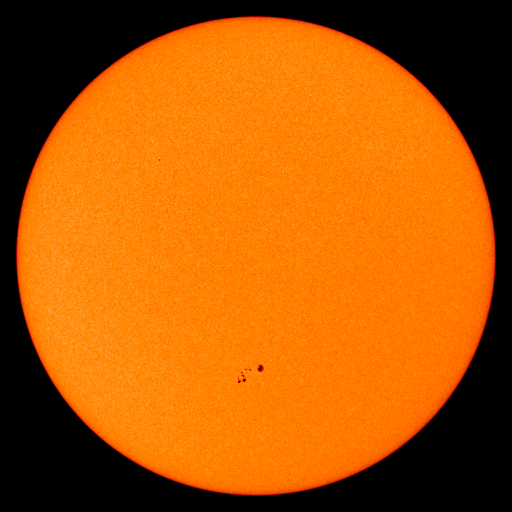
- Suddenly we have not one but two large sunspots visible at once, a situation not seen for over a year. Alas, I spun the dials earlier this morning, and 15 meters isn’t any livelier than it usually is here, which is to say, dead.
- The Google Books Settlement may well be dead on legal grounds, something that doesn’t surprise me at all. What Google needs to do now is just publish an open invitation: “Anybody who holds rights to a printed work and wants the work to be posted on Google Books under the terms below, fill out this form. We’ll handle the scanning.” I’d be first in line in what I’m pretty sure would be a stampede that would sooner or later bring in all the the stubbornest skeptics. The key: I’m willing to admit that my out-of-print works aren’t worth much. 1% of a loaf is still better than no loaf at all.
- ADDED 9/24/2009: Here’s a guy saying something that isn’t often said: Google Books is a fantastic research tool, and far from being evil, the Google Books settlement was just the first (now aborted) effort at something that simply has to be done.
astronomy
Odd Lots
Odd Lots
- When I was a (much) younger man, I wanted a ’59 Chevy. Having seen this, I guess it’s just as well that I didn’t get one. (Thanks to Todd Johnson for the link.)
- Micropayments may not allow small creators (like me) to make money. They may not allow big huge monstrous media outlets make money either. They may not allow anybody to make much money at all. Bummer. I did have hopes…
- Oh, and the Long Tail may not be as long as we thought. Double bummer.
- Has anyone reading this ever played with the Alice language/GUI system for teaching programming? (Alas, no Linux version. Triple bummer. ) Any opinions? I have nieces who are growing up so fast…
- From Pete Albrecht comes word that Chicago’s Kiddieland is closing. My father took me there in 1955 while my mom was working. We had pizza and I went on all kinds of rides. That night I puked my guts out, and my mom thought I was coming down with polio. (They don’t call it the Scrambler for nothing.)
- Here’s another thing I thought I might have imagined: World Of Giants , a b/w TV show from 1959 that went into syndication and used to run just before the 4:00 PM monster movie on Channel 7 in Chicago, circa 1965. At least two people must have watched this, and the other one must have been Irwin Allen. (And the guy who created the show must have read Richard Matheson.)
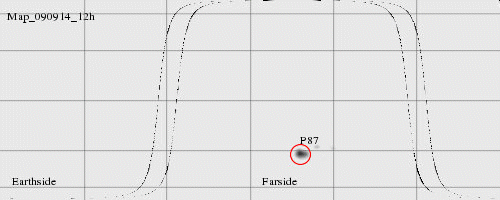
- Although the sun’s face has been devoid of sunspots for 18 days running (and 212 days this year) there is a major sunspot on the other side of the Sun, which may rotate into view sometime tonight. I boggle a little to think that we can image a sunspot on the far side of the Sun. How this is done is interesting, and has little or nothing to do with light. Flying cars or no, we are living in the future!
- From the Not Too Clear on the Concept Dept: I just nuked a spam message pitching “herbal testosterone.” Right.
Odd Lots
- I just missed seeing a nice article on the current sunspot dearth before posting my entry for August 20, 2009. The longest stretch this solar minimum is 52 days back in 2008, and we could well exceed that come early September with no additional spots. (We’re now at 45 consecutive spotless days.)
- I’m practicing rolling my eyes for the latest showing of the Mars hoax. On August 27, multitudes of people who are rumored to posess something close to human intelligence are claiming that Mars will appear the size of the full Moon. (This does the email rounds every couple of years.) Note well that if Mars were the size of the full Moon in the sky, we’d be living a disaster movie, so be very glad it’s a hoax.
- Stanford University reports that media multitaskers do not in fact multitask very well. I liked this refreshingly straightforward quote in the article: “We kept looking for what they’re better at, and we didn ‘t find it.” More details here from the Beeb.
- ZDNet reports on a virus, named Win32.Induc, that pulls a trick I’ve never heard of before: It looks for the Delphi programming environment, and infects Delphi such that any apps built by that copy of Delphi will carry the virus. I can’t quite see how this manages to propagate in a herd as thin as the Delphi programming world has become, unless Delphi programmers tend to use a lot of Delphi utilities obtained from places like Torry’s. (I know I did, so that’s my theory.)
- Maybe you had one: A die-stamped thin steel rectangular lunchbox, usually (but not always) with completely inane artwork, often branded to TV shows, toys, and other pop-culture phenomena. The Denver Westword has a “10 worst” feature on tin lunchboxes that’s worth a look. I never carried a tin lunchbox to school (we used paper bags from Certified) but I have one now very much like #1, purchased at a hamfest years ago, filled with FT-243 ham-band crystals. I’ve always wondered why the boxes always had little vents punched in the short end sides.
- Here’s an interesting 2-tube minimal broadcast-band superhet, using 12V space-charge tubes. It’s interesting enough that I might even build one, though my own holy grail is a 2-tube FM receiver. I’ve got the schematic (courtesy John Bauman KB7NRN) and lack only the time to hack it together.
- I’d never heard of morning glory clouds, probably because they mostly happen in a certain part of Queensland, Australia. The bigger question is why they get all the truly great Weird Stuff down there, and we have to settle for minor-league weirdness like Michael Jackson.
Out, Damned Spots! Out, I Say!
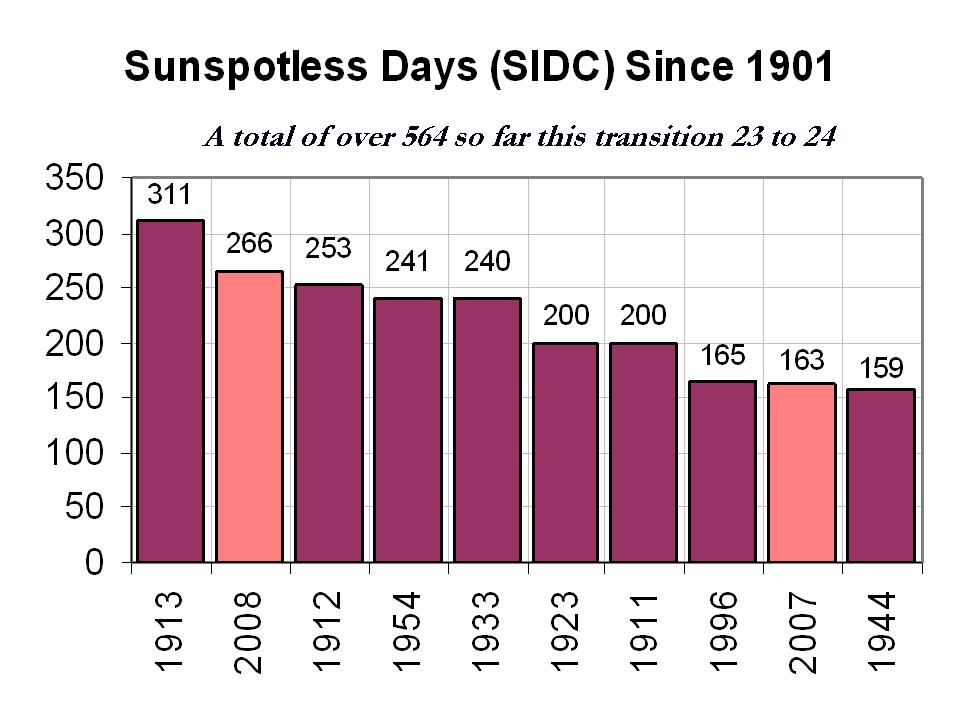
Just my luck: I get a decent dipole strung in the attic, and the sun gets even quieter than it was earlier this summer, when a flurry of tiny sunspots (and one lonely one I might promote from “tiny” to “small”) led everyone to shout that the solar minimum was over. Not so. A few weeks ago, 2009 pushed into the top ten years of sunspot-less days since 1900. Spaceweather tells me that we’ve now seen 182 spotless days this year so far, pushing past 1996 into position #8 on the No-Spot Parade. (See the graph covering complete years here.) At 40 in a row, we’re in very rarefied statistical territory, even at solar minima. And if we make it to the end of August without any spots, we could see a full spotless calendar month, which is even rarer.
The next milestone comes after 18 more spotless days, when 2009 hits 200 and pushes past tied years 1911 and 1923 into spot (as it were) #6. We need 59 more spotless days this year to surpass 1954 and reach #4. We may just possibly do that, but I’m predicting that that’s as far as 2009 will get, since there are, after all, only 133 days left this year. But yikes! This is shaping up to be a minimum like nothing seen since 1911-1913.
It’s been a cool, wet summer in Colorado Springs and, in fact, a cool, wet summer in a lot of places north of poor Texas. Maybe it’s a coincidence and maybe it isn’t. A quiet Sun is a cooler Sun, and we know far, far less about its effect on climate than we’re willing to admit. In the meantime, well, sure, I’d like to work Tuvalu on three watts into a hairpin too–but 70 degree summer days and full reservoirs are not shabby compensation.
Odd Lots
- Yes, I’ve been lax on posting, but we’ve taken a short vacation with Carol’s family, and I’m reading PDFs of the finished pages in my book, for reasons that I don’t need to go into here. I have lots to post about, but little time or energy to do it. Bear with me.
- Our new puppy now weighs five pounds and is going on eleven weeks old. He still hasn’t told us his true name, but we’ve suggested Dash, Pascal, Dover (think “White Cliffs of”) and two dozen other things, and all he wants to do is chew on Carol’s slippers. At least he’s learned to use the potty pad, a trick Aero never quite mastered.
- You can help classify galaxies from the Sloan Digital Sky Survey over at the Galaxy Zoo, which is one of the coolest crowdsourcing apps I’ve ever seen. You don’t have to know anything about astronomy to classify galaxies, but people who are passionate about galaxies may find the process less boring.
- Anyone who has ever killed time with Conway’s Game of Life has got to see this video, of a spaceship gun: a large, complex GoL pattern that generates moving “spaceship” automata that then crawl away toward the right. The gun seen from a height looks stable and in its own way beautiful, but at higher magnification it’s full of furious activity, almost like a chaotic Pac Man game. How such things are designed escapes me completely, but this makes me wonder what larger and even more complex GoL structures exist and have not yet been designed. (Discovered?) Thanks to David Stafford for the link.
- David’s hot this week: He also sent a link to an extremely intriguing article suggesting a different sort of cosmic cycle: After the Big Bang, time began running, but then gradually slows down until it stops. At that point, what had been the time dimension becomes a new space dimension, and (presumably) the whole thing blows up again with a brand-new time dimension, as a richer and in some respects more mature cosmos. Shades of Stapledon’s Star Maker.
- Although we’re still seeing TV spots by the late, great (ok, loud) Billy Mays, Mays has an heir-apparent: Vince Offer, who has begun to saturate off-peak Weather Channel ad space with pitches for Sham Wow and the resurrected Blitzhacker, now unfortunately called Slap Chop in the US. (Carol and I had one thirty years ago, and it was indeed useful.) Mays had a certain goofy warmth about him. Vince, well, he’s just…scary.
- “Sheesh, this thing is ancient! If it breaks, where am I going to find another?”
Odd Lots
* From the Words I Didn’t Know Until Yesterday Department: “Forcemeat” is meat ground sufficiently fine to make it cohere with a fat base, and mixed with spices and sometimes other ingredients before incorporating in patés, stuffings, and sausages.
* The Weather Channel is running saturation-level advertising for a “3D chalk” product from Crayola, which is apparently a selection of very bright, almost day-glow colors of sidewalk chalk, plus a pair of 3-D glasses with which to view your sidewalk artwork. Done correctly, the warmer colors seem to float above the sidewalk a little. It’s almost impossible to think of this product and not flash on the sequence in Disney’s Mary Poppins in which the gang jumps into Bert’s sidewalk chalk drawing.
* The venerable Alfred Morgan borrowed some of the circuits found in his boys’ books on electronics. I found the phono oscillator circuit from The Boys’ Second Book of Radio and Electronics in a 1943 Meissner data book, and now Peter Putnam sent me a link to a 1955 article in Popular Science showing something very close to the diabolical Geiger counter circuit that I tried and failed to build (out of the same book) in 1964.
* There are fake high-capacity USB thumb drives going around. (Thanks to Frank Glover for the link.) Nobody’s making 128 GB thumb drives yet (though they will eventually) so don’t fall for it.
* Also from Frank comes a link to an interview with Eric Lerner, the man who claims to have developed a new kind of fusion reactor he calls “focus fusion.” I’m not enough of a particle physicist to know whether this is a scam or not (though it sure smells like one) and I hope that my readers who are particle physicists can tell me whether the physics is as dicey as the business plan.
* Our long, long sunspot drought may be coming to an end. Spot 1024 is the largest seen yet of the new Cycle 24, and the largest sunspot seen in almost a year. I guess I better start shielding the fire alarm sensor wires, so I can get on 10 meters!
Odd Lots
- The Atlantic tells us that a growth industry in NYC and other crowded cities is training dogs to sniff out…bedbugs. Dogs who can tell live bedbugs from dead earn as much as $325 an hour, and work for kibble. I got some peculiar bites on one side of my right leg while we were down in Champaign-Urbana last week for Matt’s graduation, and while I can’t prove that bedbugs did it, that side of my right leg is the side that contacts the bed while I sleep (as I nearly always do) on my right side.
- From Chris Gerrib comes word that The Espresso Book Machine has finally been installed in a bookstore, where it prints from a selection of half a million books on the attached server. No word on whether these are all out-of-copyright titles or what, but after what seems like decades of screwing around (I first reported on the Espresso Book Machine, originally called the PerfectBook 080, in 2001) we’re finally getting somewhere.
- I’ve heard tell recently that Vista doesn’t play nice with the Xen hypervisor. Anybody had any crisp experience there?
- William Banting’s Letter on Corpulence is now available from the Internet Archive, and it’s interesting as the very first detailed description of the effects of low-carb diets. Way back in 1864 Banting lost weight by eating protein and fat, and seemed surprised enough by his results to write up his experiences in detail. The more I research this, the more I’m convinced that carbs are what’s killing us, and this is not new news.
- Lulu recently cut some kind of deal with Amazon to put all their books (I think; it certainly includes all of mine) in the Amazon database. However, they added five or six bucks to the cover price. Will people buy Carl & Jerry books for $21? Don’t know, but somehow I doubt it.
- Machines can often see things that we can’t (which is one reason that we build machines) and they’re willing to share what they see with us. Sure don’t look like this in an 8″…
- Ars Technica published a good article on how DRM actually makes the piracy problem worse–an insight I had years ago, and a painfully obvious one after thinking about it for a nanosecond or two.
- No rest for the weary; several people wrote to ask what I would be writing next. Not sure. I still have to get our butts back to Colorado, but once I do, I want to finish my second SF story collection, and work on Old Catholics. You can bet that I’ll be posting more on Contra too, if that counts. Further than that I won’t venture, though I think I’ll be leaving computers alone for a little while.
Odd Lots
- I like nuns (most nuns, if perhaps not all nuns) and I’ve said good things about the few that helped me get started on the road toward personal discipline and basic thinking skills. Over at the Make blog, they’ve got a few photos of an offering left at a monument dedicated to one Sister Nicodema: An elaborately painted wooden lightning bolt carefully delivered in an elaborately crafted custom case. No idea who she was or even where this is in the world, but somebody gets points for originality in implementing the tribute. She must have been one helluva teacher. (The great German term “geistesblitz” comes to mind.)
- I thought of another couple of Irishisms associated with my grandmother Sade Prendergast Duntemann: Kafoothering (furiously fussing with, or frantic activity generally) and curniklee, which defies easy definition but might be described as gross dirt. Both spellings are phonetic, and I’m guessing the originals are from the Irish language. I haven’t myself used “curniklee” in decades, but “kafoothering” is a wonderful word that bears remembering.
- Those who don’t read Contra comments on my WordPress main site may have missed Jim O’Brien’s insights on “oonchick,” which in Irish is spelled “oinseach,” and denotes a person of pathetic foolishness or stupidity. He also suggests that since in Irish the suffix “og” means “young,” a “gomog” may be a young gom, which in Irish is an idiot (or an “eejit” as Sade herself might have said.)
- The “Axis of Evil” patterns that people see in maps of the cosmic background radiation may be caused by lensing at the boundary between the solar solar wind and the slower interstellar wind. Or you can have my completely speculative opinion (not peer reviewed) that the pattern is due to the cumulative effect on the cosmic background caused by everything massive in the universe acting as a very lumpy and unevenly distributed gravitational lens. The universe is not perfectly smooth and featureless. If the cosmic background is indeed leftovers from the Big Bang, it is the farthest source of radiation possible. We’re seeing it, in a sense, through slightly wrinkly glass. How could it be otherwise?
- At least we’re not seeing the Blessed Mother in the cosmic background hiss… (Thanks to Pete Albrecht for the link.)
- I’ve known about the Baby Name Voyager for some time, but I don’t think I’ve cited it here before. It’s a Java app charting the popularity of names given to infants since the 1880s. The name “Jeffrey” barely existed until the 1930s, peaked about when I showed up, and then was mostly gone again by 2000. I always thought it was a bad idea. I wanted to be James, and was almost Eric. For a truly fascinating graph, though, enter a single letter, to see the relative popularity of all the names beginning with that letter. Like Q.
- I’m not a beer drinker, but down at Shop and Save, they have Russian beer in 2-liter plastic bottles. I’ve never before seen beer (nor anything else alcoholic) in what most people think of as soda bottles, and I always figured it was either illegal or simply a bad idea chemically. I guess not.
Odd Lots
- Still sniffling, still congested, still coughing, and still mostly lying on my back, taking a Zicam every three hours like clockwork. I feel better generally, but the growing pile of Kleenex on the floor next to the bed provides time-trend rather than anecdotal data. This has been worse and tougher to shake than I had hoped.
- The Cassini Saturn probe can actually watch ring disturbances occur, especially those caused by the way-far-in moon Prometheus. Here’s the culprit making tracks in the ring system, courtesy Astronomy Picture of the Day.
- There is a portable version of Scribus, the only open-source desktop publishing system that I respect. One key principle of degunking Windows PCs is to staythehell away from the Windows Registry, and portable apps, almost by definition, leave no fingerprints there. There’s more here than most people understand, and Wikipedia’s list of portable apps is a very good place to start. (I advise reading the entry talk page.) Here’s another big list.
- Another key principle is to avoid software that insists on launching services all the time, having tray icons, etc. Most of these are commercial packages that are desperately trying to upsell you. Best path here is to avoid commercial software as much as possible, especially trialware and “basic” versions that are invitations to install nagware and are often very hard to get rid of.
- (Next morning.) The nose is drying out (finally) but the cough is still with me. About to head out for some yummy McDonald’s iced coffee, with sugar-free vanilla flavoring, to chase a delectable Sausage McMuffin with Egg. I’m stuffing my pocketses with Kleenex, but after two days of self-enforced isolation, it’s almost within my grasp: The Contrarian Breakfast of Champions!
- (Later.) It’s been a bad season for the Global Warming crowd. Freeman Dyson jumped the Tiber, and now says that the whole thing is a religion. The Australian Bureau of Meteorology has admitted under duress that its Antarctic bases have shown a cooling trend since 1980. Another Australian, albeit a hated Tory, penned a pretty good summary of the problems to be found when you study the data and not the dogma. Word seems to be getting out: Only 30% of Americans support cap-and-trade, which has become corrupt even before becoming law. And here’s what one of the sponsors of the Waxman-Markey bill has to say about the dangers of global warming. OMG, if that tundra at the North Pole ever emerges from under the ice, we’re all gonna die!
- Remember Global Cooling? I lived through it. It was scary. The lesson? We knew shit about how climate worked in 1975. And today? We know shit plus 15%. Some humility (and caution) are called for.
- (Still later.) Gosh. I really must be feeling better. The needle has climbed out of “groggy” and is rising rapidly through “puckish” on its way back to “jovial and unprovocative.” Dare I hope to get all the way to “serene”? Not likely; the viruses are surrendering, but I still have 35,000 words to go on the book–and I can’t find any Diet Green River!
The Moon Eats Venus
 I had a tough time sleeping after 4:30 AM this morning, probably because I slept so well the previous night. (The Powers seem to ration my sleep for reasons I’ve never understood. Maybe if I got a complete night’s sleep every night I’d be unbearably perky, like that retro 60s babe Flo on the Progressive Insurance commercials.) So I finally gave up about 5:15 and got dressed. I went out on the back deck to see what I could see of the Moon and Venus, to find that the positioning was optimal bad vis-a-vis the huge pine tree behind the house. My eastern horizon is very good, where I have an eastern horizon–and alas, the Moon was rising right behind the tree.
However, by 6 AM the pair had cleared the tree, and were getting very close. I put my Canon G-10 on its greatest zoom, propped the camera on the deck railing, and took some shots. The sky was getting pretty light at that point and I knew I wouldn’t get much contrast, but there’s something a little subtle and spooky about what I did get, and I’m quite happy with the shot overall. When I knew that the occultation was only a few minutes off, I went back in and got Carol up. We both watched it from the deck, passing my 8 X 50s back and forth and marvelling at the terrific weather.
I haven’t seen a lot of planetary occultations, and there’s a fundamental difference between those of planets and stars: Stars are point sources of light. When a star goes behind the Moon, it blinks out instantly. Planets fade as their disks are covered by the Moon’s limb over a period of a few minutes. As I watched Venus dim, I realized that this was the first planetary occultation I’ve watched through binoculars. Every other occasion (I think maybe three) I was watching through one of my big scopes. I regret a little not having put the 8″ scope on the back deck last night, but experience has shown that the deck is not a very steady platform for observing. (And the driveway looks west, with the house blocking the eastern horizon completely.) There’s something to be said for brand-new experiences. Why always do everything the same way?