Jeff Duntemann's Contrapositive Diary Rotating Header Image

Daybook

Descriptions of what I did recently; what most people think of when they imagine a “diary entry.”

Souls in Silicon in All major Ebook Formats

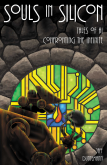
My SF collection Souls in Silicon (which I described in my August 19, 2008 entry) is now available from Lulu as a single downloadable ZIP containing all the major ebook file formats. These formats include:

  • .DOC: MS Word 2000
  • .RTF: Rich text; loads in nearly all word processors
  • .LIT: Microsoft Reader
  • .LRF: Sony Reader
  • .PRC: MobiPocket
  • .PDF: Fixed-page Adobe Reader print image
  • .HTML: Web browser

I consider these to be the most important ebook formats now in use outside of the more or less separate Kindle universe. All files are DRM-free.

When the book was first released, I configured the Lulu catalog item so that it would sell the PDF print image as a download. This was a mistake, because fixed-page PDF files are not very good ebooks if you're using anything smaller than a laptop or a tablet, and the download PDF option implied that PDF was all that you could get.

So I disabled the “download PDF” option from the Lulu sales page for the printed book, and created a new Lulu product consisting of the ebook edition ZIP file. The price is $3.99 for the ZIP, just as it was for the PDF print image. If anyone reading this bought the print image and would like the ZIP with all the other ebook file formats, just shoot me an email and I'll send it to you. (The ZIP contains the PDF print image as well as the reflowable file formats.)

Big thanks go to John Ridley for putting me on to the Calibre ebook toolset, which converts very cleanly from a Microsoft Reader .LIT file to the Sony Reader .LRF file. Odd tools like that are popping up constantly in the ebook world, and it's hard to stay ahead of it all.

If you mention Souls in Silicon somewhere, even if you only saw the print edition, please indicate that it's available in an ebook edition as well. Thanks!

I'm hard at work on my second collection, which I will (probably) call Cold Hands and Other Stories. Much depends on whether or not I decide to include my short novel Firejammer, which is a YA item and may be better off on its own or with something else like it. With Firejammer the collection would be a little long; without Firejammer, it would be a little short. (25,000 words makes a difference!) I'll keep you posted.

Souls in Silicon

Many things have conspired to slow me down since Worldcon, but I've begun to catch up, and this morning I finally got Souls in Silicon uploaded to Lulu and ready for sale.

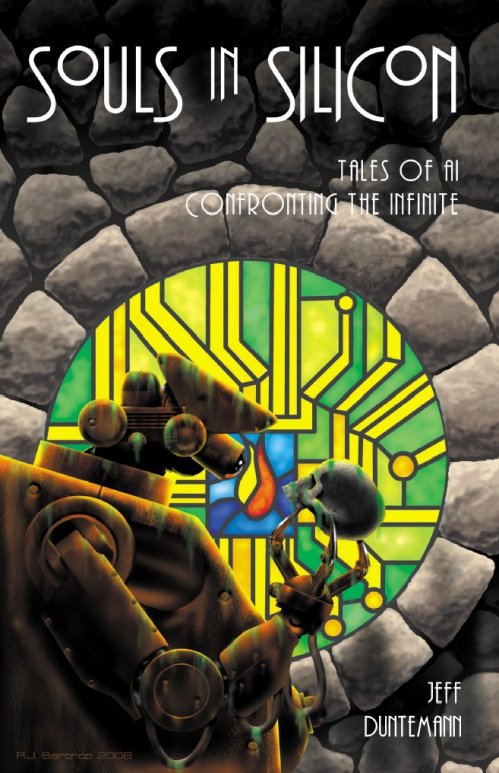
The book is a collection of all my published stories (plus a new one) about strong AI. Some may be familiar to you (like “Guardian,” which was published in Asimov's in 1980 and appeared on the final Hugo ballot in 1981) but some of it appeared a long time ago in markets that paid real money but were obscure or problematic in various ways. Jan Howard Finder's hardcover anthology Alien Encounters published “Marlowe” in 1982, but the only sales report I ever saw indicated that it had sold 125 copies. Ditto Larry Constantine's Infinite Loop, another hardcover anthology. It put “Bathtub Mary” into print in 1993, but there were shelving issues (bookstores thought it was a computer book because it was published by Miller Freeman) and the only time I ever saw it in stores was next to a pile of C++ tutorials. So it was time to get them all available again, in a single presentable volume that will never go out of print. The cover art is by Richard Bartrop. 188 pp. $11.95 print; $3.99 PDF download. No DRM.

The collection includes:

  • “The Steel Sonnets” (1975)
  • “Guardian” (1980)
  • “Silicon Psalm” (1981)
  • “Marlowe” (1982)
  • “Borovsky's Hollow Woman” (with Nancy Kress; 1983)
  • “STORMY vs. the Tornadoes” (1990)
  • “Bathtub Mary” (1993)
  • “Sympathy on the Loss of One of Your Legs” (2008)
  • …and an excerpt from my nanotech AI novel, The Cunning Blood (2005)

The book is currently available only from Lulu. I'm working on getting it ISBN-ized and converted into all the major ebook formats, and with some luck into Amazon's Kindle bookstore. I'm planning a second collection for the fall, containing all the rest of my published SF and a couple of new items. The title and and contents of that one depend on several decisions I haven't made yet, but I'll keep you posted. As always, reviews or simply blog mentions would be greatly appreciated.

Worldcon Whereabouts

We'll be staying at the Westin Tabor Center at Lawrence and 17th, which is a few blocks from the Convention Center, but not a bad walk. (I've done it before.) Haven't checked in yet, and won't be there until tomorrow afternoon, staying until Saturday.

John Frier: American Inventor

I have a very popular Web page devoted to Hi-Flier kites, and it generates more mail than anything else on my site except Contra. A few weeks ago, I got an email from Nancy Frier, introducing herself as the granddaughter of John Frier, founder of Alox Manufacturing Co. of St. Louis. Alox was one of three companies that mass-produced paper kites for the toy market in the 20th century, the others being Crunden-Martin (TopFlite) and Hi-Flier. I flew a few Alox kites when I was a kid, but they were not available at Bud's Hardware, so I could only get them when I was somehow at farther stores like Walgreen's or Kresge's. Nancy had seen my Hi-Flier page (which mentions Alox kites briefly) and offered to provide more information on Alox and the remarkable man behind it. Earlier this week, I took advantage of a fluky chance to meet her while she was traveling from Wisconsin to St. Louis, and we lunched outside of Rockford.

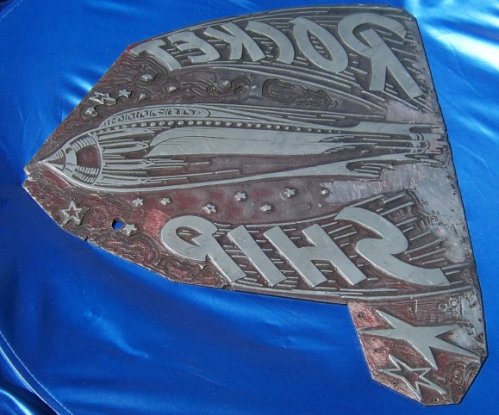
Whoa. I've been at some interesting lunch meetings in my time (and I've had breakfast with Isaac Asimov and dinner with Steve Ballmer) but this one was amazing. Almost all my information about Hi-Flier is second or third hand. Nancy was there. She had worked at Alox since she was a teenager. She actually made the kites, and by “made” I mean that literally: She fed sheets of paper and plastic into the special printing presses, and pushed the buttons. She worked the jig that stretched out a diamond of waxed string over the cut kite sails, and then folded and glued the edge tabs of the sails over the string. (This last machine was Frier's own invention, and he held patent #3,330,511 on it.) She worked for Alox until the company folded in 1989. She still has the copper letterpress plates from which Alox kites were printed, and she had one in the back seat to show me. (Below; photographed on her car window sun-screen.) And before she continued on to St. Louis, she handed me an armful of Alox kites, some of which dated back to the early 1950s. The kites were much appreciated—and I'm working on an article about Alox kites—but what really made the meeting was hearing about John Frier himself.

Born in 1896, Frier had a restless mind, of the sort that demands to know how things work and constantly tries to figure out better ways to go about them. He was fascinated by things that flew, and in 1912, when he was 17, he built an airframe with a wingspan of about 20 feet in his parents' shed outside of St. Louis. He called it a glider, but it was clearly built to accept an engine (she showed me photos) and it was certainly large enough to carry a pilot. Way cool—but then she pulled something else out of her briefcase: A letter to John from the chief counsel of the Curtiss Aeroplane Company, which threatened poor teenaged John with a patent lawsuit unless he ceased making flying machines that infringed on several unspecified Curtiss patents. Frier ignored the letter, but the following year the shed caught fire under mysterious circumstances and took the plane with it, all before John and one of his friends could complete and launch it.

John Frier served in WWI, and when he got home he returned to his main business of having ideas. One of them was a way to keep shoelaces from unraveling at the ends. Although other things had been tried, Frier's method looks a great deal like the stiff plastic ends you see to this day. (His were made of thin metal.) He obtained patent #1,318,745 in 1919, and created a company to manufacture and sell shoelaces. He named the company Alox because it was different from all other local manufacturing concerns in St. Louis—and would be right at the front of the phone book, which at that time was more of a phone pamphlet. Alox cranked out shoelaces for decades, and at least until WWII it was their core product line.

Soon after founding Alox, Frier began manufacturing and selling paper and later plastic kites for children. Nancy gave me a great deal of information and photos concerning Alox kites, but I don't have a scanner here with me and can't show you anything right now. I'll be doing a detailed article on Alox kites once I get back to Colorado, so stay tuned.

Alox is actually better known among marble collectors than kite collectors. Frier liked making toys, and in addition to kites Alox manufactured yoyos, jacks sets, jump ropes (which, after all, are basically large shoelaces with wooden ends) and Chinese checkers sets. At first he bought the marbles for Chinese checkers on an OEM basis from other companies whose sole business was marble manufacturing, but the common practice of bringing a box of marbles “up to weight” by throwing in pieces of broken glass enraged him. He bought several marble-making machines from one of his former suppliers and began making the marbles himself, at first for his Chinese checkers and Tit Tat Toe games, and later as a separate product line. The marble machines were crude (and incorporated mechanical oddities like transmissions from 1920s Hupmobiles) but John and his staffers slowly improved them, and he soon pretty much owned the US marble market. He bought cullet glass from glass manufacturers to melt into marbles, but also bought empty glass bottles in various colors on the scrap market and melted those as well. (Alox's blue marbles had mostly been Milk of Magnesia bottles.) The machines ran 24/7 because it took several days and a lot of fuel oil to bring a batch of glass to full melt, and when John Frier shut down marble production in the late 1940s, it was mostly because keeping a marble factory running all the time was a nuisance. He was the CEO, but he was also the only guy who could troubleshoot the cranky marble machines, and he liked to sleep at night undisturbed by frantic calls from his foremen.

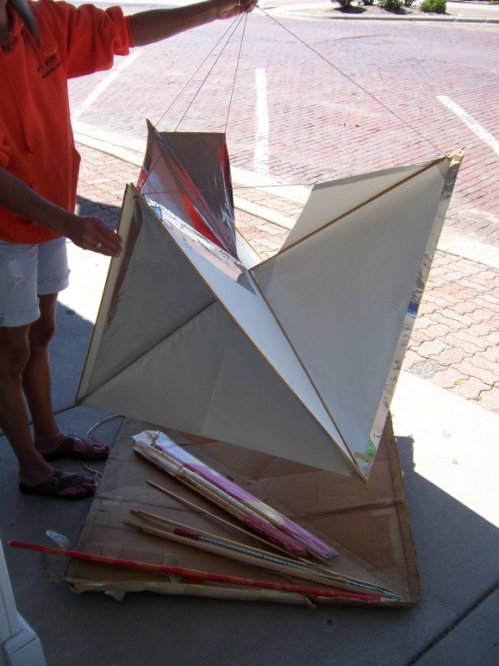
Nancy's final revelation about the Alox product line was the most fun of all: John Frier and Alox made UFOs. Shortly after WWII, Alox got the contract to construct balloon-borne radar targets for the Army Signal Corps. Alox had built thousands of ML307C/AP target devices, starting in early 1947. One of the most famous late-40's “UFO debris” photos clearly shows an ML307, as vehemently as the UFO gang has tried to deny it. Nancy had an Alox-built ML307 target in the back seat, and it was a difficult thing to photograph well, especially in a parking lot. It has a lot in common with a box kite, in that it's a corner reflector designed to fold flat.

I'm running on longer than I generally allow myself in this space, but it was great fun and a wonderful look at a period in American history when almost anything was possible. Nancy handed me a lot of material, and once I get home and get an article put together, I'll link to it here. The kites are much too old to fly (obviously) but they will take a place of honor on my workshop wall, along with the Hi-Fliers already hanging there. Nancy is considering printing and making reproduction Alox kites from the original copper plates, if she can find suitable paper and a press that can do the job. (I know very little about letterpress printing and can't help much there; if you have suggestions I think we'd both like to hear them.) I've been hoping for years that someone would begin making paper kites for the nostalgia market, and with any luck we may still get there. More as I learn it.

Juliana’s Christening

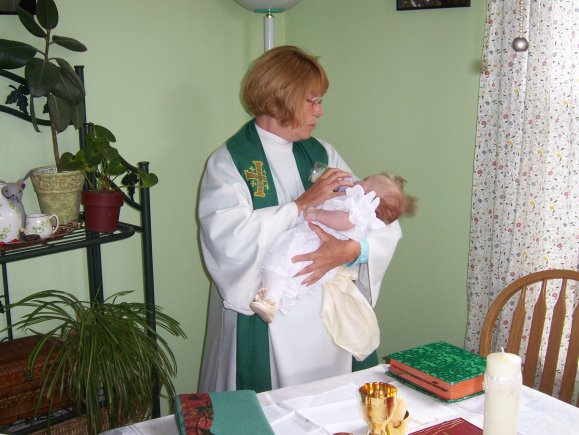
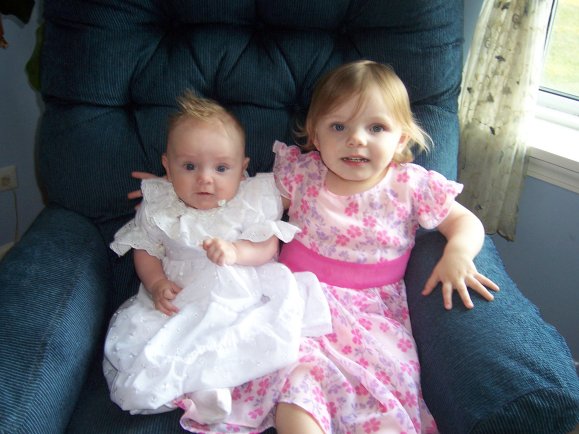
After much planning and preparation, our new niece Juliana Leigh Roper officially joined the Catholic community last night, as all of the immediate family we have left gathered around Bill and Gretchen's huge dining room table for the Mass and baptism. Rev. Mary of the Old Catholic Church presided, as she did back in December 2006 for Julie's older sister Katie Beth. Once again, Gretchen hand-made a christening dress for Julie, and Carol gave Julie the little christening shoes that she herself had worn back at her own baptism in 1953. Again as for Katie Beth, Carol and I promised to keep her on the path as best we can. Godparents don't have to be theologians; what they have to be are good examples and good cheering sections. Carol and I had excellent godparents, and the example was not wasted on us. And yes, words are my thing and I am going to attempt a simple catechism for small children, but we're a couple of years off on that yet. (Which doesn't absolve me from starting to take notes right away. Kids grow up fast.) Theology for ten-year-olds can start very simply, and I will begin with what I learned from Juliana's namesake: Lady Julian of Norwich, who taught that God is infinitely loving and forgiving, and that all manner of thing would ultimately be made well in God's own time. Sooner or later, children must also learn that that there is death and suffering and injustice, but those lessons must be learned from a platform of solid belief in the goodness of creation and God's ultimate victory over all evil and suffering.

The goodness of that creation and God's affection for his creatures was the subject of Mary's short homily from the head of the dining room table. Partway through, Julie began to fuss a little, in the time-honored tradition of infants making a ruckus in church. Without missing a beat, Mary scooped little Julie up in her arms and calmed her down as only a mother (and grandmother) can, continuing to preach her sermon with a baby on her shoulder. (This is something you don't generally see in Catholic churches.) Julie soon returned to sleep, and barely stirred when Mary took the seashell and poured the (warm) blessed water over her forehead, baptising her in the name of the Father, and of the Son, and of the Holy Spirit.

Afterward there was time for good talk, good wine (we had a Frey organic zinfandel and a Bartenura moscato) and Bill's superb grilling skills, with fresh Polish sausage and hamburgers, Hawaiian salad, baked beans, and various small sides. QBit and Aero ran around in circles in the back yard while Katie watched, laughing with delight, and even though the evening was muggy and drippy, Carol and I called it a complete and unvarnished success. Come 9:30 we packed up the puppies and headed for the door, but Katie cried and kept reaching for Carol, who had read her One Fish, Two Fish, Red Fish, Blue Fish several times. Earlier, she had been brushing what's left of my hair with her new hairbrush. She is beginning to learn about godparents and their uses, heh.

After a pretty grim ten years or so on the family front, family is happy and growing again. For many years Gretchen and I thought that our part of the Duntemann line ended with us, but God sometimes answers prayers, and midevening, when our two little prayers sat together in the big chair for pictures, somehow we knew that All Manner of Thing will be well—in fact, as far as we're concerned, we're most of the way there right now.

Almost Done with Souls in Silicon

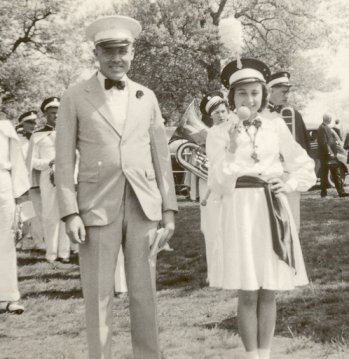
We got back from Wisconsin yesterday, having had a very good time getting soaking wet and eating perhaps a little too much. I had forgotten how pretty that part of the country was, even though my family went there often in the early 1960s. It was where my mother grew up, between the little whistle-stop of Shennington and the larger town of Necedah. (That's her at left, as Necedah High School's drum majorette in 1942, posing with her band teacher.) Carol and I explored the area a little bit while we still lived in Chicago, but that's been thirty years now, and it would be worthwhile to go back and hit Baraboo, Mauston, Mill Bluff State Park, and a number of other places we remember less well than we'd like. We want to return to Perot State Park along the Mississippi, where I proposed to Carol in 1975, as well as nearby Wyalusing. Next summer, fersure.

We're still in the Chicago area (currently in Crystal Lake) but this trip isn't entirely vacation, and I'm pushing hard to get some work done. Today was productive: I finished laying out and proofing the body of Souls in Silicon, the first of two collections I am preparing of my own SF. Souls in Silicon contains all of my published stories pertaining to strong AI, including “Guardian,” which was on the final Hugo ballot in 1981, and “Borovsky's Hollow Woman,” my 1983 collaboration with Nancy Kress, which originally appeared in Omni. Other stories in the 9-story lineup include “The Steel Sonnets,” “Silicon Psalm,” “Bathtub Mary,” “Marlowe,” “STORMY vs. the Tornadoes,” and “Sympathy on the Loss of One of Your Legs.” The collection will conclude with an excerpt from my 2005 novel, The Cunning Blood.

With the body done and the page count frozen, I can get to work on a cover. I commissioned custom cover art from Richard Bartrop, and just approved his final color concept sketch. By the time Richard is done, I should have a cover to drop the art into, and we'll have us a book. Richard is very well-known in Furry circles, but he's actually a formidable hard SF artist, and the concept, from my story “Guardian,” is terrific. Bodies are easy. Covers are hard. My mother was an artist, but I think she left her talents in Wisconsin; neither Gretchen nor I inherited them. I hope to have copies to show around at Worldcon in Denver this August, but that means I had better get to work.

Fire Drill! (Update)

The fire has been controlled, and is mostly out. Carol is home. Tomorrow, alas, is going to be very hot here, and very windy, which is always bad news on the fire front. The fire department is soaking down whatever hot spots they can find at the fire site, to keep them from rekindling tomorrow if the winds get bad.

The fire was not large (5-6 acres) but it was in a small pocket of undeveloped land surrounded on three sides by subdivisions and on the fourth by NORAD and the NORAD access road. It was right across Highway 115 from Fort Carson, so both the Army and the Air Force had an interest and contributed resources.

I'm still taking some Tylenol for the sake of my stitches, else I would be pouring myself a drink about now. Nothing like a fire down the hill to mess over what would otherwise have been a very productive day.

Fire Drill! (Update)

Update: Carol and Aero went back to Jimi Henton's house (she's the local bichon groomer/breeder) and I have this huge pile of stuff by the garage door. However, I just learned that the police reopened Farthing, which is one of the two paths into this area from outside. Broadmoor Bluffs is still closed. I'm not seeing helicopters circling anymore (I can't see the fire site from here) and I'm guessing that they're getting a handle on it. Remarkably, TV news has been almost no help. Nobody wants to interrupt the damfool soap operas.

I can be out the door with QBit and the big pile in the back of the 4Runner in less than ten minutes. In the meantime, I'm sitting in the livingroom with the TV on, reading Mark Kurlansky's Salt. I'll post an all-clear here when it's all clear.

Fire Drill!

Damn. Like, inc(damn). There is a wildfire a little less than a mile south and east of us, on the lower slopes of Cheyenne Mountain. The cops have sealed off all the roads into our neighborhood and won't let Carol get back home here. I'm gathering papers and stuff, and will be tossing whole computers in the back of the Voyager in case I have to run.

They're working on it, and if it weren't for the strong wind I'd say it wouldn't be too much of a challenge. But either way, it's a fire drill. With real fire.

Kubuntu on Painkillers

A quick update on my mouth rehab, though it borders on TMI: About two weeks ago I had 30 new crowns installed, after fussing with a mouthful of temps for most of a month, one of which had a bad habit of coming loose while I was doing something innocuous, like chewing a chicken leg. That operation was not bad, though my gums got a little beat up from the sterilizing agent and dental pick work to remove excess adhesive. So now I have 30 brilliant white porcelain crowns, and if all you look at are my teeth, well, I look like a TV anchorman.

But that leaves two to go. One of them was so badly damaged by six years under my previous horseshoe of connected crowns that it had to come out. The other is a healthy tooth but needed crown lengthening and a post in the middle of it, because it had gotten whittled down so far in 2001. Alas, a post requires a root canal, because the post has to go somewhere. Yesterday I went back and had the lower molar pulled, and crown lengthening (warning: NSFS) done on its opposing number in my upper jaw. That involved some bone scraping, which was one of the ugliest sounds I've ever heard, given that I could feel it in my…bones.

Everything becomes quiet for about six months now. My empty socket has to heal and fill in with bone, after which the surgeon will install an implant post to hold a porcelain molar. At about the same time, I'll have a root canal done on the upper and a post installed in the middle of that tooth to hold the opposing porcelain molar. And then—egad, I hope!—the whole thing will be finished.

On the other hand, I thought I was finished in 2001. Silly boy.

So I'm back on painkillers, though I don't need as many this time as when I had my gums reworked along the entire perimeter of my lower jaw back in January. And last night I did an interesting experiment: I installed Hardy Heron not once but twice, all while in a codeine fog.

Results: It went flawlessly. Linux has clearly arrived. A week or so back I downloaded and burned the ISOs for both Ubuntu and Kubuntu 8.04, the Kubuntu distro with KDE 4. I like KDE more than Gnome, because it reminds me more of Windows, and I've been looking forward to seeing V4 for several months. Both Ubuntu and Kubuntu installed without incident, each in its own 30 GB partition on my lab SX270 3.2 GHz box. I did not have the display glitches I had back in October, (even though the hardware has not changed at all) and both distros saw my network immediately.

I installed a bunch of things with the Adept installer, including some games, Boa Constructor (a vaguely Delphi-ish RAD environment for Python) and some office apps. No problems there, and Boa Constructor is worth a little experimenting and some description as time allows. My only complaint so far is a minor one: GRUB is ugly, and needlessly so. Suse and Fedora (I think) already have a graphical GRUB OS selection screen. Given the importance Ubuntu places on nontechnical users, I think it would be worthwhile to budget a little work for creating one and including it in the default distros.

The reasons are not entirely esthetic. Nontechnical people almost never see text screens anymore (except for a vanishingly quick appearance while BIOS POST does its thing) and when they do, it almost always means that something is wrong. Leaving a general good impression of desktop Linux is vital right now, as from what I can see, the OS itself is ready.

A quick skim of the Ubuntu forums online indicates that it's possible to install a graphical GRUB display in Ubuntu, and I'm going to give it a shot today or tomorrow, when the codeine is no longer necessary and I can run my brain on all cylinders. In the meantime, if any of you have any experiences (good or bad) with graphical GRUB displays, I'd appreciate hearing them.