Jeff Duntemann's Contrapositive Diary Rotating Header Image

Daybook

Descriptions of what I did recently; what most people think of when they imagine a “diary entry.”

The Comco Whatchamacallit

ComcoThingFrontpanel500Wide.jpg

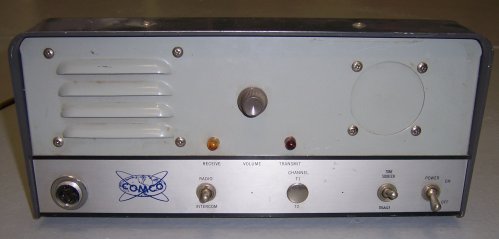
I hung yet more Elfa shelves downstairs the other day, on the only remaining blank wall in my peculiar workshop. I’m trying to get stuff off the floor and into some semblance of order. A number of tube-era radios went up on the shelves almost immediately, including a Heath HW-22A and a pair of Ameco TX-62s, one of which is a parts unit. So did something else: the tube-era thingie shown above, which has been following me around for almost twenty years. I bought it at a hamfest in the early ’90s for a dollar. The old guy who sold it to me didn’t know what it was. I bought it for the sake of the transformers inside, which were worth that much even in 1993. It turns on, lights up, and hums softly. I still don’t know what it’s supposed to do.

ComcoThingNamePlate500Wide.jpg

It’s made by Comco Communications Company, of Coral Gables, Florida. Its model number is 642-RCU. From the “RCU” I’d guess a radio control unit, or remote control unit. It has no RF parts inside. There’s an audio power amp with a 6AQ5A driving a speaker behind the grille. The front panel has a 4-pin PTT mic jack, a momentary action toggle switch marked “RADIO” above and “INTERCOM” below, with “RADIO” the default position. A hole marked “CHANNEL” with “T1” above and “T2” below is plugged. A conventional toggle switch is marked “TONE SQUELCH” above and “DISABLE” below, and beside that, an On/Off toggle switch marked “POWER”. At the center of the panel is a rheostat marked “VOLUME,” and two grain-of-wheat lamps, the orange one labeled “RECEIVE” and the red one “TRANSMIT.” A round hole the size of a panel meter is plugged. On the back panel is a fuse holder, a 5-terminal strip for spade connectors marked “PHONE LINES” and and empty rectangular knockout marked “EXT. CONTROL” from which a cut-off 4-conductor cable protrudes. That might have been a hack; the cut-off cable goes directly to the mic connector.

ComcoThingChassisTop500Wide.jpg

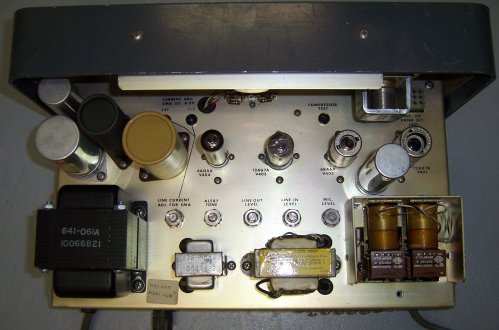
There are two pin jacks on the chassis (see above, just past the tan electrolytic) that say, “CURRENT ADJ. 5MA == 0.5V”. I’m guessing that the meter was dropped from the product to reduce its cost, and the pin jacks provided for service techs. To their right and a little way over is another pin jack labeled “COMPRESSOR TEST.” No idea on that one.

The tube complement is: 12AX7, 6BA6, 12AU7, 6AQ5A.

I suppose it might be some kind of phone patch, though it doesn’t look like any phone patch I’ve ever seen. The “RADIO / INTERCOM” switch throws me a little, since there’s no external connector for intercom lines. I haven’t traced the tangles under the chassis to any extent yet, so if I don’t know precisely what it does, it’s partly my own fault.

And I have other things to do. Even my voracious curiosity has its limits. If you’ve ever seen one of these or want to hazard a guess, please do!

Theme Creep

Sorry for being gone so long. I guess I just had to get past January. We saw the last of the painters this morning, and the only remaining big piece of this ever-expanding remodeling puzzle is the floor coverings. I wouldn’t have thought that getting bids on carpeting would be this hard. It is, at least if you don’t want to get crap carpet and have it installed by idiots. (Now on our seventh house, we’re fussy. Real fussy.) I’m doing two more Elfa buildouts, and shopping for some new office furniture. When I’ve had the energy and presence of mind to write, I made an executive decision to devote it to Ten Gentle Opportunities rather than blogging.

I lost a lot of time in the last few months, but that had nothing to do with the novel. It’s cooking along, and I got another 1,600 words down yesterday. In reading the new material over last night, I realized that something interesting had begun happening when I wasn’t quite looking: The theme was changing, and not necessarily in a good direction.

Maybe that shouldn’t be a surprise. The idea came out of a thoroughly trunk-ish humorous novelette that I wrote in 1981 and buried in embarrassment, concerning a newly built but malfunctioning AI copier that decides that it’s God, and declares jihad against the hapless AI process controller that runs the copier factory. In 1984, my fiction mentor Nancy Kress agreed to collaborate with me on a revision of the concept at novel-length as a half-fantasy love story, adding in a universe-jumping magic hacker (in the manner of Harold Shea) who drops in on a small advertising agency in Rochester, New York to hide from a berserk magician, and magic that “maps” to software in our boring, magic-free world. The magic hacker acts as a catalyst to heal the relationship of two middle-aged people, and in the process learns about software. When he returns to his own universe, he discovers that software “maps” to a form of magic far more potent than anything his erstwhile tormenter can summon. End of story.

In our 1984 effort, there were only two AIs: one the factory controller, and the other a tinkered-up magical intelligence that maps to software in our world. In a brief (and silly) subplot, the magical software falls in love with the factory controller, and in a sort of virtual sexual union, they combine into something a good deal more capable than either was on its own. Mostly, the AIs were played for laughs and acted as foils to the human hero and heroine, whose relationship they loosely echoed.

The concept had promise, but in 1984 I was only barely a grownup (32) and just couldn’t pull it off. Nancy graciously ceded me her portions, and everything went back into the trunk, where it stayed until 2006. I pulled it out and read it over that year, and very abruptly, brand-new scenes began rising out of the cluttered back rooms of my subconscious. I sat down one evening and wrote a new opening, “just for fun.” Boom! Suddenly I had a rigorous system of magic, a magical intellect that spoke only in poetry, an evolved magical predator resembling a lamprey from the astral planes, zombies dancing the Macarena, a 3-D processor technology that packs tens of thousands of execution cores into a blade module, the Triumph of Pascal (as a fictional but heavily parallel language called HyperLang, get it?) and several more AIs.

The love story was still there in the middle of it all, at least in the outline. Now, I have this old habit of heaving ideas into a story with a pitchfork. Once I grabbed my pitchfork, the love story started to get buried in ideas, most of which lay in the AI characters. What does it really take to make an AI that looks and sounds like a human being? If you start with something powerful but alien and make it human by shooting it full of NOPs and bad animation, is that a win? What would the AIs think once they understood what was going on?

Is virtual suffering real suffering?

I’ve done idea stories all my writing life, but I’ve never done a love story. I guess it’s not surprising that I’m having a lot of fun with the ideas, and a lot of heartburn over the human relationships. I’m doing my best. The path of least resistance, however, is to have fun with the AIs and their virtual lives in the Tooniverse while the human characters recede into the background. If I’m not careful and don’t begin paying attention to my outline, that is precisely what’s going to happen. I looked in the mirror this morning while shaving and said, “Be warned.”

In some ways the story has come full-circle. It was originally a battle between a humorless factory controller system and a psychotic AI living in a faulty networked copier. I’m having to struggle a little now to keep it from becoming The League of Exceptional Software pitted against slobbering malware from another universe, while their human friends look on in befuddlement and occasionally cheer.

Most of my stories have evolved as they crossed the brain/fingers barrier. A lot of them have died in the evolving, which is why my trunk, in terms of paper alone, weighs thirty or forty pounds. I’m determined not to lose Ten Gentle Opportunities the same way. After all, it’s taken literally half my life to write, and I have only so many half-lives to go.

Another Elfa Closet Done

WorkshopClosetElfaSetup500Wide.jpg

The rehab of our lower level continues apace. The tile guys finished up today, replacing the tile around the tub and some floor tile that was damaged by the mudjacking last month. The grout has to cure for another week and the toilet has to be re-set, but the tub no longer leaks. Shortly we will have a guest bathroom again.

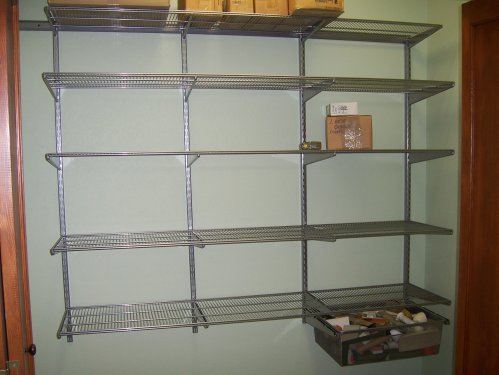
The painters begin their work on Monday. We haven’t ordered the new carpeting yet, so the carpeting won’t be replaced for probably another three weeks. In the meantime, there are plenty of odd jobs to be done down there, and yesterday I dove in on one of them: my workshop closet. I’ve been planning an Elfa buildout in that closet for literally years, but it hadn’t bubbled to the top of the stack until recently. To replace the crappy shelves I had in there with Elfa I first had to empty the closet completely, and there was nowhere to stack its contents until I was forced by the mudjacking to clear the eastern ten feet of my shop space. That in itself was an adventure in strength training; QST may be the only magazine in creation denser than National Geographic.

So last week I hauled hundreds of pounds of parts, tubes, sound boards, unfinished project lashups and much other junque out of the closet and stacked it in the newly empty space where those QSTs had been. And yesterday, level and cordless screwdriver in hand, I got the Elfa installed.

Elfa is a steel shelving system made in Sweden, built like a battleship and priced accordingly. As best I know it’s an exclusive from The Container Store chain here in the US. It’s based on a horizontal track mounted high (ideally in studs) from which vertical tracks are suspended. The vertical tracks are not fastened into the wall at all, so can slide side-to-side for fine adjustment. (Mine is biased four inches to the right.) There are several major styles (closet, kitchen, office, garage) and all kinds of interesting bits that click into the tracks. It’s basically a Meccano set for shelving.

I’ve used it twice before, in our upstairs office closet, and across two thirds of the back wall of our garage. It takes a little practice to get good at it, but there’s nothing especially subtle about the system. It was breathtaking to see just how much clutter we were able to scoop up off the garage floor and shovel onto the shelves.

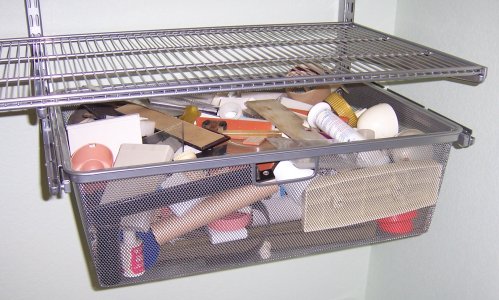
Yesterday I filled an 88″ wide closet with a six-foot shelf bank, leaving a little room on each side for specialty storage for things like brooms, vac wands, and mobile antennas, including a full set of Hustler RM-series loading elements. The Elfa system includes pull-out bins, one of which I bought to see how useful it might be. Having filled it with plastic scraps, I’ve decided that it’s very useful, and on my next trip to Denver will get two more.

ElfaBin500Wide.jpg

I’m still switching shelves around and moving them up and down to get a sense for the spacing, and may put a couple more 2′ shelves on the right side to make space for things more horizontal than vertical, like homebew lashups. That said, I’ve already re-shelved most of the stuff I’d pulled out of there last week, and still have almost twelve shelf-feet of completely empty space. As wins go, it was a biggie.

Highly recommended.

Unhappy Old Year

So. Once again we rebooted the calendar, and it worked. Whew. Couldn’t have happened soon enough. This year had its moments, but it wasn’t among the best I can recall, though it stands shoulders above 2002.

The year began with the worst flu I’ve had in 35 years. Lesson: Get your flu shots! Carol did. I didn’t. Q.E.D. There was other illness in the family that I won’t talk about, though nothing life-threatening. For that we have to move out into our friendscape. We lost Prudy Stewart, a stalwart from the local Bichon Frise Club, along with Harold Shippey, a gentleman in our camping group. Two of my grade school teachers died within a couple of months of one another: Mrs. Mary Clare Toffenetti, who taught art and French at IC school, and Mrs. Mary Veronica Condon, who taught third grade and also French. Dan Matthews, one of the kids in my grade school class, who had been a close friend for several years, died on Christmas Day. Just last night, one of our parishioners, who generally sat two pews behind us at church, had a serious heart attack. He’s in a coma and is not expected to survive.

All this since November 1, sheesh.

Oh, and my house almost blew up. Settling soil has been our bane here for years now. We had to empty the lower level and get the slab mudjacked, and are still fooling with paint chips and carpet samples now that the carpet’s been torn up anyway. All of my SF and most of my electronics magazines are packed and out of reach. It’s a mess.

For good things to report I’ll begin with the completion of Drumlin Circus, a 53,000 word short novel that came together in one furious six-week period, during which I wrote as much as 5,000 words in a single day. Jim Strickland and I put a tete-beche double novel on the market, incorporating Drumlin Circus and On Gossamer Wings, both tales from the Drumlins World.

Jim and I attended the Taos Toolbox writers’ workshop in July, conducted by Walter Jon Williams and taught by Walter and my SF mentor Nancy Kress. I described the workshop in two entries after we got back, and would have continued if my damned gas line hadn’t threatened to ignite virtually under my feet. (I hope to write a little more about the workshop in coming days.) I will say right now that if you have a little experience in SF or fantasy, Taos Toolbox is spectacular. Granted, it’s expensive, and almost unbelievably intense. Jim describes it as a 500-level graduate course in the art of the novel compressed into two weeks, and that sounds about right. Walter is currently accepting applications for the 2012 workshop, and I give it my wholehearted recommendation. I met a lot of wonderful people, workshopped 15,000 words of my current novel-in-progress, Ten Gentle Opportunities, and returned with new dedication to the craft of fiction. I’d hoped to finish TGO by the end of the year, but (as described above) the year did not cooperate. The new target is April 1. Snotty AIs, zombies dancing the Macarena, a copier factory gone rogue, magic as software, physics as alternate magic, and malware from another universe…hey, what else d’ya want?

On October 2, Carol and I celebrated our 35th wedding anniversary. We spent ten days on Oahu, generating enough gumption to start having the lower level rehabbed when we got back. It took everything we could generate, and more.

I joined the Writers Write! group here locally, and have made many friends there. The group’s motto is Just write the damn book! It’s advice I need to take.

Those are the broad strokes. Scattered among the days were little flashes of light and minor grunts of annoyance. My brakes have needed work three times. I met Cynthia Felice. My new superregenerative FM receiver has dead spots. I finished a nice steampunk computer table. That sort of thing; up and down on an almost daily basis.

I have high hopes for 2012. Carol and I have deliberately held back opening our Christmas presents until January 6th to get an upbeat start on the year, and 2012’s first 18 hours have gone pretty well. I won’t try to draw any conclusions from the data points presented. Hey, sea level dropped 6mm in 2010 alone. Blips happen, so let’s not read too much into any of them. It’s not the end of the Holocene…yet. Then there’s the Mayan calendar. Y2KXII, anybody? Let’s party!)

Happy new year, everyone. Strive to appreciate your friends this year. (You won’t have them forever!) Write more. Worry less. Go outside and check your gas pipes. Eat fat and drink sweet wine, and make sure you share what you have with others. I’ll be here when you need me.

A Forward-Looking Christmas

DogsOnCarol-500Wide.jpg

Christmas is coming a little late here. Christmas won’t entirely arrive, in fact, until a week from today–by order of the Lord of This Particular Castle. To avoid having our lower level out of commission until the vernal equinox, Carol and I have been furiously shopping for carpeting and slobbering paint-color samples on the walls, and getting estimates from painters and carpet layers. We lacked time and (especially) energy to mount a real Christmas tree, and when I went downstairs to hunt up my Lionel trains, I found that a couple of key boxes were blocked in behind all the other boxes of miscellany I had to pack up to prepare for the mudjacking. So no trains either.

This is why you haven’t seen much from me recently. We’ve done a lot of remodeling in our lives and always hated it. By the end of the day I’ve been in no fit mood to write much of anything at all. Carol and I have mostly sat on the couch covered with bichons while the smoke stopped pouring out of our ears.

We did spend Christmas Proper with a few close friends, but almost entirely avoided the six weeks of furious tearing around that a conventional Christmas seems to require. In doing so, I had an insight: Christmas as it has come down to us is almost entirely a backward-looking holiday. By 3 PM on Christmas day, the radio stations are playing colorless pop music again, and the wrapping paper has mostly been shoveled into the recycle bin. It’s over. All around the country, I can imagine exhausted Christmasers falling into their LaZBoy chairs and pondering the madness that has just concluded: endless mall-crawling, cranky relatives, dissatisfied toddlers, overly ambitious Christmas parties and dinners, toys that failed to assemble correctly, cakes that failed to rise, cookies that caramelized without benefit of caramel, and the supicious whiff of dog pee on the tree stand. In most years I can deal with all of that, even if, yes, I’m worn out when it’s over.

Not this year.

Christmas for us began on Christmas Eve. It will continue until the Feast of the Three Kings on January 6, a date my mother always called “Little Christmas.” I will play our Christmas CDs, put egg nog in my coffee, and keep the embargo on sugar lifted until that day. I will reflect that most of what I have ever wanted is already my own: mind, means, mettle, a soulmate who has stood beside me for 42 years, four great dogs, three thousand books, a unique moment in history, and all the tube sockets I could ever use. (Hair, meh. It just gums up the sink.) Carol and I will revel in the peace and quiet that began to reign at 3 PM on December 25th, and make a point of consciously reveling in that peace and quiet until, well, something else noisy and unavoidable rises out of the mist. We will look forward to it. Forward, in expectation. Not backward, in exhaustion.

Merry Christmas, all of you. Stay alive. Stay in touch. Don’t look back.

Coal That Does Conduct

coaltestjig500wide.jpg

We got 10″ of new snow last night, and it’s still coming down. Given that it’s going to be a winter blunderland out on the streets today, we decided to stay inside and get a few things done closer to home. One of these things was to spend a little time measuring the resistance of coal.

Reader Joe Bryer was good enough to send me eight pounds of coal samples, in two Ziploc bags. One bag was high-quality Pennsylvania anthracite. The other was bituminous, its origins unspecified. To take the measurements, I made a jig out of a piece of scrap plastic. I drilled two .0785 holes a quarter inch apart. The distance was arbitrary. (The size of the holes is that of standard probe tips.) The idea was simply to make all measurements with the same distance between the probes.

I measured several spots on five pieces of bituminous, and in all cases the resistance was higher than my DVM’s top reading of 20 megohms. The anthracite was a completely different story. The resistance varied from place to place on any given sample, and varied widely even on a single sample. The highest readings I got were in the vicinity of 180K ohms. The lowest was 12K. I wiped the samples with a dry rag prior to testing them.

This is promising. The 1/4″ spacing between the probes was not quite arbitrary. The carbon button microphone element in an old-style telephone is about 1/4″ in size. I have several of those in the drawer and all of them tested at between 5K ohms and 10K, depending on how you orient the element, and whether you tap it with a screwdriver. It is, after all, just a little container of small carbon grains. So I think it would be worthwhile sifting some sand-sized granules of anthracite and trying them in a mic element lashup.

Joe Bryer pointed out something I hadn’t known: Bituminous and softer coals like lignite and peat are sedimentary rocks, whereas anthracite is metamorphic rock. Pressure and heat can break down some of the long carbon chains and ring hydrocarbons of which coal is made and free up the carbon, which can then, in a dense enough fragment, conduct electricity. Hydrocarbons, even very dense ones, don’t conduct electricity and many are very good insulators. Graphite, which conducts electricity very well, might be considered the highest grade of coal, or at least the variety most affected by heat and pressure underground. (It isn’t burned as fuel because it’s not common compared to coal and very difficult to ignite.)

The next thing to test is carbon from barbecue briquettes, which I will have to beg from friends since I no longer burn charcoal for grilling. If I can find some of the drafting pencil leads I used in drafting class umpty years ago, I’m going to grind them up and test them as well. (My friend Joe Flamini W4BXG says that he’s done that himself.) In the meantime, I have a place to start, and will now set my mind to building a microphone lashup to test conductive particles in. More as I manage it.

Coal That Doesn’t Conduct

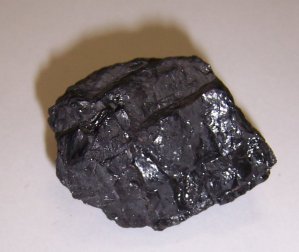
CoalLump-300Wide.jpgMy friend George Ott surprised me with a lump of coal yesterday morning, after church over at St. Raphael’s. He even wrapped it and put a ribbon on it! I could barely stand the wait to get home and check its resistance. And (drum roll, please) the lump is…an insulator.

Or a damned reasonable facsimile. With my DVM set on its 20 megohm scale, the resistance didn’t read at all, even with the probes set pretty firmly in the coal about an eighth of an inch apart. I tested at eight or ten different points on the lump, since carbon is funny stuff generally and coal is not a uniform substance. The DVM reads a 10 megohm resistor right on the money, and failed to read a 22 megohm unit. I use that DVM a lot and certainly haven’t seen anything wrong with it. But no matter how close I set the probes, I got no reading at all.

I put the lump against my belt sander and ground a flat face, which was interesting in terms of the tarry smell that came off the lump. No difference. I whacked a corner off the lump with a coal chisel. No difference, even on the fresh and very shiny fracture face. With the clean and very sharp points of the probes no more than a sixteenth of an inch apart, the resistance was higher than 20 megs. Wow.

I’m not enough of a rockhound to know what sort of coal it is, and George didn’t know either. (He got it from a blacksmith who fires his forge with coal.) It looks like anthracite in that it’s quite shiny, but beyond that I just don’t know.

Another of my readers is sending me a sample of both anthracite and bituminous, and that may help. Some of the online sources I’ve read describe coal as a semiconductor, but I think by that they only mean a substance with significant resistance. I’ve seen nothing to indicate that some types of coal would be insulators across very small fractions of an inch.

However, among other projects I hope to get to this winter is a crystal detector lashup, steampunk style, on an oak base with a copper pipe cap to hold a mineral sample for testing as a cat-whisker detector. One doesn’t think of coal as a candidate, but it certainly won’t take much work to do the science!

Basement Hydraulics

SunkSlab-500Wide.jpg

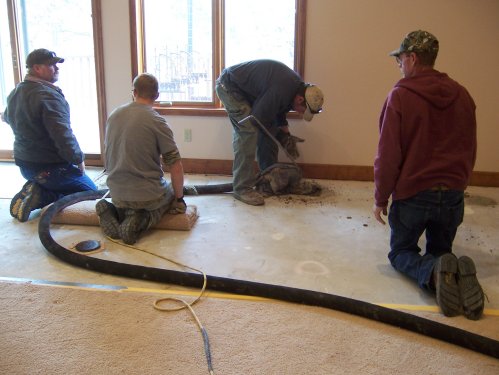
Talk about a weird feeling: I stood downstairs in one of the bedrooms after the mudjacking crew had drilled six 1 3/4″ holes through the 6″ slab and down almost two feet into the soil. They stuck a hose as thick as my arm through each of the holes in turn, forcing liquid concrete into the soil. Once all the holes had gotten a dose, the hose was moved to a hole near the north wall, and the crew boss pressed the pump button once, twice, three times.

I watched as the slab rose smoothly, almost half an inch in the space of two seconds. Whoa.

It’s been a messy, dusty, ad-hoc sort of project. In summary: They drill a number of holes through the slab. (In our case it was seventeen.) They pump liquid concrete (“mud”) through a hose into the soil and/or voids under the slab. The voids fill up as the soil rises beneath the slab. Eventually, with no more voids to fill, the pressure of the liquid concrete lifts multiple tons of concrete slab back to where it was before it began to sink. The liquid concrete stabilizes the soil beneath the slab, and with some luck we won’t see the slab settle again.

There were a few weirdnesses. Here and there liquid concrete forced itself up between the slab and the stem walls (and out of a few of the holes as well) like a glistening blob in a third-shelf horror movie. The bathtub didn’t quite return to its former position and may have to be pulled and re-set.

Still, as best we can tell, the operation was a success and the patient not only survived but rose from the dead. There’s much mess down there still, with plastic taped up all over the place and my fiction and magazine stacks all boxed and inaccessible, but the flaw that precipitated the whole business has at least been dealt with. Given that we had to empty the rooms completely, we decided to pull the carpet and replace it. And with the carpet gone, there’s no reason not to re-paint. Carol has been meeting with decorators. I’m designing a new layout for the furniture. It will have been a huge amount of work (and way, way too much money!) but when we’re done, the lower level will look very good.

More on the project as it happens. The wind you heard through the pines last night, however, was a massive sigh of relief.

I Want a Piece of Anthracite for Christmas…

Yes, I want a lump of coal for Christmas. Two actually: Santa, if you’re listening, see if you can get me four or five ounces of a good glossy anthracite, and a similar quantity of mid-grade bituminous. I’m not sure where else I’m likely to find it. (Ok, ok, eBay. Last resort…)

I haven’t been bad. I’ve been curious.

A question occurred to me the other day while I was hauling boxes around the lower level: Does coal conduct electricity? And if so, how well? I know that carbon does, but of course you have to specify which kind of carbon. Diamonds do not conduct electricity. Carol’s engagement ring is big enough for me to have put an ohmmeter across its large facet thirty-odd years ago. The carbon rods running down the centers of conventional carbon-zinc batteries conduct very well. Mechanical-pencil lead conducts electricity. Resistors, in fact, were basically painted lengths of pencil lead until relatively recently.

Coal, now. Hmmm. I would run downstairs and do the science right this minute, but I’m not sure I’ve held a piece of coal in my hand for forty years. Uncle Joe Labuda burned anthracite in a coal stove to heat his flat down Back of the Yards around 1960. I was fascinated by the lumps of coal in the bin behind his stove for their luster and even more by their smell, which was a less acrid form of the coal smoke that hovered over the neighborhood all winter, at least until people started installing natural gas space heaters.

Online research suggests that the resistance measured across the thickness of a one-centimeter cube of anthracite runs from the mid-hundreds to low thousands of ohms. That suggests that sand-grain sized particles of coal could be used to create a carbon button microphone. My friend Art Krumrey actually did this circa 1963, by beating on a carbon rod yanked out of a dead flashlight battery, and loading the grains between a soda bottle cap and half of one of the thin steel puck-shaped containers that large rolls of Scotch tape used to come in. He basically duplicated the circuitry of a primordial telephone connection, and we sent our voices over fifty feet of wire without any active devices at all, just a few dry cells in series with the cobbled-up carbon mic and a pair of dynamic headphones. It was boggling how loud the audio was, so loud that it overloaded the headset unless we spoke in practically a whisper.

This was how telephone systems worked before amplifier tubes were invented: The voice audio signal coming out of the carbon mic was already high-level, being a variable resistance in series with a high-current power source. In fact, electromechanical repeater amplifiers were created by mechanically coupling a dynamic earpiece to a carbon button mic. With decent batteries to drive the system, repeater chains like that could carry voice signals hundreds of miles without a vacuum tube in sight.

What I really want to know is whether a steampunk-era garage inventor could have created a usable carbon button mic using granules of coal, of if purer carbon would be required. If I can find a lump of coke that might work better, and turning coal to coke is not exactly alchemy. (I’m not sure I want to do it myself.) If the resistance of a lump of good anthracite were low enough, it could also function as the cathode of a carbon-zinc primary battery, which would be interesting all by itself. Water-cooled carbon mics the size of pie pans were used in series with high-speed alternators to generate voice-modulated RF before the advent of RF power tubes. It’s a delicious steampunkish concept, full of sparks and ozone and odd things turning too quickly for their own good.

Of course, I have a Drumlins World story concept that involves simple electromechanical wireless voice transmission systems. The sinister Bitspace Institute has a very secret radio communications network, and when a pair of spindly teenage boys independently invent spark radio, well, interesting things happen–especially when you throw a few drumlins into the mix.

Still taking notes, but even a few ounces of good coal could make for some interesting experiments, just as my steampunk Geiger counter did last year. Once the lower level is done I hope to lash something up to measure the effectiveness of different kinds of carbon granules in microphone service. Whether the story itself gets written or not, I expect to learn something, and that’s good enough for me.

Behold the EggMcSpamFin!

EggMcSpamFin-500Wide.jpg

The place is a mess. Not as messy as it’ll be by tomorrow night, but it’s still a mess. The movers got everything transferred to the uncarpeted portions of the lower level yesterday, and the carpeting has been pulled up. Plastic tarps are all over the place. Tomorrow the drilling begins.

lilfrypan200wide.jpgIn the meantime, when Carol and I broke for lunch an hour ago, I tried something completely different. I scrambled a single egg in a bowl, dumped some butter into the little one-egg fry pan that I’ve had for years (left) and with the burner on medium made a scrambled egg disk. I then threw a Bay’s English muffin in the toaster, and while it was toasting I broke open a Spam Single onto a Corelle plate and heated it up to a nice sizzle in the microwave. When the muffin came out of the toaster I buttered it good and proper, threw the scrambled egg disk on a muffin’s lower half, lowered the sizzlin’ Spam Single onto the egg, and then slapped the muffin lid on the whole business.

Damn, that was good! Cheap, too, as lunches go. Eggs are about 20c each. Spam Singles run about a buck. A single Bay’s English muffin costs me about 40c. Might have used a nickel’s worth of butter. Total $1.65. Almost entirely sugar-free. Filled me up completely and will probably carry me all the way to suppertime without any need to snack. It would be less fattening without the English muffin, but try as I might, I can’t do completely without English muffins.

Highly recommended.