Jeff Duntemann's Contrapositive Diary Rotating Header Image

Daybook

Descriptions of what I did recently; what most people think of when they imagine a “diary entry.”

Out, Out, Damned 2012!

I think we misunderstood the Mayans. (Like that’s hard?) They weren’t talking about the end of the world. They were telling us to hang in there: The end of 2012 was at hand. I’d drink to that, and tonight I probably will.

Boy. I’d like to wash this year right out of my hair–and I don’t have a whole lot of hair.

I had had high hopes of relaxing on the shores of Lake McConaughy with a kite string in my hand and one foot in the water on the day I turned 60, but no: Damfool Colorado had to catch fire. Jimi Henton fled to our house with all her dogs (and two of ours) when the smoke got too thick at her place, and while no one we knew well was injured or lost their homes, it was a near enough thing, especially having seen it on the news from 1100 miles away.

Deaths and serious illnesses continued to whittle away at my circle of friends. A lot of that simply happens as you climb into your sixties, but that doesn’t mean I have to like it. It was unnerving to check the Facebook page of a woman I knew in college, only to find that she had died over a year ago. Other good friends had open-heart surgery, cancer surgery, and lesser but nonetheless confounding failures in the meat-suit machinery. Indeed, I had a few of my own.

Then of course there was the tribal hatefest we call elections, when people I thought I knew gave themselves over completely to a species of slobbering, eyes-rolled-back-in-the-head rage against The Other that was terrifying to behold. This is the way that genocide begins, and I was under a pall until it was over. Even then, it took weeks to shake off the depression. And even now, there are a few people who simply will not let it go. It’s a psychological truth that I originally found in Colin Wilson’s writings: Once we grant ourselves permission to hate, it feels good and is devilishly hard to give up.

I know it makes me sound like a crank, but maybe it’s a cause worth cranking on: We must stop this national orgy of partisan hatred.

I guess there were some upsides to 2012. I finished my first full-sized novel since 1999, and only the second I’ve done since high school. My nephew Brian proposed to his beautiful girlfriend of many years, Ali, and we have a big-bash wedding to look forward to next September. I gave my accumulated hoard of Lego to our nieces Katie and Julie, and they’re loving it. I continued to be startled by the richness to be found in loving Carol, as I have now for 43 years. (I’m fond of saying that I fell in love with her half an hour before I even met her.) QBit still jumps into my lap whenever he can. I’ve made new friends (particularly in my Thursday night writing group) and rekindled my love of Pascal programming, now that Lazarus is ready for prime time. We threw a couple of nerd parties that people are still talking about.

2012, bleahhh. I’m going to go downstairs and watch a movie with my forever girlfriend, and toast to Lady Julian with a glass of Roscato wine and a slice of Lou Malnati pizza. Hope heals. Stomach lining regrows. Scar tissue means that you weren’t hiding behind the couch the whole time.

Cut to the chase: All manner of thing will fersure be well. But man, the bottle of Advil is empty.

Continuity Pass

I should never promise anything “tomorrow.” Most of the time, the universe conspires with itself to make a liar of me…as it did this time.

Anyway. I have just completed the second pass through Ten Gentle Opportunities. It’s what I call a “continuity pass.” The goal is to ensure that the story makes reasonable sense, taking particular care to repair “plot holes.” It’s not really a polish pass. In a very real sense it’s a tech edit, like those I used to do on magazine articles and still do on book-related material from time to time. Here are some of the things I watch for, and fix when found:

  • People, things, or ideas introduced early in the story but never mentioned again. We all know that stories grow in the telling–but they also contract, and in doing so early elements sometimes get squeezed out. This is especially important in stories (like this one) that took a long, long time to tell.
  • Things introduced later in the story that are not “foreshadowed” and thus may strike the reader as a complete surprise, or (worse) deus ex machina.
  • “Jumps” in a character’s emotional state. Growth and change are important in characterization, and have to be done out where the reader can watch them happen. If a character changes too abruptly, or off where the change can’t be seen, it sounds hokey.
  • General inconsistencies in the ways people and things are treated early on in the story vs. later in the story.
  • Finally, to make sure that all the made-up words are spelled the same way throughout. (This isn’t trivial when the story contains proper names like Ttrynngbrokklynnygyggug and Jrikkjroggmugg.) I originally coined a lot of proper names from Stypek’s universe that had no vowels in them at all, but in workshopping chapters I found that nobody thought this was amusing but me. (Maybe I was a little too impressed with the famous 90’s gag about Clinton air-dropping vowels on Bosnia.) I went back and added just enough vowels to suggest a pronunciation.

There is still polishing to be done, and here and there some stiff rewriting. I simply don’t like Chapter 57, for example. I intend to rewrite it from scratch once I get a little emotional distance from the story. As it’s only 1200 words, the rewriting won’t take long. The rest of the polishing to be done involves watching for “echoes” (words used more than once a little too close in the manuscript) and probably eliminating some adverbs, though I think the current campaign against adverbs is a deranged fetish perpetrated mostly by bad writers and people who teach writing without writing much of anything themselves. Polishing is a separate pass and my next challenge. Much of the first half of the book has already been polished (I’m a compulsive polisher) so the pass won’t take long.

I’ve sent the story to my beta testers, and now I’m waiting to get some reactions. In the meantime there’s a root canal in my future this Wednesday morning. It’s nothing I haven’t known about for some time, and I’ve been through enough of them to have a reasonable idea what I’m in for. One peculiarity of my biochemistry is that the nitrous oxide gas used as a calming agent by some oral surgeons simply doesn’t work for me. The surgeon doing the procedure has an office with an interesting gimmick: flat-panel TV sets in the ceiling, so that while he’s drilling out your molar you can lean back and watch Raiders of the Lost Ark. As for the inevitable anxiety in the runup to a root canal, I suspect that ativan steps in where nitrous fails. We’ll find out on Wednesday.

Explicit. Expliciat. Ludere Scriptor Eat!

This morning, almost three months late, I found myself writing the last words on the first draft of my novel Ten Gentle Opportunities. The final line (not counting the epilog, which I wrote months ago) is “Let’s talk.”

So let’s.

Back in 1980, as part of my programming job with Xerox, I was given a tour of the assembly line for the new model copier that my software system was tracking. It was a fascinating business. There was some automation but not a lot. Copiers-in-progress moved along a line, and people bolted/connected things to them, just like Model T Fords. Forklifts and electric carts were running around, carrying pallet loads of parts and subassemblies and lots of other stuff I couldn’t identify. At the end of the line there were ranks of completed model 3300 copiers, waiting to be tested and then plastic-wrapped for shipment. The building holding the assembly line was ginormous, and the interior space was fifty feet high or more.

Given the space it was in, the line seemed awfully, well, two-dimensional.

I’m not sure when I got the idea, exactly, but if the assembly lines of the future are going to be completely robotic, with few or (ideally) no humans standing around while the line is running, why carry parts around on carts? If you can make robot hands good enough to bolt copiers together, you can make robot hands good enough to pitch and catch. Sure, a baseball is an optimal case, but with enough compute power, you should be able to throw a circuit board, a subassembly, or a whole copier from one point to any other point on the floor. Damn, I thought, there’s a story in that somewhere.

The next year, I wrote it. The story was called “Paradise Lased.” It was about such an assembly line, controlled by an experimental AI called Simple Simon. In the story, the copiers have AI too, and one of them comes back for warranty repair with a truly peculiar problem: The copier thinks it’s God. In a corner of the factory, the control head is pulled off the copier so that the rest of the machine can be refurbed and resold. Through a high-speed wireless network, the delusional control head worms its way into the consciousness of the many dimwitted robots in the factory, demanding that they worship it. Simple Simon, being smarter than the robots, refuses. God the Copier declares war.

I finished the story, but never tried to sell it. Even as young and green as I was (29) I knew it was thin gruel. Mostly it was an excuse to imagine an entire robotic manufacturing ecology, and make a little fun of what I considered the extravagantly optimistic AI predictions bouncing around Xerox (and many other places) at that time. There was a human character in the story (one!) but he was just a walking point of view. The story was really about Simple Simon the AI. I was so enchanted by robots throwing capacitor joule grenades and eventually whole copiers at each other that I gave the human character almost nothing to do but run away from the robots and listen to Simple Simon complain. I tossed it into the trunk with an interior vow to do something better with it someday, ideally before it came to pass.

It took two more tries and 31 years, but I did it.

More tomorrow.


By the way, the Latin title to this entry is not my own; I can only dream of knowing Latin that well. It comes from Michael Covington, who offered it when I announced on Facebook this morning that the first draft was finished. Translation:

“It ends. Well does it end. Let the scribe go play!”

Indeed.

Spam Supposedly from Facebook Friends

As mysteries go this was small change, but I stumbled across its solution earlier today: spam nominally from Facebook friends. I’ve been getting a recognizable species of link spam every day or two for a couple of months now. The From: field always contains the name of someone I know. The From: email address, however, is unknown to me and does not belong to the person named. The Subject: field is short and nondescript, like “Hello”. The body of message is brief and follows this form:

super http://spammityspam.spam/goosebrow/53zappovat/

11/21/2012 10:33:27 AM

The From: email address is always a gobbledegook address from a big email service like Hotmail or AOL. There may be two or three words before the link, but no more than that. The link destination is different every time. I don’t know, don’t care, and don’t intend to find out what’s at the other end of the links.

I first assumed that someone I knew had gotten his or her address book hijacked by a trojan, which has long been a common practice when a machine is hacked. The interesting thing was that many of the people didn’t know one another at all. (I asked a few of them.) My next thought was that my own address book had been hijacked, except that two other people (out of eight or nine spams that I had tucked away to examine) were folks for whom I did not have and never had an email address. It took awhile for me to realize that the only common element was their presence in my Facebook friends list.

Bingo.

I sniffed around and found a nice description of the problem on CNET. In short, there was a Facebook vulnerability that allowed a scraper to lift the names (but not the email addresses, nor any private information) from my facebook friends list. Facebook has fixed the vulnerability, or claims to have fixed it. Facebook being Facebook, however, I’m sure there are plenty of others down there in the morass.

Given that over half of the posts in a recent sample of my friends feed today were idiotic or hate-filled images (many images consisting solely of words, which is idiocy cubed, and sometimes words too small to read, which is idiocy to the seventeenth power) I wonder sometimes why I bother.

One Big Band-Aid

Where have I been? Healing. No, I didn’t break anything. (I did floss one of my crowns right out of my mouth last Saturday night. Note to self: Popcorn hulls don’t hide very hard. Back off on the shear force a little.) What I did is watch a number of people I’ve known for some time, including a few that I nontrivially care about, soil themselves hurling hatred at entire groups of people they’ve never met and pretty clearly know nothing about. It almost made me quit Facebook for awhile, though it’s a little unclear how one actually goes about quitting Facebook. (The account of a woman I knew in college is still there even though she died two years ago.)

Reading that stuff hurts. Am I nuts? Maybe. I value friendship, for one thing, and for another, tribal hatred is the first step toward genocide. Giggle if you want. Years of research into tribalism, psychology, history, and our killer ape origins suggests that it’s true. I would write more about it except that knowingly hurling yourself into depression is pretty much as dumb as it gets.

Furthermore, it stopped Ten Gentle Opportunities dead in its tracks, at least for the time being. Am I annoyed? You have no idea.

So I’ve been spending a lot of time in my big chair, reading things that have nothing to do with elections as a way of putting a sort of giant band-aid on my soul. It’s been a mixed bag. Some quick notes:

  • Train Wrecks by Robert C. Reed. (Superior Publishing Company, 1968.) If you need steampunk mayhem in a big way, find this on the used book sites. Virtually every way that locomotives and rolling stock can die are well-represented, including a few that you’ve probably never heard about. This might even be depressing if I didn’t like trains (and steam power) as much as I do. (It also made me damned glad I live in 2012 and travel in a Toyota.)
  • Wicked River: The Mississippi When It Last Ran Wild by Lee Sandlin. (Pantheon Books, 2010.) Still working on it, but what we have here is a collection of colorful anecdotes about the Mississippi from 1800-1863, when it was dredged for reliable river commerce. Pirates, floods, storms, and the New Madrid earthquake. I paid a buck online. Worth ten times that. (Maybe not twenty.)
  • Marry Him! by Lori Gottlieb. (Dutton, 2010.) Meh. Short, breezy read extending (a little) what I read in an article in The Atlantic some years back. Got it cheap in the B&N bargain bin, which suggests that it bombed. No surprise, given that the author is basically shouting “Attention princesses! We are currently experiencing a severe prince shortage. Please select an archduke or viscount while they are still available. Thank you.”
  • Electric Radio Magazine. Jack Smith K8ZOA sent me twelve years of this stunning little monthly, from 2000-2012, and I’ve been savoring them in my loose moments for several weeks. The focus is vintage ham radio gear, especially AM phone, which I would be doing more of if there were people close by to do it with. I still have a working Sixer, Twoer, 99er, and a G28, plus a couple of other things on the shelf that need work.

Carol and I spent some time in Chicago. Our niece Katie turns six next week and we bought her what my sister described as “an RC helicopter in a hamster ball.” It’s an Air Hog Heli-Cage, which has a pair of thin plastic hoops around it, like an equator and a prime meridian, which keep crashes from becoming too serious. Needless to say, in the hands of a not-quite-six pilot, the bands earned their keep. It was amazing how quickly both girls learned to fly it, including Julie, who’s only four. My brother-in-law Bill is even better, and landed the gadget on one of the blades of his livingroom ceiling fan. Wow.

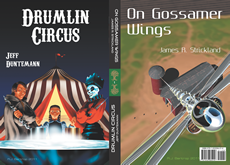
Now, RC helicopters are fairly easy to describe. Not everything is. One evening, my older nephew Brian and his fiance Alexis twisted my arm into watching a YouTube video called “Gangnam Style.” Words fail me. Most of the song is in Korean, except for a peculiar Greek-American interjection, “Opa Gangnam Style!” plus “Hey Sexy Lady!” here and there to prove that computer audio is working correctly. I was impressed by the young Korean chap at about 1:50 who was dancing energetically in an actinic yellow leisure suit. I didn’t know you could lase polyester. Most boggling of all was the fact that the video has been downloaded 693,000,000 times, plus or minus a significant fraction of humanity. I caught myself wondering what it would be like if seven hundred million people had read Drumlin Circus. I would probably have a new minivan–and little or no trouble selling Ten Gentle Opportunities.

Anyway. I’m better now. I’ll have nothing more to say about the election except for one very peculiar thing, which I will take up as soon as I understand it a little better myself. Hint: There may be a stoner stampede into Colorado next year.

In the meantime, I have a pop song to eject from the inside of my head. Listen at your own risk. About all I can say is that it’s better than listening to politics on Facebook.

My Hair Is ( Finally) On Fire

I’m certainly behind schedule. I’m modestly over (word) budget. I’m still wracked by doubts as to whether the whole loony concept makes sense. But today I experienced a breakthrough, and finally, as Jim Strickland so wonderfully puts it, began writing like “your hair is on fire.” My final, trademark Jeff Duntemann mayhem-filled action climax is well underway. I hope to finish it (and thus the book) in less than a week. To do that, my hair will have to be on fire and remain on fire for a little while longer.

I’ve done this before. I’ve actually done it a lot, which may, at least in part, explain my hairline. In my system of measurement, one “Writing Like Your Hair Is On Fire” unit is equal to 2,000 words captured in one 24-hour period. In my history as a fiction writer, I’ve achieved as many as 2.7 WLYHIOFs. In nonfiction I’ve managed 4.5–and that was back when my hair was vanishing at 40% the speed of light. No wonder.

Ten Gentle Opportunities has been an excruciating project for a number of reasons. It’s humor, and humor is hard. More than that, it’s a love story. It’s actually either two or two and a half love stories, depending on which Love Story standard unit you use. I’ve never written a love story. Now I’m writing two and a half of them, all at once. For the love stories to make sense, I also have to include an AI sex scene. It’s actually an AI menage a trois…but before anybody gets bent out of shape, I need to add that the AIs remain fully clothed throughout (Simple Simon is incapable of removing his clothes) and no naughty bits are mentioned whatsoever. Among humans, sex (as my mother so often insisted) may well be chemistry. Among the AIs of the Tooniverse, it’s undocumented kernel call 105.

For the past ten days I’ve been gnawing on the love story problem, writing a few hundred words, then yanking them out and writing another (different) few hundred words when the first batch didn’t look right. Humorous or not, I’m trying very hard to create characters with some depth to them, which means that character and relationship arcs are important. In this kind of writing, you can’t just reach for the starships anytime you get bored with the people. (I’m famous for that.) I have a plan, and I’m stickin’ to it. If it means blowing my self-imposed deadline, so be it.

As for the hair, hey: There is life after hair. I’m living proof.

Worldcon Wrapup

2001lostsciencecover.jpgIt was a relief to step off the plane in Colorado Springs and grab a chestful of thin, dry air. I’ve lived in dry climates since early 1987, and I’ve lost my taste for late-summer Chicago mugginess. The toughest part of Chicon 7, which concluded on Monday, was going back and forth across the Chicago River between the Hyatt and the Sheraton and wondering if I were walking above the river or wading through it. The con went very well, considering my aversion to crowds. I got to see a lot of people I don’t see very much, granted that I missed a few. I heard some readings and workshopped a couple of stories with my friends from the 2011 Taos Toolbox workshop. And the Hugos, which I haven’t seen in person since (I think) 1986. John Scalzi was easily the best Hugos toastmaster I’ve seen since I began attending worldcons in 1974. He was funny, he was terse, he was great at improv, and he held the awards for the winners as they spoke their thank-yous into the mic. (There was nowhere else to put them.) He’s losing his hair and doesn’t shave his head–he certainly gets private points from me for that.

I was not aware of it at the time, obviously, but a misguided attempt at automated copyright protection killed the stream that Chicon was sending out to people who couldn’t be at the con. This was idiotic on so many levels–the video clips being “protected” had been given to the con by the studios specifically to be shown at the awards–and reminds us that robots should not be enforcers. Never.

The very idea of copyright, on which artists in many areas depend, is being weakened in the public mind by crap like this. If something eventually kills copyright, it won’t be the pirates.

I had a marvelous interview with the fiction editor at a major press, at which he agreed to read the manuscript for Ten Gentle Opportunities. Better than that, he took notes on my experience and my background (I brought both The Cunning Blood and one of my computer books) and suggested that what he might like even more from me than a humorous fantasy mashup was a good ripping hard SF action adventure.

I wondered for a moment: Gosh, could I do that? (Only a moment. A short moment. Ok, no moment at all.) I had intended to pursue my first Drumlins novel The Everything Machine after TGO was on its way. Now, I’m not so sure. The Molten Flesh is less far along, but it may get promoted to the top of the queue. We’ll see.

I did spend a fair bit of time with my sister and her girls down in the dealers room. (She and Bill publish and sell filk CDs as Dodeka Records.) As usual, I did a little shopping, emphasis on little. (We didn’t drive, so whatever I bought had to be packed home on what I call a “sewer-pipe jet.”) But I found something wonderful, as Dave Bowman notably said in 2010.

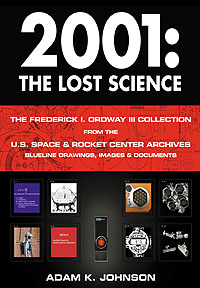
Across the aisle from Dodeka Records was Apogee Prime, a publisher specializing in aerospace books in several categories. They had a new book that, at 12″ X 14.5″, was mighty big for my creaky old suitcase, but I bought it anyway: 2001: The Lost Science. What we’ve got here are original photos, sketches, and literal blueprints of the technologies presented by Stanley Kubrick in 2001: A Space Odyssey. Much of the material was thought to be lost, and when the sequel 2010 was filmed in the early 1980s, a lot of it had to be re-created from scratch, often by having artists watch the original movie fifty times with sketchpads in their laps.

The book draws on the personal collection of Frederick I. Ordway III, who is a real rocket scientist and former colleague of Werner Von Braun, and worked on the Explorer 1 project. Kubrick hired Ordway to help him predict, as reasonably and realistically as possible, what space science would be like in the year 2001. This book is a good overview of his predictions, at least those that made it into the 1968 film. Satellites, space stations, nuclear propulsion systems–these were the aches that a certain class of nerdy 16-year-olds were feeling in 1968. For a good many reasons, only some of which I’ve discussed here, 2001 has long been and will likely remain my favorite film of all time. I remember those aches, and wear them proudly, as they are the aches of boys who dare to dream.

This is a coffee table book, but one that you may actually read cover-to-cover. (I’m not quite done but will be soon. There have been times when I’ve had to take a deep breath and set it down.) Softcover. $49. Very highly recommended.

Peace Through Superior Flier-Power

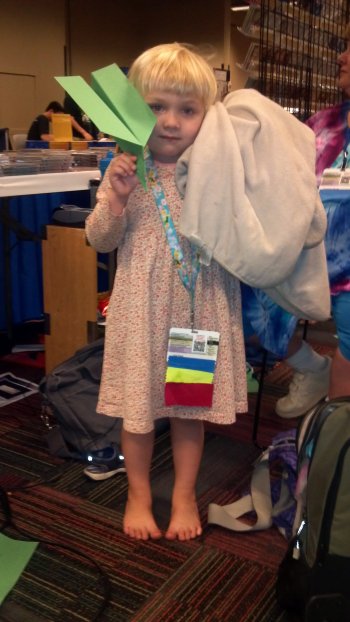
Julie At Chicon-350 wide.jpgWorldcon, Day 3. I spent a goodly chunk of today helping Gretchen and Bill at their tables down in the dealer room. Part of this involved distracting Julie (my younger niece, age 4) who was bored and making Gretchen a little nuts. Her sister Katie is old enough to go to the kid programming room by herself; Julie still needs an adult escort, and will accept no substitutes for Mommy. Mommy, alas, had a table to run.
We did our best. I showed Julie how to make a paper airplane from a sheet of green construction paper and two paperclips that had been hanging out in the bottom of my briefcase. We got us a decent airplane together, and I tried hard to persuade her that aviation is more finesse than brute strength. She had a tendency to want to wind up and throw the plane with all her might; after a few demos she seemed to pick up on the fact that a little thrust in a straight line will work better than a roundhouse discus hurl. The plane flew, Julie was delighted, and Mommy got some much-needed peace.

All in the greater cause of growing up. My older cousin Diane taught me to make paper airplanes as well as other things, like pumping a swing. I was older than four, too. My catalog of Uncle Jeff Tricks is both deep and broad, but most require a little more physical maturity than either Katie or Julie have just yet.

I did notice with considerable pleasure that Katie was building things out of mainstream Lego (not MegaBlox) in the kid programming room. There is a Lego hoard in a corner of my workshop, awaiting the proper time. That time is coming soon.

Again, much of a good con is conversation, and I had quite a bit of that. I even spoke briefly with Harry Turtledove at his signing for Every Inch a King. I stood in awe of Steve Jackson’s creation called “Steampunk Chaos,” which is a sort of huge Rube Goldberg marble-track thingamajigger with a steampunk flavor that Steve has been assembling now for several years. He evidently builds a core machine and then invites bystanders to dig into his boxes full of loose parts and extend it. Most of the extenders were young teen boys, and by all accounts they were having a marvelous time. I took photos but none really captures the geeky bronze (painted) awesomeness of it all.

The crowds at Worldcon this year seem a little thin, both to me and to others that I spoke to this afternoon. Rumor has it that the organizer of DragonCon explicitly pledged to drive the SF Worldcon into the sea by siphoning off younger congoers, and he may well be succeeding. The response, of course, would be to hold Worldcon a little earlier, prompting at least some people to attend Worldcon first and exhaust their resources before DragonCon. That may or may not work, but the graying of Worldcon was painfully obvious, and it would be well worth a try.

More visiting tomorrow, maybe a little more shopping, and a long-awaited chance to pitch Ten Gentle Opportunities to a major publisher. Stay tuned.

Harry Harrison, Gentleman Atheist, RIP

65,000 words. This is still hard. But I am damned well going to make it work.

One reason I will make it work is a man who left this world today for other worlds, not that he was any stranger to other worlds. Harry Harrison is one of those guys who isn’t appreciated as much as he deserves, for reasons that escape me. Most people know of him for Slippery Jim Di Griz and little else. We forget that his story Make Room! Make Room! inspired Soylent Green. Almost nobody knows that he wrote the Flash Gordon newspaper comic strip in the 50s and 60s. (I didn’t know it until I read his obituary.) And I’m amazed that more people haven’t read what I consider just about his best work, The Daleth Effect. And what I do consider his best work may not be everybody’s choice, but too bad: The Technicolor Time Machine beats all.

When I was fresh out of the Clarion SF workshop in 1973, I cleaned up a Clarion story of mine and sent it to him. He bought it for $195, and when it appeared in his anthology Nova 4 the next year, I was (finally!) a published SF writer.

The story was “Our Lady of the Endless Sky,” now in my collection Cold Hands and Other Stories. It’s about a slightly clueless Roman Catholic priest who manages to be sent as the Catholic chaplain to a church constructed on the Moon. When an industrial accident destroys one of the lunar base’s hydroponic gardens, a new garden is built under the transparent dome of the church. Father Bernberger is heartbroken. He’s lost his church…or has he?

It was a decent story for something written by a 21-year-old kid who was “young for his age.” But far more remarkable than that was the fact that Harry Harrison bought it at all. You see, Harry was an atheist, and said so as often as it took for people to get the message. So why would he buy a story about religion?

The one time I met him, at the SFWA reception at one of the late 70s Worldcons, I thanked him for buying the story, and asked him exactly that. (All the SMOFs had told me about him being hostile to religion.) He laughed and said, “It wasn’t about religion. It was about a man who had faith.”

He told me to keep writing. I did.

Now, I’ve taken a lot of kidding and scolding and eye-rolling down the years for being such a naif as to go to church every Sunday and even (egad) pray. I’ve seen a lot of desperately mean-spirited condemnation not only of religious nutters (as though there have never been atheist nutters) but also of the quietly religious people who tend the sick and feed the poor without making any attempt to convert them, nor saying anything more about it.

None of that from Harry Harrison, at least not that I’ve ever seen. He was a gentleman atheist who gave me a push by publishing my story about a church and a priest, even though it went against the grain of his personal philosophy. He shook my hand and told me to keep going. He wrote good, engaging yarns that made me gasp and made me laugh, yarns that I freely admit to imitating. He is one reason (though not the sole reason) that I will not condemn atheism as my species of Catholicism is sometimes condemned.

Godspeed, good friend, however you may understand the wish.

Whosever Language This Is

This doesn’t happen too often, but today it stopped me cold: I was writing a paragraph from Ten Gentle Opportunities and couldn’t decide which of two usages was the right one. When there are two ways to say something, I generally have an intuitive sense for which is the more correct way, based on what I’ve read as much as what I’ve learned of proper grammar. This is one of the benefits of reading much and broadly.

Today I got stuck between two usages that both felt a little wrong, and both almost precisely the same measure of right. Here’s the sentence in question, done the way I learned it way back in the Precambrian:

Carolyn stabbed the End Call button, and rose to go fetch her intern, or whosever intern he was.

It sounded a little off. The other way also sounded a little off:

Carolyn stabbed the End Call button, and rose to go fetch her intern, or whoever’s intern he was.

My (moldy) style books all say “whosever” but I hear “whoever’s” a lot more in recent writing. I think what we’re seeing here is a usage at the tipping point. In a few more years, “whosever” will become an archaism, and people will look at you funny when you say it.

Is this good or not? I don’t know. Language evolves; sound and sense and all that. About the only thing I’m certain of is that I’m old. But I knew that.