Jeff Duntemann's Contrapositive Diary Rotating Header Image

Reviews

Evaluations of products and services

Taos Toolbox 2011, Part 1

SnowBearLodge500Wide.jpg

I got home yesterday afternoon, and the smoke is still coming out of my ears. I haven’t posted here recently because it was all I could do to stay ahead of the coursework and the critique. My friend Jim Strickland described it as “a 500-level course on the art of the novel crammed into two weeks.”

That’s putting it mildly.

What I’m talking about is Walter Jon WilliamsTaos Toolbox writers’ workshop, which just concluded yesterday morning at the Snow Bear Inn at Taos Ski Valley, New Mexico. The workshop was taught this year by Walter Jon Williams and Nancy Kress, with a guest lecture by Jack Skillingstead. Jim Strickland drove down from Denver Sunday morning and stashed his car in our garage, then joined me in the 4Runner for the 225 miles to Taos. I took my completed steampunk computer table, to which I had grafted the Aethernet Concentrator scant days before we left. Carrying the table, the pipe legs, the Concentrator mast, a Dell GX620 system with 20″ monitor, an ammo can full of tools, plus clothes and a cooler full of food up the stairs from the parking lot took some doing, as we were at 9,800 feet. Mountain geek I may be, but one chases oxygen atoms like fireflies up there.

SteampunkWorkstation500Wide.jpg

This is not a workshop for beginners. Jim and I were two of fourteen students, of which I was the oldest. Not one was under thirty. Most of us had already sold one or more short stories, and at least three of us have sold novels. Jim has two novels in print (plus a short Drumlins novel), and astrophysicist Alan Smale was recently nominated for the Sidewise Award for alternate history. Christie Yant is Assistant Editor at Lightspeed Magazine. One had the sense of a mass of talent around the common-room table that could (with just a few more neutrons) go critical.

For two weeks we heard lectures, took notes, discussed the issues, and presented both written and oral critiques of one another’s work. Oh, and sometimes we ate and (more occasionally) slept. When we were not at the big conference table, we were back in our respective lairs, reading manuscripts and hammering on laptops or (like me) larger iron. All told, we each read and critiqued about 200,000 words of material. It took ten days for us to loosen up sufficiently to set aside time to crack a few bottles of wine and a bottle of The Kraken 94-proof dark rum. (This was highly appropriate, as student Jeffrey Petersen had presented a novel starring a giant…flying…squid.) Walter complimented us as being the hardest-working class he’s hosted in several years conducting the workshop. We worked so hard that almost nobody hit the hot tub. By the last day, Nancy Kress herself told the class, “I am just about out of words.”

Words. It was about words. It was about making our words do precisely what we want them to do, and then getting them into the hands of our readers. It was one of the most intellectually challenging things I have ever done. I left emotionally and physically exhausted and am still catching up. It was expensive, but worth every penny. It may have rebooted my career as an SF writer.

More tomorrow.

Lazarus, Stay Where You Are!

…because when you came forth, you stepped on my bootloader.

I’ve tried to like Lazarus. I’ve tried for years. I can only assume that (as also evidenced by its similarly screwy cousin, Kylix) there is something in the Linux platform that makes Pascal compilers go a little bit whacko.

A few days ago I installed the KDE Fedora Spin in a new partition on my Linux box. It’s been a good education in the Plasma desktop. Plasma is all very blue and cold looking (way too blue for me, in fact, though the default wallpaper is striking) but unlike my first taste or two of KDE 4, it actually works.

So I started installing the software I’m familiar with to begin using it, and somewhere down the list was Lazarus, the Delphi-ish GUI front end for FreePascal. The package available from Fedora was V0.9.28.2, which is considerably newer than the one I have installed on Ubuntu Lucid, and only a little older than the one you can get from the project Web site. After it downloaded and installed all of its enormous pile of stuff, it asked me to restart Linux. I did.

And grub failed to run.

All I got was a blinking text cursor in the upper-left corner of the screen. This is the first time I’ve ever seen grub fail, apart from the well-known habit of Windows to overwrite grub with its own bootloader. (This is why Windows goes in first, if you’re going to have it at all.) I booted the Ubuntu 11.04 live CD I’d burned a few days after it was released, just to see if my MBR had been damaged. As best I could tell it had not, but I’m not good enough at grub’s internals to really be able to tell what was wrong with the software itself. Since I had plenty of free space on the 750 GB drive, I just installed Ubuntu on yet another partition, hoping that its update of grub would put things right. And it did.

So why would installing a compiler and an IDE mess up the OS bootloader? (Anybody?) I don’t have a lot of clues. The copy of Lazarus I installed looks like it works as well as Lazarus ever does, so I can’t assume that something in the installer or the package glitched and overwrote something unrelated. None of the other partitions on the disk were affected, as best I can tell. I’m tempted to install Lazarus under Ubuntu, to see if it will stomp on Ubuntu’s copy of grub as well…but that will happen another day, when I’m not as busy and not so grouchy.

Fedora Spin: KDE Desktop

Sometime back I ran into a concept called Fedora Spins, which are customized Fedora installs with different desktops (KDE, LXDE, XFCE) or a slant in some direction like security, graphics, or games. I downloaded the KDE Spin ISO earlier today, burned it to CD, and this evening (having burned out on ebooks) took it for a…ride. I had 300 GB of free space on my Linux box, so there was no reason not to, and I’d like to get a little better at the KDE Plasma desktop.

Some reactions:

  • The Fedora partitioner is very good. I did a manual partition operation, and created a new 60 GB partition for Fedora, and a 12 GB swap partition. It helps to know a little bit about partitioners generally, but overall it was intuitive and gave me no trouble.
  • For some reason, Fedora installs grub with grub’s hiddenmenu option enabled. (It’s conceivable that I accidentally chose that somehow, but I don’t recall being asked.) This means that at boot time, grub’s menu isn’t displayed, and the system boots directly into Fedora. (The system already has Ubuntu Lucid and Windows XP on it.) You can get the boot menu by pressing F10 during grub’s timeout period, but otherwise you aren’t presented with an OS menu at all.
  • Fedora recognized the existence of my XP partition, but didn’t know what it was. In grub’s menu, XP is therefore listed as “Other.” However, if you select it, grub boots it just fine.
  • Fedora has a GUI bootloader configuration utility that allows selection of the timeout value and the default OS. However, the utility’s sole window does not have a Save or Apply button. You can make changes, but closing the utility throws them away. Wow. This is a bug, and not a brand-new one.
  • Unlike Ubuntu, Fedora does not automatically add the initial user account to the sudoers list. So try to do anything rootish like editing grub’s config file gives you that inane message “jduntemann is not in the sudoers list. This incident will be reported.”
  • Adding yourself to the sudoers list is seriously unintuive, but the best way is probably to use the visudo command, which opens a vi edit window with the sudoers list ready to change. Add USERNAME ALL=(ALL) ALL to the end of the file and save; it’s done. Details here.
  • Fixing grub requires editing the grub.conf file and commenting out the hiddenmenu option. While I was there, I also changed the description of the XP partition from “Other” to “Windows XP.”
  • A 2.8 GHz Dell SX280 does not have sufficient graphics chops to run Plasma’s desktop effects. I wanted to see just how slow they were, but within seconds of enabling desktop effects, Fedora disabled them again. I knew that the SX280 wouldn’t run them well from my online research (it’s one reason I’m getting a more powerful Linux box shortly) but I didn’t know the system would simply refuse to run the effects against my wishes. Interestingly, Ubuntu’s GNOME desktop effects subsystem works on the same machine.

Overall, getting to a usable configuration with Fedora is a lot more screwing around than with Ubuntu. But once done, it works well. More as I experience it.

Daywander

It’s half-past April. Do you know where your seasons are?

One of ours is missing. My nephew Brian and I woke up this morning to find a blanket of snow on Alles Street, and while Carol out in Crystal Lake reported less, it seems like everybody in greater Chicago got whitened sometime during the night.

So it was a good day to stay inside and continue my ongoing struggle with malformed epubs. I created a number of them a few years back when the epub format was new and the tools barely past primordial, and I’ve been meaning to fix their innards for awhile now. The tools are better these days. One I upgraded just this morning was Sigil, a (mostly) WYSIWYG editor designed specifically for epub-formatted ebooks. Version 0.3.4 (released March 8, 2011) is a huge improvement on 0.2.1, which I’d been using for some time, and if you haven’t upgraded yet, go for it.

Sigil 0.3.4 provided my first look at FlightCrew, an epub format validator created by the Sigil team to do a better job of what the EPubCheck utility does: Test to see if an EPub file is intact, structurally complete, and internally consistent. FlightCrew is installed with Sigil and can be invoked by clicking a button in the Sigil UI. It detects more problems than EPubCheck does, and will tell you things like whether a graphics object shown in the manifest is unreferenced, and whether any essential element of the document is missing. (For some reason, my older epubs had no <language> element, which FlightCrew caught instantly–and then Sigil fixed automatically.) Passing FlightCrew does not mean your epub file is perfect, but it does mean that it will probably render correctly in any epub reader written with half a brain.

Sigil is a good first step toward pure WYSIWYG epub development, and it still has a code view for things not yet doable from the GUI, or imported from an old or incompetent editor. I’m still fooling with my epub edition of Willibald Beyschlag’s The Origin and Development of the Old Catholic Movement 1870-1897, but it now passes FlightCrew and I should post it sometime in the next few days. Better news is that I got my epub of “Whale Meat” clean enough to make available on the B&N Nook store, where you can find it for 99c. The first Copperwood Double went live there today as well, and I’ll have a lot more to say about the project once the book is available on Kindle and in print, which should be within a week or so.

This is my first foray onto the Nook store (with Kindle coming up next) and I will say that the B&N PubIt system was trivial to figure out and use. It does come with some small weirdnesses: The book description and author bio fields for the Nook store give you no way to italicize, so if you mention your other books, you either have to uppercase them or just live with un-italicized titles. There’s also a check box for specifying when an ebook is public domain material, but B&N doesn’t make any distinction between works in the public domain and works derived from public domain sources. Beyschlag’s original article is in the public domain, but I’ve done some edits to make it read more easily, and I would like to retain copyright on the edited text. (This is legal and there’s nothing dicey about it.) I guess it’s not an issue of huge importance, especially if I don’t charge for it.

One thing I looked at today that I don’t recommend is NookStudy. It’s an app for Windows and Mac that establishes a 180-day rental market for ebook textbooks. There is no iPad nor Android version. The app is basically a DRM wrapper for Adobe Digital Editions, and to even install it you have to have an Adobe account. NookStudy ties rented textbooks to specific computers (a maximum of two), not to a user ID, and if you need to change out a computer, you have to do all the legendary begging and pleading that you have to do to move Adobe’s Creative Suite to a new system. Worse, when the 180-day rental period expires, all your marginal notes vanish with the textbook itself. Sniffing around online shows that almost no one is happy with the system, which is a buggy and extremely limited way to use some very expensive ebooks. (The rentals are about the cost of a used copy of the printed book.) It’s not usable outside the US because of longstanding geographic rights issues that plague many areas of book publishing. Publishers are obviously terrified of what ebooks might do to the textbook industry, and in consequence, NookStudy is 40% barbed wire by weight–and made me glad I graduated 37 years ago, when textbooks were printed on rugged stuff and would last forever.

Taking a Breath

This has been a helluva month. To finish Drumlin Circus I wrote 26,000 words in two weeks, and then by six days later had polished it, laid it out, proofed it, and combined it with a second short novel (by the formidable Jim Strickland) to make something book-sized, with a twist. (More on the twist in a later entry.) We’re now waiting for the cover art, and so for a day or two I’ve had a chance to pick up my office, read a little, run the dogs around, and ruminate on what I’d learned.

coincellgrab.jpgOh, and I bought a TV for downstairs. A TV. 55″ wide and 1.37″ thick (!!) by my digital calipers. Sure, I’d like a flying car. But this again reminds me that we really do live in the future.

The do-it list was getting long. I’ve needed to replace a couple of coin cells in the Dell USFFs we have here and at church for some time. In most PCs this isn’t difficult, but Dell put the coin cell holder in a bad spot, especially in the SX270. Pulling out the old cell, no sweat–that’s what God made needle-nose pliers for. Reinserting a new cell would be easier too, except that the pliers would short out the cell. So I put a short length of shrink tubing over one of the two jaws and held it over a match for a bit. Shazam! The cells survived the operation, and I broke no fingernails trying to coerce them in either direction. It’s a trick worth remembering if you can’t use your fingers to get coin cells into place behind that plumber’s nightmare of a heat sink you’ve got.

One of the things I had to do to write Drumlin Circus was adopt an older style for the first-person narrator, who is an educated city guy in an 1890s sort of culture, albeit one not on Earth. This isn’t normal diction for me and I had to train myself to do it, first by reading largish chunks of The Time Machine and Food of the Gods, and then by going back to Gene Wolfe’s boggling 5-volume New Sun saga, which I hadn’t been through in ten or fifteen years. Again, the complexity of the tale boggled me a little (as did more than a few of the words he repurposes but never invents) but this time I was ready: I had ordered Michael Andre-Driussi’s Lexicon Urthus and kept it at my elbow. It’s a 420-page index of terms, concepts, and proper names from the series, with not only their meanings in the story but also their derivation from myth, religion, and other languages. If you intend to read the Urth cycle closely, you’re gonna need this. Highly recommended.

Over the next few days here I’ll try to cover a few more noteworthy things associated with Drumlin Circus. Mostly I want to reassure you all that I’m back and looking forward to writing here a little more regularly than I’ve been.

Review: How to Train Your Dragon

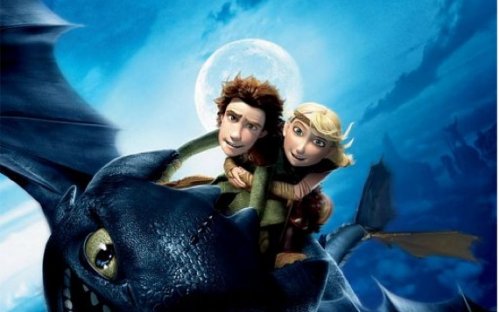
DragonRide.jpg

Having seen Despicable Me and Monsters vs. Aliens in the past couple of years, I was ready for another delightfully silly kid-flick adventure. And so, my being on the upswing out of the worst flu virus I’ve confronted in twenty-five years, we rented How to Train Your Dragon. Ready for silly! Ready for snotty! Ready for dumb!

Whoa. Not ready. Not. Not even close.

Wow!

Now, how was I fooled? Consider the premise: Spindly young teen Viking kid named Hiccup assists Gobber the Blacksmith on Berk Island, which has dragons like some Viking islands have mice. The whole tribe considers Hiccup a pointless nuisance–especially the chief, who, alas, just happens to be his father. The other and only slightly older kids have all won their horned helmets and are already in dragon-fighting school. Killing your first dragon is the only way in, and Hiccup tries, not by main force but by building goofy hornpunk weapons like a crossbow that flings bolos. Wham! He downs a dragon with his first shot, but then gets a bad case of empathy and can’t bring himself to finish it off as would earn him the tribe’s respect–and perhaps a second look from long, leggy Viking girl Astrid.

Instead, filled with remorse for having shredded an aerodynamically necessary section of the dragon’s tail with his bolo artillery, Hiccup befriends it, feeds it, and (in his offtime at Gobber’s forge) builds a tail prosthetic to allow the dragon to fly again, teaching it to carry him in the bargain.

That’s how I understood the plot going in, training the dragon and all that. There was plenty of silliness to go around, and the plot twist from you-kill-it-you-eat-it to you-hurt-it-you-heal-it was predictable in a good way. That’s where the surprises began. The first thing that jumped up out of nowhere was the dazzling panoply of landscapes, seascapes, and cloudscapes, rendered with a gorgeously detailed hyperclarity that bordered on surrealism. Backing up these distant descendents of matte paintings was an electrifying score from John Powell (solo, Henry Gregson-Williams was not involved this time) that draws heavily on Celtic themes and gives you a white-knuckle sense for the exhilaration of flying over open water and between the impossible stone spires of Berk’s archipelago.

I was a little surprised that Hiccup was not played more for laughs than he was. Maybe nerd fortune is turning around: Hiccup is a geek and a maker and a sort of Dark Ages citizen scientist, who observes closely and takes good notes in his leather parchment chapbook, quick to challenge the conventional dragon-fighting wisdom of his people and capitalize on his new knowledge. (There is dragon catnip, for example, and Hiccup makes good use of it.) Ultimately, what he discovers is that everything he and his people thought they knew about dragons was wrong, including an extra-large economy-sized surprise that I confess I did not anticipate at all.

The dragon (which Hiccup names “Toothless” before he notices that its teeth are retractable) is a beautifully realized character itself, with a very expressive face that suggests a lot more intelligence than you’d expect in a cartoon animal. All the adult Vikings speak with Scots accents while the kids talk like Chicago north-siders, which seems to be a trope in fantasy film these days. I wonder how many kids understood the sly reference to Hiccup’s horned helmet being made from half of his late mother’s bra. Beyond that, well, no quibbles–basically, no quibbles at all. It’s a fantasy tailored to the peculiar daydreams of geeky 14-year-old boys, and it reminded me how full of daydreams 14 had been.

Daydreams? What’s missing? Nothing: You jump into the saddle of your dragon, the girl whose heart you just won climbs in behind you and wraps her arms around your chest (!!!) and with a roar you’re off into the sky to rescue your knucklehead grownups from their own stubbornness, and prove to your father that he was wrong about you. The neighborhood kids who used to give you wedgies are now your friends and followers and they fall in behind you, each on a dragon too. But you’re not on just any old dragon: Your dragon is the Corvette of dragons, the ink-black, blue-lightning-spitting Night Fury that no one–no one–has ever tamed before you did.

Yeeeeeeeeeeeeeeeeeeeeeeee-hah!

I won’t spoil the rest, assuming there’s anybody in the Western Hemisphere who hasn’t seen it yet. The crude humor is kept to a minimum (compared especially to Shrek and Robots) but I think preschoolers will find the dragons frightening. And while I admit that I’m peculiarly vulnerable to films about boys who win their fathers’ respect, I still insist it’s the best cartoon fantasy in years.

Very highly recommended.

Restoring Grub with Rescatux

If a task has to be done often enough, sooner or later somebody will automate it. And so it happened with a very common task that I’m glad I didn’t have to do the hard way: Restore Grub to the MBR after a Windows reinstall overwrote it.

Windows does not play nice with Linux the way Linux plays nice with Windows. When you install Linux on a hard drive that already contains a bootable Windows partition, Linux adds the Windows instance to the Grub bootloader menu, allowing you to choose which OS to boot on startup. On the other hand, when you install Windows to a hard drive that already contains a bootable Linux partition, Windows ignores the Linux partition and puts its own bootloader link into the master boot record (MBR.) At startup, the system boots straight into Windows. Linux is still there, but you don’t get to choose to boot into it at startup.

Getting Grub back into the MBR after a Windows reinstall isn’t hideously difficult, but it’s a bit of picky terminal work done from a LiveCD. The trick is knowing how. The canonical description of how to do it is borderline incoherent, including advice like “This method apparently no longer works. Use with caution (if at all.)” The information is all there, but you have to dig a little to make sense of it. (Being a Linux geek helps a great deal.)

There’s now an easier way that I wasn’t aware of the last time I had to reinstall Windows on a dual-boot system: The Rescatux LiveCD. It’s a Debian instance with some scripting added that puts up a wizard and automatically detects installed bootable partitions. It then rebuilds the Grub bootloader menu and points the MBR back to Grub.

A couple of cautions:

  • The wizard is fairly terse. Don’t expect a great deal of handholding. If you don’t have any prior experience with Grub, read the documentation on the Web site. Then read it again.
  • Give the wizard time to work at each step. When you click the OK button, the options reappear immediately, but when there’s some disk access to be done, the script goes off to work and doesn’t give you any indication that it’s working. It doesn’t take more than a few seconds. Be patient.

I failed to be patient the first time I ran Rescatux, and clicked something once too often. (I’m still not entirely sure what.) When I booted the system again, Grub ran and Ubuntu was listed, but this time Windows was missing. There’s some rough justice in that, I guess, but I need to get into Windows just as surely as I need to get into Ubuntu. So I rebooted back into Rescatux and ran the wizard again, giving it enough time to finish each step. Another reboot, and Windows was back in the Grub bootloader menu.

Supposedly Rescatux works with both Grub 2 (the current version) and “Legacy Grub,” V0.97. My system uses Grub 2, and thus I didn’t test its dealings with older Grub versions.

It’s still a little rough, but it saved me a certain amount of eye-crossing terminal work this afternoon, and that’s always a good thing. Be careful and read the doc before you begin, but having said that, I do recommend it.

Replacing Bad Caps in a Good Monitor

Samsung214TBadCaps3Cropped500Wide.jpg

About a month ago, my three-year-old Samsung 214T 21″ LCD monitor started flickering so badly that it could induce a seizure in a lump of granite. It’s been my primary monitor for some time and I love it for several reasons, not the least of which is that it’s a 4:3 and has a built-in pivot on the VESA-compatible stand. So if I want portrait mode I can have it, and all of my machines including the older Dells support it at its 1600X1200 native resolution.

I set the ailing 214T aside and swapped in my downstairs monitor (the older and slower but otherwise similar Samsung 213T) followed by some research on repairs. I had a hunch it was bad electrolytic capacitors. Freaky hardware behavior these days has a high likelihood of being bad electrolytic capacitors, for reasons I explain here. And sure enough, a chap on eBay was selling a caps repair kit specifically for the 214T for $14 shipped. I ordered it, and when it arrived in today’s mail I wasted no time getting to work.

Samsung214TBadCaps1Cropped350Wide.jpgThe “kit” is just a Baggie with six caps and a short length of thin wire solder. If you don’t know soldering you’re going to have some trouble. However, the vendor has a very nice tutorial specific to the similar Samsung 204T/214T units here. It helps that we’re dealing with a power supply board and not a logic board, in that power supply board traces are usually big enough to see. Anybody with a spoonful of bench tech experience won’t have any trouble unsoldering and removing the old caps and getting the new ones soldered in. That took me maybe 10 minutes, granting that I’ve been soldering for almost 50 years and had top-shelf bench tech training at Xerox. No, your real problem will be getting the damned thing apart to where you can remove the PC board to work on it. And the first step is the worst: prying apart the two black plastic halves of the monitor’s case. LCDAlternatives suggests a putty knife in their tutorial, and that’s precisely what it took. And even though I’m very good with disassembly (bruising up a customer’s machine was a serious no-no at Xerox) I scratched up the 214T pretty thoroughly just getting into it. Alas, these units were not designed to be repaired.
Two of the six caps on the power supply board were obviously bad (above left) in that they were domed on top, and one had begun to leak. The others had no visible defects, but that doesn’t guarantee that they hadn’t failed, or wouldn’t fail soon. The kit had six, and I replaced all six.

Total time for the repair was about an hour, including disassembly/reassembly. When I got it plugged back in and powered up, it worked like new, including being a little brighter than it had been shortly before the flickering began. (This is in line with what I’ve read about the effects of bad caps on monitors.) All in all I consider it a big win: Absent the repair, the monitor would have been scrap. I might not have bothered on a smaller or older monitor, but this one I feel is exactly right for what I do, and an hour spent giving it a few more years of service was an hour well-spent indeed.

Tripwander: Cruise Wrapup

Carol Jeff Formal Night-500W.jpg

Prior to our cruise, I hadn’t had a drink in a couple of months, mostly because alcohol and Tylenol don’t mix, and I was scarfing those to keep myself sane until the shingles rash on my back went away. So this trip I rediscovered the delights of a good pina colada, which really depends on two things: 1) ice crushed fine enough in the blender, and 2) enough but not too much booze. Holland America does a lot of things well, and one of them is the festive and yet humble pina colada. First rate.

The food, as on most cruise lines, was excellent, and I noticed something else: The portions were smaller. I’m more than fine with that, since I’d rather have a smaller quantity of really good food and not bring it home on my waistline.

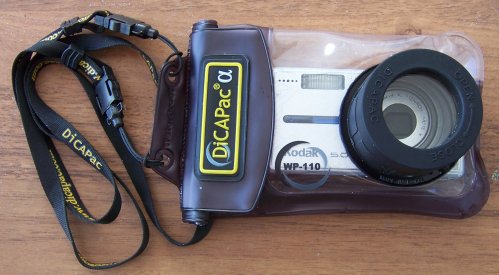
dicapac-front-500W.jpg

Way back in the summer, when we still thought we were going to Hawaii in October for our anniversary, I bought a clever thingie on eBay called a Dicapac WP-110. It sounds like an over-the-counter nausea remedy (nausea remedies were much on my mind last week) but it is in fact a heavy duty resealable plastic bag sized for various digital cameras. Sounds dicey, but for something so much cheaper than an underwater hard case ($25 vs. $175) it worked pretty well. There are many models, all the way up to the big ‘un for SLRs. Make sure you check which model fits which cameras.

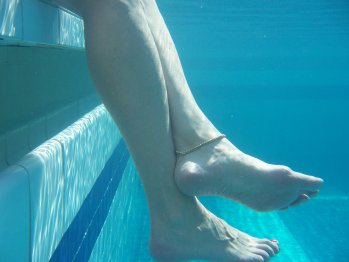
dicapac-test-pool-350W.jpgTesting it was a challenge. We had hoped to bring home pictures of fish and coral and such, but as I’d mentioned earlier, both of our snorkel trips were canceled due to rough water and high winds. Our last day at sea, I put my beat-to-hell spare Kodak V530 in the bag and dunked it in the midships pool. Fish were scarce, but I did get a good shot of Carol’s ankles, and, more to the point, no water got into the bag with the camera.

Framing the shot was hard because of reflective effects; you have to be looking square at the LCD display or optical weirdness will occur. Pushing the camera buttons is a challenge, and early practice (both above water and in something easy like a pool) will be a great help. I guess the really big issue is to make sure the seal is sealed. It’s a ziplock plastic bag, after all, and if you “cross-thread” the meshing plastic tracks, you’ll flood the bag and probably lose the camera.

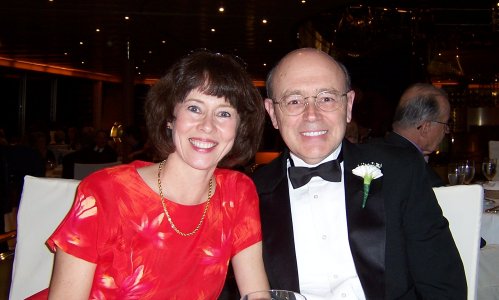
collarextender.jpgPerhaps because of its older demographic, Holland America is not as informal as other lines like Carnival. On 7-day cruises there are still two nights where dinner is formal, and to avoid packing a suit I rented a tux from the ship. The cost was not outrageous, and apart from a little tightness in the shirt collar (fixed with a cheap plastic collar extender, of which I always keep a few in my travel bag) the tux fit perfectly.


In summary, we had a great time not doing much (well, ok, I read three books) and escaping a winter that is descending far too quickly. We hadn’t gotten out on the open seas like this since 2004, and (seasickness notwithstanding) it was long past time.

What Dogs Gave Us

We domesticated dogs. And dogs, in return, made human civilization possible.

Work with me here. A lot of my recent reading has been about human origins, stemming from my fascination with Homo Neanderthalis and what became of him. Two books of note: The Third Chimpanzee by Jared Diamond (1993) and Before the Dawn by Nicholas Wade (2007.) Jared Diamond is always a good read, and even though the book is showing its age I strongly recommend it. Wade covers much of the same turf, but does so with the tools of DNA analysis that simply didn’t exist twenty years ago, when Diamond was doing his research. By counting mutations and working backwards through Y (male) chromosomal DNA and mitochondrial (female) chromosomal DNA, we can infer a great deal about human populations, where they came from, how they changed, and when. Of some of it I’m dubious–the extrapolation about the sources of human language, for example, seems a stretch–but most of it is no longer controversial, nor even exotic.

Both authors draw on anthropological research of stone-age peoples who survived into the 20th century. (Diamond did a lot of that research himself, in New Guinea.) The picture they paint of early humanity is grim: We are not fallen angels. We are risen apes. The hallmark of early humanity was deliberate genocide: New Guinea tribesmen told Diamond straight-out that their overall tribal goal was the extinction of other tribes. The homicide rates among such tribes are many times that of the homicide rate in Detroit; men who cannot claim to have killed another man often cannot persuade women to marry them. This seems to have been the pattern for hunter-gatherer societies as far back as we can see via the fossil record. Many Neanderthal skeletons show the marks of multiple healed bone and skull fractures, and a couple of them evidence of spear impingement on bone. Constant warfare was the pattern, and the method (judging from modern stone-age peoples) was the dawn raid: Raiders would stealthily draw close to a rival tribe’s encampment, and wait for the rivals to turn in. Then, when there was just enough dawn light to move well, the attackers would fall upon the sleeping rivals and spear them where they lay.

This worked, and worked well. People have to sleep, so the attackers had the advantage. Then one day about 15,000 years ago, something unexpected happened: Animals around the rival encampment sensed the attackers creeping in for the kill, and set up a huge and unfamiliar racket. The rival group, awakened by the animals, grabbed their spears and gave chase. The attackers had been up all night waiting for just the right moment. The defenders had just had a good night’s sleep. They could outrun their sleepy-eyed assailants, who had a ways to go to return to their home turf. More than a few attackers probably took a spear through an eye socket, and once enough of your dawn raiders take a spear through an eye socket, dawn raiding becomes a lot less compelling.

All because of some previously unknown animals who looked like wolves but made noises that wolves did not make–and appeared to consider the rival camp to be friends rather than food.

As best we can tell, dogs were first domesticated about 15,000 years ago, which was just about the time that Homo Sapiens was moving from wandering hunter-gatherer societies to settled societies that eventually became agricultural and pastoral societies. Just how they were domesticated is still unknown, but the work of Belyaev and his silver fox suggests simple selection by temperament: Ancient wolves became camp followers, and ancient humans tossed them scraps. Wolves who could stand to be near humans ate better without working as hard and had more pups. The few stone-age tribes we’ve been able to study sometimes captured wild animal juveniles and kept them as entertainment until they became grouchy on maturity. Dogs need to be handled as puppies to be fully at peace with humanity as adults; perhaps those wolves-in-transition descended from adult wolves who were handled by humans as pups and remembered: Those two-legged whatchamacallits handled me without hurting me–and they toss me aurochs bones!

15,000 years ago, that was a helluva deal if you were a wolf.

Explaining the bark is tougher, but group selection suggests that if some quirk in the genes of certain wolves allowed those two-legged whatchamacallits to survive and thrive, there’d be more aurochs bones and more yappy wolf/dog pups. Evolution works fast: Belyaev turned wild fox into peculiar (if not completely domesticated) pets in only 40 years, simply by selecting fox who were most willing to be handled when young and least snarly and aggressive when mature. A fox who will lick your face instead of biting your nose off is most of the way to a dog anyway; in another hundred years, he’d be sleeping at the foot of your bed and fetching tennis balls.

The bottom line is this: Without dawn raids, settled living rather than wandering became possible, and settled living fostered the development of villages and agriculture and trade and writing and all the other precursors of the lives we live today.

The Neanderthals had bigger brains than we do. What they didn’t have were dogs. And, lacking dogs, the unfortunate louts dawn-raided one another to extinction, leaving homo sap and his faithful yappers to pick up the turf and eventually take over the world.

Raise a glass of Laughing Lab Ale to canis familiaris: Everything we are we owe to him. Good dog!