Jeff Duntemann's Contrapositive Diary Rotating Header Image

Reviews

Evaluations of products and services

Antistatic SATA Drive Boxes

BlueDriveBox-500Wide.jpg

Well, one out of two ain’t bad: I didn’t get a headcold on our trip back from Chicago, but I did pick up an eye infection. (Carol got it too; such things are highly communicable. As the old Brel/Shuman song goes, “We will kiss with our eyes…”) I’m not going to be doing much reading or computing today (nor perhaps tomorrow) but the antibiotics we got at urgent care are on the job and I hope to return to ordinary life on Monday. One quick entry in the meantime and I’m going to go put a cold rag on my face again.

In the huge bin of held mail we picked up today was a box containing something I ordered before we left: A trio of antistatic plastic boxes sized precisely to hold a 3.5″ SATA hard drive. The idea is to use the SATA slots on the top of my new tower case quad core to handle backup. Take a drive out of its box, drop it in the slot on top of the case, do backups, then yank it and put it back in its box. SATA is faster than USB, and the SATA electrical interface is hot-swappable. It’s a natural.

The fit is just snug enough so that the drive will not spill out of the box accidentally while I’m handling it. There is a little block of conductive foam on the lid to keep the drive from rattling around when the lid is closed. The latch is firm but doesn’t take a pliers to open. (Ok, I do have strong thumbs.) I bought three boxes in three colors for $9.24, from Amazon. It’s interesting to me that although the three boxes appear to be physically identical, the three colors are sold at different prices–even when they come from the same dealer. The boxes looked like they might have held a MM paperback, but not quite. I’m sure I’ll find other uses for them as time goes on; I’m good that way.

Highly recommended.

Review: The Thermaltake V9 SATA Toaster Case

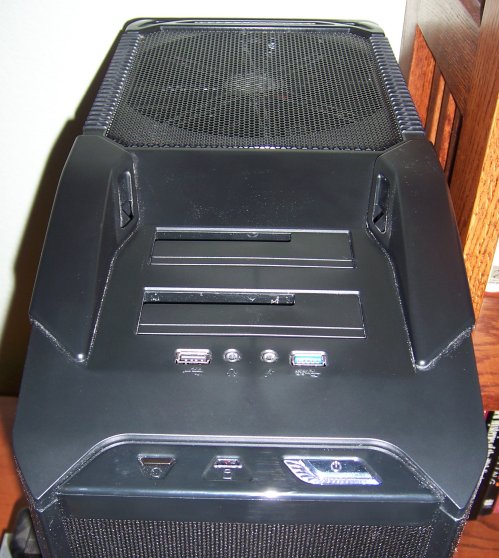
V9 Case Top Dock.jpg

After I fried my 2009-era Antec quad core tower machine, I had my favorite local box shop put me together a new quad core, this time in an interesting case: the Thermaltake V9 BlacX. Like virtually all cases you buy on the parts market these days, it’s a gamer case, complete with lots of fans and the obligatory plexi window on the side so (I presume) your friends can admire your junk. The fans are there to cool ranks of screaming graphics cards. If you’re using integrated graphics, as I am, you can probably turn most of them off. With just the front panel fan going, the inside of the case here runs at 75-77 degrees F (I measured it with a Radio Shack probe digital thermometer) which is hardly molten death.

I bought the V9 for a very particular reason: It has a double SATA toaster dock built right into the top panel. I’ve been using an Ineo USB toaster dock for some time, and like it a great deal. As with any gadget of its class, it needs its own wall wart, and there’s the inevitable data cable. The notion of having a toaster dock like that right on the machine means that I can lose a wall wart and a data cable from the ratsnest. The V9 case provides two.

The Gigabyte mobo I’m using has six SATA ports. Four of them are SATA 2.0 ports, capable of data transfer rates up to 3 Gbps, and two are SATA 3.0 ports, which can go as fast as 6 Gbps. (The choke point is most likely the drives you’re using, not the ports themselves.) The two 6 Gbs ports go to the internal drives. Two of the 3 Gbps ports go to the twin toaster docks on the top panel. Another 3 Gbps port goes to the optical drive. That still leaves me with a spare SATA 2.0 port, and the V9 even leaves me an empty bay in the front panel if I ever want to put a second sled slot in it.

Each of the two docks are almost identical to the Ineo dock, in that they can accept either 2.5″ SATA laptop drives or standard 3.5″ SATA drives. The dock ports do not use USB connectivity, as I initially suspected. There is no electrical or logical difference between drives plugged into the top dock ports and drives mounted internally and connected to SATA ports of similar speed.

SATA drives are hot-swappable, which means that yanking them out of a SATA connector with power on will not physically damage them. However, the OS needs to manage removability, and I haven’t poked at that aspect yet. From what I’ve read, there is a TreatAsInternalPort registry key governing whether a given SATA channel is removable or not. I believe that making a SATA port removable cuts down its throughput some. (Further research may be needed.) For the moment I’m happy to plug drives into the dock while powered down. When XP boots up, it sees them as though they were internal drives, which (electrically) they are. I’ll play around with the removability bit as time allows.

The case is too new to judge, really. I have a quiet Antec power supply in it, and the front fan makes barely a whisper. It has all the external ports I need. Key here isn’t functionality so much as survival in daily use. The Antec 900’s USB ports started to die after only a year or so in service. Check with me again after the V9 has lived for three or four years in my new downstairs office with the Wimhurst carpeting. USB ports may be the least of my worries.

So far: highly recommended.

Review: John Carter (of Mars)

I wrote this three weeks ago and then forgot to take the file to Chicago, duhh. I assume everybody’s seen the film by now, but I’m not sure what else to do with the review but post it.


carterswoola.jpgSaw John Carter with a few geek friends, all of them (but me) EEs. It got lousy reviews for the most part, but I was intrigued by the idea of a quarter-billion dollar pulp novel. Because I know what pulp novels are (and because I read A Princess of Mars when I was 15 or so) I was by no means disappointed. Guys, it’s a pulp novel. This means that it’s either about cleavage or else bashing your enemies to a pulp.
Disney made this one, so the cleavage is minimal, and the pulping quite bloodless. The costuming and CGI creations, on the other hand, were breathtaking in a sort of half-Spartacus, half-Steampunk way that we don’t see very often. (I really can’t think of another example, though the very uneven 1961 George Pal film Atlantis, the Lost Continent comes close.) Much of the film was shot on location on an alien planet called Utah. The rest came out of whole CGI cloth.

And that, my friends was worth seeing. The tusked, four-armed native Martians called Tharks looked absolutely real, right down to the eyes. They fidgeted, they pouted, they even wept, and they did not all look alike. It is a credit to the production quality and attention to detail that in other films the Tharks might be consider monsters; here they were more or less the bad boys you stayed away from in high school or (very) occasionally befriended. There actually weren’t a lot of monsters, once you discount the Tharks as ugly but mostly human dumbasses. One of them, however, was my favorite living thing in the whole film: Carter’s six-legged Martian dog sidekick Woola (technically a calot) who might accurately be described as Jabba the Mutt.

I liked the human characters a lot less. After all, I’ve already seen Spartacus. Carter himself (Taylor Kitsch) was forgettable beefcake. The bald guys were unconvincing, and reminded me of mysterious, hair-challenged heavies in a multitude of bad media pieces all the way back to Ming the Merciless. The princess-scientist Deja Thoris had remarkably durable eye makeup considering the roughousing she engages in. Then again, so did Sophia Loren in the underappreciated 1957 big gun epic The Pride and the Passion. (So, in fact, do most movie heroines who aren’t ugly by design.) The Zodangans and the denizens of the city of Helium (what was Burroughs thinking?) were toga-epic extras, who brought all the passion of plum pudding to their parts.

I twitched every time I heard someone say, “…then Helium falls.” Hey, if Helium falls, why do we fill blimps with it?

The steampunkish walking city of Zodanga was a nice touch, explaining as it does why Mars appears to have long lines spanning its deserts. That’s just Zodanga tracks, and Zodanga has a lot of legs. Nonetheless, it’s a very big item, and if you’re not so dumb as to just sit and wait for it to step on you, I’d guess it’s fairly easy to outrun.

Unfortunately, the one big thing that bothered me immensely in the film was key to the plot: Carter’s Supermannish ability to jump a hundred feet straight up, supposedly because of the lower gravity on Mars. Sorry, no. Mars’s gravity is 3/8 that of Earth, so a 200-pound ruffian would still weigh 75 pounds. I might believe fifteen feet straight up, or 60 feet in a horizontal long jump with a good running start. And if Carter can, the slender and apparently muscular Tharks should be able to. Not so.

That’s my main complaint, apart from the fact it’s sometimes difficult to tell exactly what’s going on. I’ll freely admit that I didn’t care. John Carter is about spectacle; fights among improbable flying machines, goofy aliens, and endless startling things purchased by the compound interest of Moore’s Law. Don’t expect it to make sense. (Alas, don’t expect it to make much money, either.) Resist the temptation to crack helium jokes. (If Deja Thoris is a Princess of Helium, why doesn’t she have a squeaky voice?) Just turn your brain off and enjoy the scenery.

Guiltily recommended.

Media System Reassembly

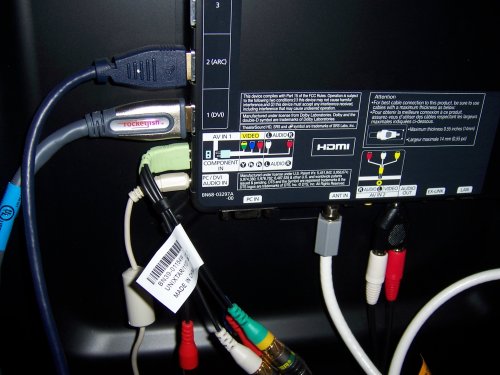
Back Of TV - 500 Wide.jpg

This may be obvious for some, but for whom it isn’t, I want to call it out and describe it as extremely useful: If you ever have to dismantle a complicated audio/video system, take pictures of the cabling before you pull it all apart.

We bought a flat-screen TV and associated media components last year for the lower level, and a Geek Squad guy came out to assemble and test it for us. Now, I’m not a big media guy. I watch movies when I’m on the treadmill, and sometimes TV. I’ve spent my time learning other things. So when I had to empty out the carpeted areas of the lower level, I took one look at the ratsnest behind the electronics and dove for my digital camera. I took pictures of the cables behind the TV and each of the other components. Yesterday, when it was time to put everything back in place after a two-month hiatus (which is more than long enough to forget everything) I printed out five color copies of the pertinent photos, and had it all reratsnested and working inside of twenty minutes, with no false moves at all.

I recognize that it may be difficult to get a camera behind some systems. If you can, pivot each component out far enough to snap what’s plugged into it. If you can’t, well, maybe using longer cables would be a good idea.

Having fought with media messes like this on many occasions, I’m guessing that this technique saved me hours I would otherwise have wasted and never have again. Highly recommended.

An Informal Theory of Tribalism, Part 1: Background

I’m much of the way through an excellent book: The Better Angels of Our Nature by Steven Pinker, whose previous works on my shelves here include How The Mind Works, The Language Instinct, and The Blank Slate. The book’s dual mission is to demonstrate with hard research and reliable numbers that violence in human societies has declined and continues to decline, and perhaps to explain why. So far I’m persuaded by the first element of its mission. The second, well, I’m not as sure–but I’m also not finished with the book. However, I’ve read enough to recommend it, assuming you don’t mind long, dense books that require focus and an open mind to get through. The Better Angels of Our Nature provides solid backing to the impression Colin Wilson gives in his 1984 tome A Criminal History of Mankind: that the past was a bogglingly cruel and violent place, not only in certain parts of the Earth and in certain societies, but everywhere. Today, by contrast, we live in the safest and most peaceful era in human history. The improvement has not been linear, but graphed over centuries (and not merely years or decades) it’s been steady. This is counterintuitive if anything is. Still, the citations Pinker presents are beyond my ability as an amateur historian to challenge. Much of his thesis involves things I’ve not read of in detail before. Pinker’s description of the widespread practice of infanticide in our past is especially chilling. I may recognize the evolutionary logic for some of it, but the repugnance nearly all of us feel when contemplating the idea reflects how far we’ve come.

In short, we are not fallen angels. We are risen apes.

I’ve had a suspicion for quite a few years that the root cause of human cruelty and violence is tribalism. Pinker’s book provides more evidence that I was right. He cites a number of causes of violence, but most of them are either the consequences of tribalism, or tribalism outright. Furthermore, tribalism is something primal, something we inherited from the killer primate ancestors we share with creatures like gorillas and chimpanzees, who are enthusiastic and highly calculated murderers of their own kind. We see it in our own historic records as far back as they go, and also in the societies of aboriginal peoples who have avoided contact with modern societies until recent times. (Jared Diamond has written much about his experiences with recently contacted tribes in the new Guinea highlands; see The Third Chimpanzee for a sample.)

It’s easy for those of us in the Intellectual Elite to cluck and roll our eyes at any suggestion that tribalism is still with us. Don’t. What we’ve made great progress suppressing are warfare and murder, mostly by sheer dint of will enforced via societal pressures against fountains of violence like polygamy (polygyny, more precisely) and honor cultures. We’re still having trouble with deeper evils like idealism, but idealism is not a consequence of tribalism. (It certainly takes advantage of tribalism, as Marxism did with great success in the past hundred-odd years. Let’s not confuse the horse with the rider, even if both need shooting.) Tribalism is very much with us, and whereas it causes less murder than it used to, it still shapes our thought and our societies in ways that should give us pause. It generates hatred like nothing else out there, and enslaves even the brightest of us.

The quickest way to find evidence is to read the comments sections of forums covering anything less technical than the alignment of IF strips. Everyone knows what flamers and trolls are. They’ve been around since there were online forums. I saw them in my bang-path days in the early 80s. Anonymity amplifies the temptations to flame and troll; see the very brilliant take that Penny Arcade has on the topic. I was a little surprised to see how much the psychology of flaming and trolling is rooted in tribalism. As with a lot of insights, once I knew what to look for I saw it everywhere. I’ve actually engaged the trolls here and there, to see how they react to certain kinds of provocation. (If you ever stumble across any otherwise uncharacteristic or inexplicable posts of mine online, it’s almost certainly me poking a troll with a stick and taking notes.) I now think I know enough to summarize my research and toss out an informal theory of tribalism, especially as it applies to our online world.

The series here will not be contiguous. It’s a difficult thing to write about, and I have other topics on my do-it list, most of them more fun if less provocative than this. I do want to ask that you put on your Cloaks of Heroic Courtesy before you click the Comment link. I always welcome thoughtful and polite discussion. However, if you insist on flaming or trolling, I have a perfect opportunity to tap my pointer on our virtual blackboard and use you as an example: “Kids, here’s still more evidence supporting my theory. Let me explain what’s going on in this comment…” Be the student. Don’t be the lesson.

Next: What tribalism is.

Another Elfa Closet Done

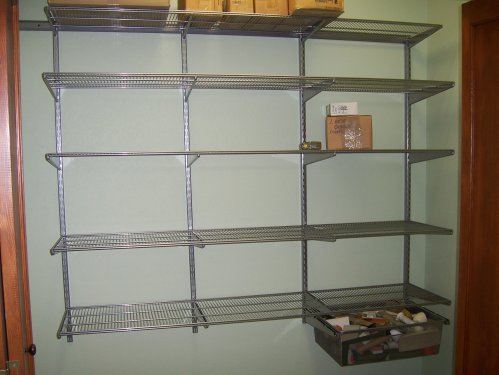
WorkshopClosetElfaSetup500Wide.jpg

The rehab of our lower level continues apace. The tile guys finished up today, replacing the tile around the tub and some floor tile that was damaged by the mudjacking last month. The grout has to cure for another week and the toilet has to be re-set, but the tub no longer leaks. Shortly we will have a guest bathroom again.

The painters begin their work on Monday. We haven’t ordered the new carpeting yet, so the carpeting won’t be replaced for probably another three weeks. In the meantime, there are plenty of odd jobs to be done down there, and yesterday I dove in on one of them: my workshop closet. I’ve been planning an Elfa buildout in that closet for literally years, but it hadn’t bubbled to the top of the stack until recently. To replace the crappy shelves I had in there with Elfa I first had to empty the closet completely, and there was nowhere to stack its contents until I was forced by the mudjacking to clear the eastern ten feet of my shop space. That in itself was an adventure in strength training; QST may be the only magazine in creation denser than National Geographic.

So last week I hauled hundreds of pounds of parts, tubes, sound boards, unfinished project lashups and much other junque out of the closet and stacked it in the newly empty space where those QSTs had been. And yesterday, level and cordless screwdriver in hand, I got the Elfa installed.

Elfa is a steel shelving system made in Sweden, built like a battleship and priced accordingly. As best I know it’s an exclusive from The Container Store chain here in the US. It’s based on a horizontal track mounted high (ideally in studs) from which vertical tracks are suspended. The vertical tracks are not fastened into the wall at all, so can slide side-to-side for fine adjustment. (Mine is biased four inches to the right.) There are several major styles (closet, kitchen, office, garage) and all kinds of interesting bits that click into the tracks. It’s basically a Meccano set for shelving.

I’ve used it twice before, in our upstairs office closet, and across two thirds of the back wall of our garage. It takes a little practice to get good at it, but there’s nothing especially subtle about the system. It was breathtaking to see just how much clutter we were able to scoop up off the garage floor and shovel onto the shelves.

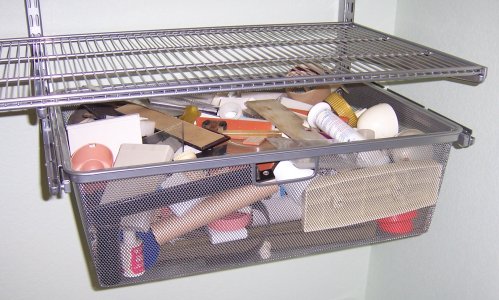
Yesterday I filled an 88″ wide closet with a six-foot shelf bank, leaving a little room on each side for specialty storage for things like brooms, vac wands, and mobile antennas, including a full set of Hustler RM-series loading elements. The Elfa system includes pull-out bins, one of which I bought to see how useful it might be. Having filled it with plastic scraps, I’ve decided that it’s very useful, and on my next trip to Denver will get two more.

ElfaBin500Wide.jpg

I’m still switching shelves around and moving them up and down to get a sense for the spacing, and may put a couple more 2′ shelves on the right side to make space for things more horizontal than vertical, like homebew lashups. That said, I’ve already re-shelved most of the stuff I’d pulled out of there last week, and still have almost twelve shelf-feet of completely empty space. As wins go, it was a biggie.

Highly recommended.

Minty Failness

I gave it a good shot and I tried, honestly I did. But Canonical’s Unity UI simply doesn’t work for me. It’s obvious that Canonical is trying to create a single UI that will serve end-user computing from top to bottom. It’s just as obvious to me (now that I’ve had six weeks or so to play around with a Droid X2) that there is no single “end-user computing” anymore. Desktops are fundamentally different from smartphones, or anything else (tablets, possibly; we’ll see) that is primarily tap-and-consume. I’m having no trouble working the Android UI on my phone, and Android habits don’t intrude on my desktop synapses. I’m not confused or in any way slowed down by the differences between the two, no more than I’m confused about the differences between a shovel and a rake.

So if Unity is all I get under Ubuntu, Ubuntu has to go. Others seem to agree with me, and at times the discussion gets disturbingly violent. Online I’m seeing that huge numbers of people are fleeing Ubuntu for Linux Mint, which I’d barely heard of a year ago. I have to smile a little bit, because Linux Mint is Ubuntu, basically pulled back to a variation on the GNOME 2.3 interface. The upcoming release (Mint 12) will move to GNOME 3, which worries me a little (I like GNOME 2) but I’ve seen word that Mint 12 will allow users to have something very like the old UI–which is precisely what Canonical did not do with Ubuntu and Unity. It was Unity or the highway, and boy, it’s bumper-to-bumper out there.

There’s an enormous issue of why we’re suddenly tossing older and much-loved UIs away without nary a glance over our shoulders, when there’s no compelling reason to adopt one of the new models. Programmers like to create Shiny New Stuff, fersure. I in turn don’t like to change the way I interact with the machine I use, unless such changes make me a lot more effective. So far, the costs in relearning ordinary tasks far outweigh the fairly paltry benefits for me.

I’ll take up that issue eventually. In the meantime, I’ve hit the highway, and installed Linux Mint 11 Katya in its own partition here on the quad core. The OS looks great and works the way I’m used to working. I have some minor quibbles, like the failure of the Software Manager to tell me when it’s done installing something. Ubuntu does this well, but Mint installs and gives no sign. This was critical when I installed WINE, since (because WINE is not an app, strictly speaking) it’s tricky to determine if WINE was fully and correctly installed. Because running Software Manager again and selecting WINE still indicates “not installed,” I think there’s something wrong.

Small stuff. The big deal is that Mint doesn’t work well with the integrated graphics on my EVGA NForce e-7150/630i Core 2 Quad motherboard. The default graphics drivers worked, but looked clunky and don’t support effects. Installing the recommended proprietary NVIDIA drivers produced weird graphics failures, including windows refusing to render once they’re over a certain size. (Some windows would not render at all, and simply remained blank and white even when first instantiated.) Using the supposedly experimental NVIDIA 173 drivers worked better, but still fails on certain apps, especially Stellarium, which worked exactly once and then comes up with a blank, black window every time. I’m not willing to give up Stellarium, so at this point Linux Mint is on hold while I wait for Mint 12 Lisa.

Linux Mint has supposedly become the 4th most popular OS on the planet. It’ll be interesting to see if that continues to be the case once they cut in the mandatory GNOME 3 upgrade. I’ll give GNOME 3 the same consideration I gave Unity, but I’m also looking closely at the Xfce UI and Xubuntu. It’s going to be an interesting year in the Linux world. I’m keeping all my old Linux installer .iso files, trust me.

Goggling Google Goggles

As at least ten people by now have written to tell me (though Eric the Fruit Bat gets credit for being the first) Google has a project targeted at recognizing things in the physical world and looking them up online, as I wistfully wished for in my September 17, 2011 entry: Google Goggles. I vaguely recall hearing of the product on its first release, which (because it was for Android) was not something I could fool with on Windows.

There’s even a word for the general concept, though it’s not one I would use: augmented reality. I’m not looking for things to augment reality so much as simply document it–but in this age of exaggeration, I guess that’s pretty much the same thing.

Google Googles is a mobile app currently available for Android and iPhone. You aim your smartphone (assuming it has a camera, as virtually all do) at something, and tap a button. The phone takes a photo, and then (I assume) there’s a conversation with the Google mothership to see if the photo resembles anything already in the recognition database. The app is free, at least for Android, and I’ve been having some good fun with it trying to see what its limits are. Here’s my report:

Google Goggles recognized the following things:

  • A bottle of Coke Zero.
  • A conventional painting of Jesus Christ.
  • A conventional painting of St. Francis of Assisi.
  • Two different contemporary paintings of Ben Franklin.
  • A bottle of Campus Oaks Old Vine Zinfandel.
  • The Colonel Sanders portion of the KFC logo. (Without “KFC”.)
  • The Virginia Cavaliers alternate logo.
  • The iconic Rolling Stones tongue logo.
  • The Insane Clown Posse logo.
  • The Dave Matthews Band logo.
  • The Hieroglyphics band logo.

It did not recognize the following things:

  • Me. No clue about my standard publicity photo, as seen in my blog header, even though it’s logged in Google Images.
  • A headshot of Isaac Asimov, also found on Google Images. I guess I don’t feel so bad.
  • QBit. (It states clearly that animals generally aren’t recognized.) It did say that he resembles a poodle, a kitten, and two bunnies. Goggles isn’t the first entity that thought QBit was a poodle, though I won’t mention the kitten part to him.
  • My Celtic peat cross. It said the cross resembled several tall, skinny women dressed in black. I can almost see that.
  • The Nike swoosh. Failed four times. Now that surprised me.
  • A tape measure.
  • A fork. It thought the fork resembled the Statue of Liberty.
  • A knife. It thought the knife resembled a white bunny.
  • A 430-ohm, 2-watt carbon resistor. It thought it resembled the Canadian flag.
  • A cordless telephone handset.
  • My Weber gas grill.
  • A pair of headphones. It said my headphones resembled a wristwatch.
  • A screwdriver, though it did say my screwdriver resembled photos of other screwdrivers.

I’m reasonably happy with this record, considering that Goggles is more a proof-of-concept than anything close to what I want to document (ok, awright already, augment) reality. It does seem to prefer things that are enormously popular. My first suspicion was that Goggles would not recognize anything that did not include OCR-able text, but most of the logos tested have no text, nor did the paintings of Jesus, St. Francis, and Franklin. Goggles had an impression that QBit was a small white animal, and there were flickers of recognition of a screwdriver. So far, so good. Cripes, it’s only 2011.

So. Share your success stories, if you have any. I’m modestly impressed.

Dipping Into Books: Conjuror’s Journal

Conjuror's Journal Cover 300 Wide.jpgOne of the most obscure of the best books I’ve read in the last 30 years is Conjuror’s Journal, by Frances L. Shine. As best I can tell Miss Shine published just three novels, all with Dodd, Mead, between 1968 and 1978. There is almost nothing about her online, and given that she seemed to be 60-something in her 1978 jacket photo, I’m guessing that she’s passed on.


The novel is a Pepys-style diary from a mulatto conjuror (parlor magician; nothing paranormal about it) traveling around Boston in the 1790s with his dog Socrates, giving magic shows while trying to unravel the mystery of his parentage. The story is by turns insightful, funny, and sweet, with just a touch of melancholy here and there, mostly in Joshua’s recognition of the pain he sees in the people he entertains. It ends well (nay, triumphantly) in a way that few stories do anymore, and a lot of what I like about it is simply that. Perhaps the best way to persuade you to hunt up a copy (there are plenty on the used book sites for a dollar) is to give you a quick sample here. I hope to do this now and then with obscure books that I think deserve more attention than they’ve gotten.

February 15, 1794.

Man is a hapless creature, after all, upon this earth; all his vaunted powers as nothing in the face of Loss. This have I tried and proven more than once.

This day I was met in the Lane by a small lass in a sore way of crying; who called out my name and seized my coat in her little hand. She had hung about the door waiting for me; and, 0, Sir, look! Could I not make it to be alive again? Wrapped tenderly within her apron was a dead canary.

I was stricken by her simplicity. Having marvelled at such wonders as her childish eyes found in my sleight-of-hand, she thought on me as a kind of miracle worker who could, an’ he would, make all well again. There was in her utter trust an innocent blasphemy that made me shudder.

Most tenderly, I spoke to her; explaining how far my poor gifts at conjuring fell short of what she asked. My words brought forth a fresh burst of tears. Then my bird’s dead! Charlie’s dead! My heart welled with pity. How can one speak to Six Years of the bending of man’s stubborn will to the Divine purpose? All I could find to do was to palm a coin, fumble in her hair with a “What have we here?” and proffer the coin to purchase another bird.

Child-like, she made pause at the bright money. But then she shook her head mournfully. She wanted no other bird–she wanted only Charlie. Off she went a-weeping, the dead bird cradled in her apron.

Poor little maid! Perhaps till this day her heart has known naught but joys. My bird is dead. Be it youthful dreams, or first love; be it the sense of infinite possibility contained in one land, one idea; we all, soon or late, must utter that same cry.

Taos Toolbox 2011, Part 2

Jim And Nan Coffee 500 Wide.jpg

(Part 1 here.) The Snow Bear Inn is really a set of ski condos only a quarter mile from one of the Taos Ski Valley lifts. The units are complete apartments including kitchens, some with single bedrooms, some with two. Jim Strickland and I shared a two-bedroom suite. The kitchen was well-equipped; indeed, far better equipped than we needed. It had a separate wine refrigerator, coffee grinder, four-slot toaster, blender, crockpot, and probably a few other things on the high shelf that we never poked at. Food was provided in the common room for tinker-it-up breakfasts and lunches. Four dinners a week were catered in by a local woman who really knew her stuff.

Jim and I quickly fell into a daily routine: I’d be up at 6, showered by 6:15, and shoveling grounds into the coffee maker by 6:30. Jim got up about then, and I’d scramble two eggs for each of us. By 7:30 we were already hard at work unless someone stopped by for coffee, as Nancy Kress did more than once. (See above.) But even with morning visitors, by 8:30 both of us were reading mail and hammering out notes on the manuscripts up for critique later that day.

By 10:00 we were gathered around the conference table in the common area downstairs, and if anybody wasn’t there by precisely 10, Walter would lean out the door and give a blast on the Air Horn of Summoning. This happened rarely; mostly we were all present and ready to roar by 9:45. On most days work began with a lecture by Nancy, followed by a short break and then either two or three stories for critique. Lunch happened as time allowed, often before the third critique but always limited to thirty minutes. The class day wrapped up with a lecture from Walter. At that point, typically between two and three PM, we would shift into edit mode, and begin work on the following day’s critiques and our own second-week submissions. Some worked in the common room. Most of us went back to our own rooms. (Alan Smale preferred to sit with his laptop on a folding chair between the buildings.)

I quickly fell back into college-student mode, taking notes on a quad pad in my frenetic block printing, precisely as I did at DePaul in 1974. By Tuesday July 12 we were definitely into drink-from-the-firehose mode, critiquing first-wave submissions (distributed via email before the workshop began) that ran as long as 11,000 words. Toward midweek we were also working hard on our second-week submissions, which nominally demonstrated what we’d learned in the first few days.

Peter Ed After Dinner.jpg

Dinner was catered in at 6PM every day but Friday. While not exotic, the fare was beautifully prepared, and included barbecued ribs, coconut shrimp, broiled tilapia, grilled steaks, baked chicken breast, home-made potato & egg salad, and lots of other things I may have been too tapped-out mentally to recall. There was always good conversation over dinner (see above: Peter Charron and Ed Rosick) but by 6:45 most of us to our scattered laptops went, continuing work for the following day. I sometimes kept hammering until 8 or 8:30. At that point I was toast and generally gave Carol a call before falling exhausted into bed. There was a little late-night fellowship over bottles of wine down in the common room, but it all happened long after my bedtime.

Some people managed to get the 20-odd miles down the valley to Taos for occasional shopping or touristing, but my old bones preferred to stay put and rest while rest was possible. The impression I want to give here is that this was boggling hard work, and unlike my Clarion experience back in 1973, there was almost no clowning around.

My camera doesn’t do a great job with indoor shots. For a good collection of captured moments from the workshop, see Christie Yant’s Flicker album.

Next: How critiquing worked.