Jeff Duntemann's Contrapositive Diary Rotating Header Image

Reviews

Evaluations of products and services

Magazine Meanderings

We brought home two weeks' worth of mail this afternoon, and in the pile were the latest issues of all the print magazines I currently subscribe to: QST, Nuts & Volts, The Atlantic, and Wired. Every month I read them—or major portionsof them—and every month I fret for the future of the magazine business, in which I played with great success for fifteen years (1985-2000.)

QST isn't doing too badly. It looks pretty much the way it looked twenty years ago, and it fulfills its editorial mission better than any magazine I've seen in recent times. The amateur radio demographic isn't doing well, as our average age is now up in the high 50s somewhere, but the editorial people know their readers, the ad people know their advertisers, and somehow they make it work. I just wish they'd publish a review—or simply an announcement!—of my Carl & Jerry reprints.

And I continue to be amazed at how well Nuts and Volts has grasped what Tim O'Reilly has brilliantly nailed as the Maker Psychology: People who build stuff because they love to build stuff, whether it actually turns out to be useful or not. It's the last real big-time magazine about electronics, and I bought a lifetime subscription in 1980 for $5! I just wish they'd publish a review—or simply an announcement!—of my Carl & Jerry reprints. (Is there an echo in here?)

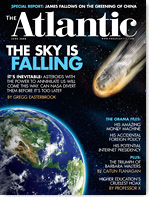
I'm not as sanguine about The Atlantic, and haven't been for five or six years now. Still, every time my sub runs out, I re-up, having been wowed by an article or two right in the nick of time. They used to publish thought-provoking articles about things I hadn't heard about before, or didn't understand, or both. A couple of issues ago, they published a cover story about…Britney Spears! The readership apparently sent away (from one of those wonderfully eccentric little 1/12 page ads in the back of the mag, doubtless) for authentic Transylvanian torches and pitchforks and began marching on the mag's offices on New Hampshire Avenue in DC. Me, I'll be contrarian here and say that Britney didn't bother me too much. Maybe she was an experiment. Maybe the editorial staff wanted to prove to their bean counters that slutty, washed-up pop singers are not the keys to the kingdom; if so, they succeeded in spades. No, my big gripe with The Atlantic is that they became obsessed with political personalities a few years back, and now it's Obama or one damned Clinton or another on the cover almost all the time. I wouldn't mind articles about political ideas so much, but no—it's all about how desperate Hilary is getting, and how Obama will learn how to walk on water by his inauguration next January. (Hint: Pray for a winter cold enough to freeze the Potomac.) I was ready to let it lapse back in January, and then they published Lori Gottlieb's brilliantly ascerbic little spitting-into-the-evolutionary-wind commentary called “Marry Him!” I re-upped. And this month, mirabile dictu! Their cover story is a reasonable layman's overview of threats to the Earth from asteroids and comets. There's the inescapable praise-for-Obama piece and a peculiar backhanded tribute to G. W. Bush, both of which I could have done without, but there was also an anguished piece by an adjunct professor teaching English to night school students telling us that not everyone has what it takes to get a college degree. We'll see who wins come next January when I have to write another check, but my editor's intuition detects a back-office struggle between editors who think we like to read about ideas and editors who think we like to read about, um, our national mental illness. Hey, guys, John-John Kennedy himself couldn't make it work. Whatthehell makes you think you can?

And then there's Wired. Like the trademark alternating color bars on their spine, I subscribe and lapse, subscribe, and lapse. The colors and the page layouts still give me headaches, but to ensure that I'm still young old (rather than old old) I have to keep in touch. And they have their moments: The current issue's cover text is absolutely, unreservedly brilliant: “Attention Environmentalists: Keep your SUV. Forget organics. Go nuclear. Screw the spotted owl.” I wanted to cheer. And then I went right for the cover story, to receive the worst impression that they had gotten the idea for the cover but then chickened out when trying to create the article. A few hundred disjointed words without much in the line of facts qualifies as a rant but hardly an idea piece, and the tiny nuggets of information they tossed in simply made me nuts to find the rest of the story somewhere. In the meantime, what the current issue tells me is that in some quarters, at least, our national mental illness is not politics but ADD. There's almost nothing in the whole issue that's more than a few hundred words long. Wired has for some time been approaching what I might call “magazine theater”: Giving the reader the impression that they're reading a magazine. It's currently paid for, but I think the bar on my spine is about to change colors again.

Still, consider the fate of Sky and Telescope, which I dropped in February after subscribing for over twenty years, because I just wasn't reading it. I took Harper's for a year back in the late 80s. Now I riffle through it in airport newsstands to make sure I'm not missing something. (I'm not.) And don't get me started on Scientific American

I love magazines. I guess I'm just fussy. But you knew that.

UltraDefrag

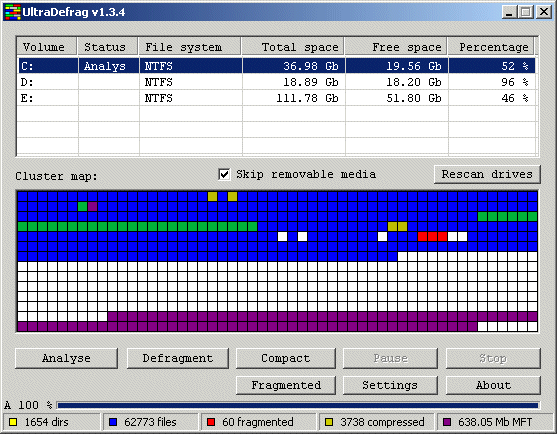
As part of my research for Degunking Essentials (basically a condensation and updating of my three Degunking titles) I happened upon a free disk defrag utility that's worth trying: UltraDefrag. It's open source and hosted on Sourceforge, meaning it's safe—at least if that's where you get it from.

The defrag utility built into Windows 2000 and XP is a crippled version of Diskeeper. It defrags but does not compact—that is, it does not consolidate the defragmented files toward the low end of the hard drive, and sometimes leaves a large number of contiguous files scattered around on the drive. The commercial version of Diskeeper is quite good and I bought it years ago, but UltraDefrag seems to do everything Diskeeper does, and it's free. UltraDefrag compacts files, separating files and free space. As an option it can also defragment the page file at boot time, something I've never done. (I don't perceive any increase in responsiveness having done it, though. I doubt it has to be done very often.) The UI is less whizzy, but results are what you're looking for, not flashy graphics. UltraDefrag is small, simple, reasonably fast, and easy to use. Get it here. Highly recommended.

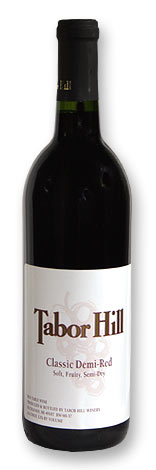
Tabor Hill’s Classic Demi-Red

We brought a wine home from Chicago last summer that sat quietly in one of the top slots in our kitchen island rack, mostly out of sight and until a few days ago, completely forgotten. The wine is Tabor Hill's Classic Demi-Red. It's a $9 wine from Michigan, and I broke it out looking for something that would go well with a spicy (for us at least; read here: has some spices in it) chicken goulash that Carol threw together just for fun.

Yes, it's fairly sweet by wine snob standards, but it's less sweet than St. Julian's excellent Red Heron, and on a sweetness par with most white zins. It has the virtue of not being sour, as semi-sweet wines too often are, probably by imitating white zin. It's fruity and does not have the sour white zin ragged edge. The label calls it “soft” and I agree. No perceptible bitterness, and not grapey, though “grapey” is not a show-killer for me. (It usually means having a whiff of concord in it, which is not always a bad thing.)

It's a 12% wine and went down very easily, making a good complement to the goulash. I don't know where all you can get it. We saw it in several of the Meijer's markets outside Chicago, and I can only assume it's common in Michigan. I have yet to see it in Colorado, and we probably won't have it again until our next trip in.

Nonetheless, if you like sweetish wines, I call it highly recommended.

By the way, tonight is The Wall Street Journal's Open the Bottle night, and we will (finally!) be opening the bottle of 1994 Schlossadler Dornfelder that we failed to open for our 30th wedding anniversary back in '06. Maybe's it's vinegar. I don't know how well dornfelders age. But we'll let you know.

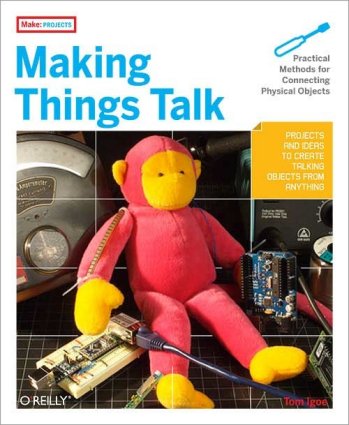
Review: Tom Igoe’s Making Things Talk

Triage is a harsh mistress. I started out in computing with the CDP1802, a microprocessor designed for embedded systems work (it was used on the Viking Landers!) and for all the software I've used and the code I've written since then, I miss poking wires in breadboard holes and hitting the trigger of a wire-wrap gun. There's only so many hours in a life, and embedded work has not made the cut.

That may change. Embedded systems tinkering is easier now. Much easier, and for a couple of reasons: 1) The processors themselves can be had on small boards with appropriate I/O connectors; you don't have to fool with loose chips anymore. 2) Development software is better, mostly because now there is development software. In 1976 I literally had to write binary code by hand. (F8 FF A2… Yes, yes, I know, barefoot and uphill both ways. But if you think I'm exaggerating, you simply weren't there.) And, the point of the current discussion, 3) there are books like Making Things Talk, by Tom Igoe. Wow.

The first time I saw the cover I was confused: It shows a stuffed monkey and the completely inane blurb, “Projects and ideas to create talking objects from anything.” I literally thought it was about fooling with speech synthesizers. But no: It's about networking embedded systems modules with technologies including Ethernet, USB, Bluetooth, and Zigbee. The microprocessor modules under discussion are the Atmel AVR-based Arduinos, augmented by a host of sensor modules and connectivity modules that can be breadboarded on the same 0.1″ spacing blocks we used to use in 1976. In a sense, we now have modules the way other people have chips. (And in saying so I am indeed just boasting.) We can raise our consciousness to the level of connecting functional blocks rather than individual inverters and logic gates. That is a very big win.

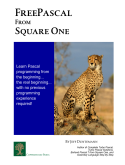
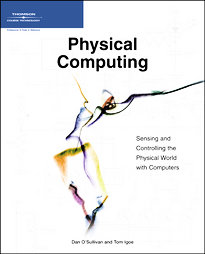
The book is patient (as good tutorials must be) and begins with probably the finest introduction to low-level networking that I have ever seen. If you are a software developer you will understand it; if you have no experience whatsoever in networking or programming, you may have some trouble. A good prerequisite text would be Tom Igoe's 2004 Physical Computing (written with Dan O'Sullivan) which focuses on the older Basic Stamp modules and their close relatives. Physical Computing introduces both electronics and programming to a degree that Making Things Talk cannot. That said, Making Things Talk presents examples using a Java-derivative programming environment called Processing, which is free and open source and much gentler conceptually than programming in raw Java or, merciful God help us, C. (Pascal would be gentler still, but as we all know, Pascal is a kiddie language that cannot accomplish anything useful. You must believe this. A C programmer said it. QED.)

Once the essential groundwork is done, the book teaches through projects, good projects that are mostly fun and in many cases even useful. The book explains how RFID tags work and how to read them, and how to read 2-D barcodes with a Web cam. The most fascinating projects are those that involve physical location sensing, using modules that perform infrared ranging, ultrasonic ranging, GPS, and “digital compass” modules, all of which made the robot guy within me itch like hell. We didn't have stuff like that thirty years ago.

Although it doesn't get a huge amount of coverage in the book, the XBee module (which implements a Zigbee data radio system) fascinates me: It's basically jelly-bean logic implementing a short-range mesh network, and I intuit that hobby robots of the future may well consist of swarms of semi-independent functional blocks knit together coherently through the Zigbee network protocols, under the control of a multicore master processor. And damn, I would love to build something like that.

Anyway. Here are a few additional observations on the book:

  • It has at least process color on most pages, with beautifully shot full-color photos on many of them.
  • The technical figures are abundant and very well done.
  • The type is very small, the margins narrow. This 425-page book would have been a 600-page book back in the 90s. My guess is that O'Reilly wanted to the keep page count down because of all the costly interior color. Note to my age cohort: Prepare to squint, or go get yer readers.
  • There is far less discussion on debugging than I'd like. Coding is easy—as is plugging jumper wires into breadboard blocks. But when something doesn't work the way it should, where do you start? The book is mostly silent on that crucial point.
  • In general, the book probably covers a little too much ground, and doesn't go for quite enough depth. Zigbee is subtle, and its subtler features are not explored here. This may not be a completely fair criticism, but it supports my conviction that you must be a journeyman embedded systems type to really get the most from this book, as a lot of the blanks you must fill in yourself.

Don't let any of that stop you: If you have some clue about embedded systems modules and want to learn embedded systems-level data communications, there is nothing like this book anywhere. And if I do decide to go back to embedded systems tinkering, this will be the book that pushes me over the edge. Not yet—I have a rocket or two to finish and a few other things to do—but soon, soon.

Highly recommended.

Recent Reading

I haven't reviewed many books lately, but that isn't because I haven't been reading. I read quite a bit, if not as much as I often wish I had time for. If I don't review a book here, it's generally for one of these reasons:

  1. Reviewing books is difficult to do well, and my time/energy is committed to other things;
  2. The books I read are sometimes so vanishingly narrow in interest that I doubt anyone would care what I thought of them;
  3. The books are so-so and I can't bring myself to spend time describing them.

This third point is the most interesting of the three. A really bad book I might mention to save you time and money. But what about a so-so book? Is it worth any effort at all?

This applies to wine as well as books. I try a lot of wine and like only some of it. The things I like I mention here, especially if they're unconventional. (Generally this means not dry.) I've mentioned a few wines that I loathe, like the unfathomably awful Sweet Walter from the incomprehensible Bully Hill Vineyards in upstate New York. But something like Taylor Sauterne is difficult to describe, as it has so little character I'm not sure what to say. It's not quite tasteless—just mostly tasteless. (It's certainly nothing like the other sauternes I've had in the past. But then again, it's an $8 twist-cap wine.)

So today I'm going to mention a few of the books I've read recently, including the odd things that I expect no one among my readership to be interested in. I won't spend a lot of space on any of them.

  • The Thunderbolt Kid by Bill Bryson. (2006) Probably the best of the current batch, it is nonetheless extremely uneven. Gut-splitting hilarious in places, it also has long runs of very boring stuff, and occasional departures that suggest anger that the author can't quite express. Misses more than it hits. Borrow it maybe, and when things get boring, skip to the next chapter.
  • Ghosts and Poltergeists by Herbert Thurston, S. J. (1954, and now out of copyright) A deadpan description of, well, ghosts and poltergeists from around the world and across centuries of time. Competently written but dry; if you want a diverting read in similar turf, try Colin Wilson's Poltergeist.
  • The Polish National Catholic Church by Paul Fox (undated, probably 1957ish) A self-description of the PNCC for prospective converts. Nice little book, with some interior color. Includes church history, its constitution, liturgy, and directory of parishes. Best concise description of the church at its peak that I've seen.
  • Who Really Cares? by Arthur C. Brooks (2007) Reviewing this book will only get me beaten up, but it reads well and provides loads of research that I'm not entirely sure I understand the same way that the author does. His conclusion: Political conservatives are less selfish than liberals, who are in turn less selfish than independents. My conclusion: It's down in the noise. Try again, dood.
  • The Fall of the Dynasties by Edmond Taylor. (1963; may be out of copyright) 300-level European history text that I read to try and understand WWI. Eye-crossingly dense, but he covers all the bases and I think I now have a grip on what destroyed Europe in 1914: Itself. What Europe is best at. Surprise!
  • Huck's Raft: A History of American Childhood by Steven Mintz. (2004) Almost worth a review, and not a total waste of time, but the author describes more than he explains, and I put the book down having gained a great deal of information but not a lot of insight.
  • Every Knee Shall Bow: The Case for Christian Universalism by Thomas Allin and Mark T. Chamberlain. (2005) Covers ground well-covered in other books on this topic, and doesn't add much that I haven't seen. Confines itself to scriptural argument, and doesn't go after more gnarly philosophical questions like, How can eternal punishment for finite transgression be just?
  • Original Blessing by Matthew Fox. (1983) A muddy-headed challenge to the Augustinian heresy that changed original sin to original guilt. Fox makes me nuts sometimes, but here and there he goes places nobody else wants to go. He's willing to condemn Augustine of Hippo, something no one else (except me) is willing to do. I honestly don't know what to think about this book, which will be incomprehensible to anyone without a fair grounding in Christian theology.
  • Complexification by John L. Casti. (1994) Awful, but not so awful I wanted to waste the energy required to throw it at the wall. Maybe a smarter guy could grasp what's there. Or maybe there's nothing there to grasp. Pass.

Note also that I cruise a lot of computer books, but I haven't sat down to read one cover-to-cover in years. I haven't mentioned any of those here, good or bad. I also occasionally pull out books I've already read and reread a few chapters to clarify some question that's been haunting my mind. I haven't mentioned those here either, but that's actually a growing slice of my reading time, and an interesting phenomenon all by itself that I should take up again at some point.

That will have to do for now. I know I've read a few other things in the last couple of months, but they made such a light impression I don't recall what they were, which says something right there.