- Carol and I were at the Longmont Dog Show over the weekend, and Aero got another two blue ribbons, though that was in the Open Dog category and didn't yield him any points. I actually “handled” (took around the show ring) another dog owned by Aero's breeder Jimi Henton. Showing Jackie (Jimi's Hit the Jackpot) was fun, especially since Jackie is the biggest, heaviest, strongest bichon any of us has ever seen (23 pounds, all of it muscle!) and there's nothing the least bit fussy about him.
- The Make blog aggregated an item on making your own railcarts and railbkes. I've often thought that this might be fun (it's certainly nothing new) but the snag is that when railroads abandon a run of track, they typically tear up the rails for scrap almost immediately. The mere presence of iron suggests that trains come through, if only occasionally, and that would make me nervous. I have been looking for but have not yet found an index of track sections where trains are known not to run.
- In the certifiable Brain Sludge category of Web content falls Topher's Breakfast Cereal Character Guide, which lists (and in most cases shows images of) all the characters hawking cereal on boxes and commercials that you've ever heard of, and I suspect more than a few that you haven't. The list also includes purely fictional cereals like Calvin's Chocolate Frosted Sugar Bombs, and Admiral Crunch and Archduke Chocula from Futureama. Early versions of the Rice Crispies Elves are interesting—and I never knew that Tony the Tiger had a spouse. All here.
- Speaking of cereal, this article confirms my grocery-store math: House brands cost as much as 40% less than largely indistinguishable name brands. If you're spending more for gas, at least spend less on Rice Chex. The only type of cereal where house brands taste distinctly different to me are oat toruses, or whateverthehell you call them in the generic—Cheerios clones. The house brands are not necessary bad (in fact, the Trader Joe's house brand oat toruses are distinctly better) but it's odd that all the chex and the flakes can't be told apart but Cheerios brooks no imitation. By the way, most house brand cereals are made by Ralston Foods. Here's their list. Of interest to geometers are Crispy Hexagons. What, no Crispy Dodecahedrons?
- And to round out the discussion of nostaligic carbs, I regret to inform all who may care that Dressel's Cakes are really and truly gone forever. Their distinctive frozen whipped-cream chocolate cake was a Chicago standard for 75 years, coming from their plant at 66th and Ashland Avenues, but the firm was bought by a French company a few years ago and dismantled for reasons unclear. (I'm glad I can still get Green River!)
- Mike Reith sent a pointer to goosh, a purely textual interface to Google that works a lot like the Unix shell. Could this be useful to the vision-impaired?
- There are no visible sunspots right now, and according to several items I've read, there have been none for some weeks, and very few for months, all the way back into the middle of last year. Ham radio guys (like me) track sunspot activity closely because it affects shortwave radio propagation. Here's a sample. It's probably too early to worry, but long-term sunspot minima have been very bad juju in the past.
Odd Lots
Short items presented without much discussion, generally links to other Web items
Odd Lots
Odd Lots
- Wired aggregated this item about a convertible bus/railcar that somehow suggests a modern take on the legendary Rio Grande Southern Galloping Goose lashups. I like the concept a great deal, especially for rapid transit in places where there are rails but not enough population density to create a dedicated passenger rail system. The technology is hardly original with Japan; I see Union Pacific maintenance pickup trucks riding the rails all up and down the old Northwestern corridor outside of Chicago every time I'm in town. The trucks straddle the tracks at a grade crossing, drop their flanged steel wheels, and then apply traction from the truck's rear rubber tires. I don't see why a passenger bus of some sort couldn't do the same thing.
- I don't recall when someone asked me this (or, in truth, who it was) but the decorative font used on the cover of the Degunking books for the main titles is the Chicken King font from Font Diner. The similar decorative font used in the main chapter titles is Fontdinerdotcom Loungy. Font Diner is a type foundry that specializes in retro fonts, and they have a bunch of them, generally sold in 10-font packs for $28.
- My uncle ran a dairy farm in Wisconsin until 1975 or so, and in addition to milk, his herd produced a mid-boggling (to me, at least) quantity of cow manure. Finally we have a small-scale mechanism for harvesting the methane produced by decaying manure. The consolidation of small dairy farms like my uncle's into monster corporate milk producers makes something like this not only economical but pretty compelling.
- What the open source world needs is a sort of integrated bootloader system as good as or better than Apple's BootCamp. I've been hearing about GRUB2 for a long time, but it doesn't seem any farther along than it was a year ago. Coreboot/FILO is another interesting idea, but as I read it would require close cooperation of PC hardware manufacturers—which would be a good thing, fersure, if it would happen. (That may be the big trick.) I'm considering the commercial Bootit NG for my next machine, but in the open source world I don't see a lot happening. If I'm missing something, do let me know.
Odd Lots
- Someone's invented a glass jar with a screw-on lid on both ends. Makes sense: By the time you reach the bottom of the peanut butter, most of the oil is gone and what's left is as hard as a rock. Or, alternate lids and gradually work your way toward the middle. If you keep alternating which end is up, the oil won't be as likely to collect on either end and the peanut butter may stay softer until it's all gone.
- Bruce Baker directs us to a Webring of homebrew CPUs. No VLSI. No LSI. Maybe TTL chips. Or discrete transistors. Or relays. I wire-wrapped a COSMAC machine with 2K of RAM back in 1977, and I thought it was a job. Wow.
- As an individual with a “special relationship” to calculus (and a special fondness for filk) I damned near bust a gut watching this. The Slashdot commenters (who are interesting all by themselves) need to get a life, or at very least a sense of humor. Most of them weren't even alive when Disco was first-run, and so I suspect the comedy shoots right by them.
- Epson has been demonstrating a proof-of-concept model of an A4-sized e-ink display with a mind-boggling resolution of 3104 X 4128 pixels, in monochrome. 385 DPI is more than enough for monochrome graphics (though gray-level depth is not stated) and within a few years, a full-sized letter/A4 ebook reader will not only be possible but inevitable.
- From Jan Westerlink comes a pointer to a wonderful gallery of home-made kites, including one I especially like, especially in light of yesterday's entry: A 4-cell tetrahedral made by rubber-banding 24 bamboo shish-kebob skewers together. Scroll down to pictures 24 and 25. Beautifully done, if a little prickly: If that thing dives toward you, duck!
Odd Lots
- Most people know that the New Age Millerites believe that the world is going to end on December 21, 2012; if that's news to you, here's a nice overview of this deliciously deranged topic, courtesy Frank Glover.
- Several people online, in an almost offhand fashion, have indicated that Vista's knucklehead UAC feature is training people to click “Allow” automatically, no matter what it's asking about. That may be the single greatest design error in Vista, and could over time render Vista as insecure as anything that came before it, and certainly less secure than just working in an LUA under XP.
- A reader has asked me to post an entry on all magazines to which I have subscribed and re-upped at least once, but no longer subscribe to. That would be an interesting collection, and a long entry, but I'll try and get to it soon. One of that group that I might still read if I had enough time is First Things.
- I had a tin toy robot when I was six or seven, and it seems like most of my friends had one or two. So it was a Boomer kid-culture phenomenon, and one I don't see much about these days. Here's a photo gallery from Wired with some nice shots. Most of my early childhood nightmares were about robots and mummies, which suggests that my two subconscious fears (at least according to one amateur Jungian friend of mine from twenty-odd years ago) were of death and berserk machinery. I'm not so sure; that was what most of the cheap horror/sf flicks I saw on Channel 7 were about at that time.
- Another interesting article/discussion on the Fermi Paradox. Me? I think we really are alone. I don't know why just yet. If I had to guess, I'd say that it's because imagination as a mental mechanism is rare. But I've been thinking about this for thirty years and keep coming back to that conclusion.
- Lordy, I remember these from catalogs back in the early 60s. Why do they suggest a filk: Looking Through the Eyes of Badminton! (Thanks to Bishop Sam'l Bassett for the pointer.)
Odd Lots
- Sorry for the recent quietude here; the weekend was a whirlwind, and it took all of yesterday just to catch my breath.
- Scott Kurtz' PvP webcomic celebrated its first ten years by showing us that Brent Sienna actually has eyes. Wow.
- Allan Heim sent me a pointer to a nice article on the Fermi Paradox that expresses a position I have been drifting toward for most of my life: That we are probably alone in the universe, perhaps not only as intelligent, tool-building beings but also as living things, period. The author makes a case that being alone in the universe would be very good news, but not for the reason you might think. Read it.
- Borland is apparently selling their CodeGear division (which develops and supports Delphi) to Embarcadero Technologies, a database tools company. This was not unexpected, and to be honest with you, I can't tell if it's a good idea or not. One of Delphi's most serious problems is that it got so good after five or six years that most people stopped upgrading; I'm amazed at how many people are still using Delphi 6. The cost of the product was also an issue—there is no ~$100 starter edition—and the Turbo Delphi Explorer experiment demonstrated how important the ability to install components was. An amazing number of people wrote to me to say that they downloaded the free product, installed it, fooled with it for a week or so, and then went back to Delphi 6.
- From Mike Sergent comes a pointer to a NYT piece indicating that most people do not have the training to discern the level of subtlety in wine flavor that they claim to, and that a lot of it may exist mostly in our heads anyway. This is not news (to me, at least) but it's nice to see it going mainstream.
- Michael Covington posted a fascinating graph of changes in home prices from Q4 2006 to Q4 2007, suggesting that the “housing bubble” has not been evenly distributed. The coasts have suffered, as have most major cities and trendy places like Colorado's Front Range, but flyover places like Nebraska and Wyoming have posted solid increases in that time. In addition to that, sharp differences by state suggest that state-level housing and banking policies have more to do with housing cost changes than most people are willing to admit.
- Also from Michael is a graph demonstrating that the US economy is not as much of a disaster as Big Media has been hammering on. (I won't invite all the usual hate mail by explaining in detail why this is, as it's pretty obvious if you think about it.)
- The other day I found myself thinking something remarkable (for me): I would rather buy a Mac and run my essential Windows apps in a Parallels window (or in a compatibility box like Crossover) than move to Vista.
Odd Lots
- Here at the condo this morning, I can't bring up squat on the Web because everybody's out there trying to figure out who won the Democratic primaries last night. So I did an absolutely unheard of thing: I went down to the White Hen, got some of their great coffee, and picked up a newspaper. What a notion.
- I'm hearing more and more people say that Wi-Fi doesn't work as well as it used to, which is weird because microwave physics hasn't changed recently. But…look at how many APs Windows can see from wherever you are. From my kitchen table here, NetStumbler sensed twelve APs…and walking around inside our dinky little condo picked up four more. Three of the strongest signals were on default Channel 6—and five out of sixteen were cleverly named “linksys.” I don't think it's the physics, folks.
- After Meetup.com went all-paid (and highly paid) I investigated an alternative called Gatheroo, which later (in response to another damfool lawsuit from somebody) became Zanby. The site's been redesigned and is worth a look if you want to start a meatspace social network where you live. There are both free and paid levels of participation, and it's certainly not as expensive as Meetup.
- Matthew Reed (and lots of others after him) sent me pointers to articles about the recent implementation of memristors, which are a species of passive electronic component postulated in 1971 but not actually implemented until HP researchers made some earlier this year. Whether this interests you varies directly by the strength of your passion for electronics, and whereas I understand the concept now, my head is still spinning trying to figure out what it implies. Everybody's talking about better computer memory, sure…but what could this do in simple analog circuits?
- Jim Strickland sent me a pointer to a YouTube video about a flame triode amplifier/oscillator lashup, and guys, you gotta see this. It's basically a vacuum tube without either vacuum or tube: When the electrodes get hot, it starts amplifying. I don't fully understand the physics yet, but this would be one fantastic high school science fair project. The question arose in our local group as to whether this could be considered steampunkish, and I'm not sure. People in the steampunk era had no problems generating reasonably hard vacuum and blowing glass envelopes. What they had problems with was understanding electrons. Nonetheless, with a big enough flame and some honkin' batteries, you could have done some impressive things back in 1888.
- Global Cooling adherents have been sending me pointers to Watts Up With That, and Icecaps.us. Fascinating reading, including numerous facets of the climate change discussion that you won't see in Big Media. F'rinstance: Weather monitoring installations that were built sixty or seventy years ago out in the leafy countryside have recently become surrounded by new development, buildings, pavement, etc., and as a result are now in the middle of heat islands. What might that do to long-term temperature data? Hmmmm….
Odd Lots
- We had rockfish for dinner the other night, and since I didn't know exactly what I was eating, I researched it (it's nothing remarkable; a sort of domesticated sea bass) but in the process I happened upon a brilliant little animated hard SF short about an unflappable interstellar sportsman of the future who goes out with his faithful pet monkeydog and trolls for The Big Catch: “Rockfish.”
- While we're doing animated videos, don't miss the charmingly inane steampunk short “A Gentleman's Duel” from the same studio.
- From Frank Glover comes a pointer to an interesting article about whether there are “habitable zones” in our galaxy. We're caught between our schedule, our metals concentration, and our supernovas, and ferdang, somehow we got placed “just right.” I'm always a little suspicious of charts that somehow get us dead-center. Supernovas may trigger lots of interesting things, from radiation-proofed cellular reproduction systems to “novel” stars and planets. I'm far from sure that zones closer to the Core are so deadly as to preclude the evolution of any kind of life—just Life As We Know It.
- Are you nervous about European-style national health care? You should be.
- Also from the NYT: The housing crash will likely cut the US birth rate, which roughly tracks housing availability and may be the reason that the birth rate is so low in Europe, with its staggeringly high housing costs.
- A compendium of really weird products, including wedgie-proof underwear and a Hilary Clinton toilet bowl brush. What boggles the mind is that this is not a collection of hoaxes: All of these items are real.
- Here's an eye-crossing but interesting paper that explains a lot of why I dislike competitive sports.
- From David Stafford comes news of one of the most bizarre motorcycles ever imagined. It's electric. It works a little like the Segway. It gets points for design, fersure, but…you ride. I'll watch.
Odd Lots
- Ok. It's April 16, and outside it's 30° and blizzarding. There's about two inches on the ground already and we may get another 4″ – 6″ tonight. Would you fools please stop calling it “global warming” and start calling it “climate change” before the whole world decides we're idiots?
- In one respect the snow is welcome: There were two very bad wildfires here in the last couple of days, one of them only about fifteen miles due south of me, and the smoke was bad enough to make my allergies go ballistic this morning.
- Interestingly, the fire broke out about a quarter of a mile from where we intend to go RV camping the day after tomorrow. (As best we know, the campground has not seen any fire or other damage on their land.) Snow seems to follow us on camping trips. (That little adventure was on the last day of summer, people!) We're hoping this time will be different.
- Democrats in Congress are spearheading an effort to compel states to collect state taxes on out-of-state online vendors. Far from targeting corporate fat cats, the effort will cost ordinary people, including some fairly poor ones, a great deal of money. Tell me, now: How is this supposed to help you win elections?
- I just bought an off-lease, nearly flawless Dell Optiplex SX270 3.2 GHz Pentium 4 with a 60 GB hard drive and a DVD-ROM…for $199. Computers, like books, have gotten so cheap that they're basically disposable. If this machine dies any time soon, I'll just buy another, wincing a little to imagine that my 1978 Intersystems DPS-1 S-100 bus machine with a 1 MHz 8080 CPU cost me $3600 1978 dollars. (It was the first and still the coolest-looking computer I have ever owned that I did not build myself.)
- The story I could not identify in my April 10, 2008 Odd Lots (about a guy who extracted gold from seawater) was “The Man Who Ploughed the Sea” by Arthur C. Clarke, and it was a Harry Purvis story from Tales from the White Hart.
- From Bruce Schneier's CryptoGram comes a pointer to a wonderful little piece on what sorts of books bookstore shoplifters lift, and what sort of man a bookstore shoplifter is. (You do subscribe to CryptoGram, don't you?)
- The lyrics to one of the funniest pop songs ever to hit the Billboard Top 20 are (legally) online, at the author's Web site: Dean Friedman's 1976 “Ariel.” It's one of the few songs I would ever consent to perform in public, though that would require that I learn to play some kind of an instrument. Maybe this.
- Bob Thompson sent me a link to one of his posts relating (as my entry for yesterday did) to catalogs of the 1960s, in this case the Sears Catalog. His comments pertaining to chemistry sets are bang-on, though I would add that a significant amount of the value of chemistry sets lay in allowing kids to imagine themselves as scientists—chemistry has more identifiably iconic paraphernalia than almost any other scientific discipline—and what kids can't imagine themselves as, they generally won't become.
Odd Lots
- Those who marveled at the quirky motion of the Big Dog quadripedal robot should not miss the (inevitable) video parody.
- And while we're watching videos, make sure you watch this one, starring a Pope Benedict XVI bobblehead identical to the one on my bookshelf. While this is what I call “gentle humor” and I suspect that Good Pope Bennie (with whom I disagree but whom I do not despise) would have laughed had he seen it, the usual grump-ass moroons who object to things like this prevailed to have the ad pulled. Fu on 'em.
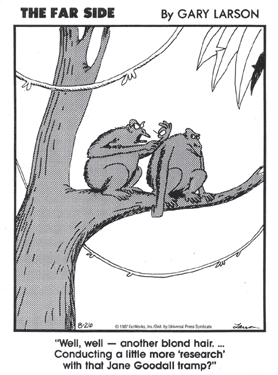
- Which of course reminded me of this famous Far Side cartoon, which incensed Jane Goodall's staffers but made the great lady herself laugh. My father told me early on: Life demands a sense of humor. Only cowards cannot laugh at themselves, and only hopeless slave-collar tribalists cannot abide humor about their own leaders.
- George Hodous sent me a link to an artist who uses intersecting lasers to etch a crystal cube containing a 3-D starmap of our stellar neighborhood out to five parsecs. Nice work, and if you ever forget, he's marked the direction to the galactic core.
- Maybe this is why I started to get muscular in middle age. Thanks to Frank Glover for the pointer.
- Takahiro Kato of Japan sent me a link to his page on 12V tube work, including a 30mw transmitter he designed. It's in Japanese, and (alas) the machine translation link does about as well as machine translation links generally do. But look at his construction techniques—I haven't seen anything that clean and rational for a long time.
- Those who love The Rocketeer (whether the graphic novel or the film) will want to take a look at this, documenting a Swedish inventor who has come damned close to making it real. (Yes, he does look more like Buzz Lightyear than Cliff Secord.) No explanation here of why his pants don't catch fire, but hey, wow.
- While hunting for a new standard model thumbdrive to replace the no-longer-made Cruzer Mini I ran across this prototype. Not what I need but very cool nonetheless. Let's just hope they don't pollute it with U3.
- In thinking about non-obvious disruptive technologies, it occurred to me that using nanotech filters to separate gold from seawater could be hugely disruptive to nationalk economies if it became effective. However, with gold at about thirteen ppt (parts per trillion) in seawater, it would take a lot of nanofilm to get any useful quantity. I vaguely recall an old SF story about a guy who pulled gold out of seawater somehow. Anybody remember what that was?
Odd Lots
- I've had a difficult week here; new dental problems have arisen, culminating in an unplanned root canal this past Thursday, followed almost immediately by a much-delayed flight from Denver to Chicago for an Easter visit, where they happened to be having a blizzard. (The earliest Easter since 1913 corresponded with a lingering winter across the Midwest.) Tooth troubles continue, so if my posts have been (and continue to be) a little sparse, that's most of the reason.
- Our early Easter this year caused some people to ask how the date of Easter is calculated. Well, it's not pretty. At least next year it happens in April, whew.
- Here's a nice article describing a problem that is by no means recent: The split between people in the Catholic Church who can worship with a light heart, and people who invariably equate reverence with grimness . This has been an issue at least since Pope Pius IX lost the Papal States in the mid-1800s, after which the Papacy became obsessed with its authority and lost any ability to laugh at itself or anything else. (Pope John XXIII bucked the trend, but we didn't have him anywhere near long enough to make a permanent difference.) Roman Catholicism needs a sense of humor far more than it needs a Pope, but this may be one of those things that won't be solved within my own lifetime.
- In keeping with its long history of contempt for the consumer (which, in all fairness, is rife in Japan) Sony attempted to charge purchasers of its laptops $49 not to install a crippling load of crapware on the machines. Apparently they've taken so much flak for it that they recently dropped the fee. What I find boggling is that they willingly cripple their own machines by selling huge numbers of crapware slots, which makes you wonder how much money they make in the crapware business. We may be heading down the same path here for laptops that printers have followed, in which the printer is a thin, shabby thing sold for very little that makes money for its parent company by consuming artificially expensive ink/toner cartridges.
- It seems that I've been hearing a great deal within my own circle of contacts about people who try to help nontechnical folks (often parents) make Vista work with existing peripherals and software. The script goes like this: Nontechnical person brings home a new Vista PC or laptop from Best Buy and tries to install older software or connect it to various external hardware devices. Install fails; system aborts in various weird ways; technical person tries to fix (or simply understand) the failure, to no avail. Moral here: Do not use Vista. Everything that isn't needless window dressing is there for Microsoft's or Big Media's benefit, not yours. (Reread the venerable Vista Failure Log if you haven't read it for awhile.) You can still order PCs from vendors like Dell with XP preinstalled. Do it while you still can. And failing that, start researching Ubuntu/Kubuntu.
- Speaking of failure, WiMax (which we have seemingly been waiting for since the last ice sheets retreated) may be a failure because it's lousy technology. The wireless DOCSIS technology mentioned in the linked article as a solution has been around for some years and doesn't have a much better reputation. We may in fact be asking too much of low-power microwave broadband systems—fixed point-to-point broadband is totally at the mercy of topography and even vegetation—and I keep coming back to the conviction that some sort of “roof-hopper” mesh network may be the best path to follow. People are doing this in some areas; why it isn't seen as a more general solution puzzles me.