- On Monday I returned the last third-pass page proofs (of a very gnarly part of the book, the partial instruction reference) and if the publisher’s schedule is to be believed, Assembly Language Step By Step, Third Edition goes on press tomorrow. Real books should be out of the bindery and in the warehouse by September 22.
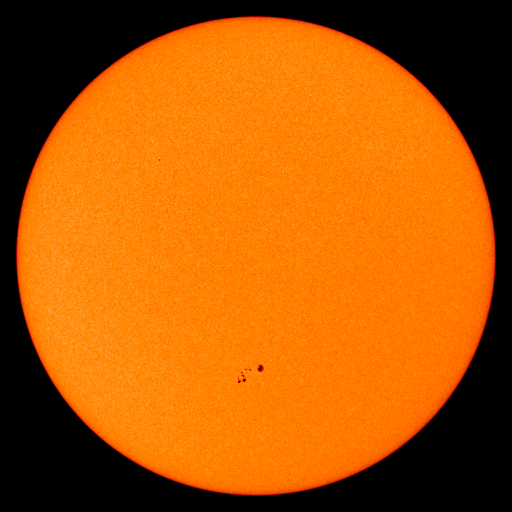
- We came within a few hours of having a sunspot-free calendar month in August, but then very late Monday night, a barely visible sunspeck showed up, ruined the run, and then immediately started to vanish. The sunspot minimum appears to be heading for a double bottom, and there are people at NASA suggesting that deeper mechanisms are changing within the sun, and we may be a long time before seeing anything like a proper sunspot peak. So much for DXCC on 10M.
- Cory Doctorow speaks up on cloud computing, the goal of which, he says, is to allow companies to make money in a mature computing market by charging you month by month for computional facilities that you already have at home. So tell me: How many people actually collaborate in the Cloud, as a percentage of people who actually compute? I think it’s in low single digits–which suggests that the Cloud as an idea is something like 95% scam.
- If you’re following Michael Arrington’s CrunchPad project, the CrunchPadFans blog is worth a visit every week or so. It’s a little sparse, but there hasn’t been much news generally on the long-awaited gadget in recent weeks. I intuit that it would make a jack-fine ebook reader, if software to handle the major formats is included or installable.
- And speaking of ebook formats, Sony has announced that it will be supporting the EPUB format in its new reader products, days after Google’s announcement that it will be doing the same within its Google Books system. EPUB is a reflowable open standard not controlled by any particular firm, and if I had to finger a winner in the ebook standards wars (at least for primarily textual works) this would be it.
- Further relevant to ebooks is a reader app I’ve been fooling with on Ubuntu: Okular, which is nominally a PDF viewer but can open and display lots of other formats, including DjVu, CHM help files, Epub, Plucker, MobiPocket, and a few others. Although it’s a KDE 4 app, I’ve had no difficulty making Okular run under GNOME. Okular on a suitable handheld Linux-enabled device could make a helluvan ebook reader.
- And Okular led me to the KDE on Windows project, which aims to create native-code ports of KDE apps to Windows, with an installer to make it easy for non-techies. It’s early and the product doesn’t look as easy as it should be, but then again…it’s early.
- I’ve discovered a much higher-resolution photo of the old Turtle Wax building at the Ashland/Ogden/Madison intersection in Chicago here. We would pass that building on the way to my grandfather’s house Back of the Yards back in the late 1950s, and my mother would always point out the 25-foot tall turtle on the top of it. Cool building, too, turtle or not. Gone now, alas–the turtle and the building both.
Odd Lots
Short items presented without much discussion, generally links to other Web items
Odd Lots
Odd Lots
- This morning, Slashdot aggregated two articles representing both sides of the Google Books settlement: The Authors Guild arguing for it, and the William Morris Agency arguing against it. My thoughts: Since nobody knows where this will lead, but it will happen whether I opt out or not, I’m in. It’s not like I’m making money on books like Turbo Pascal Solutions anyway. If they can wring a few nickels out of my old material, I for one will be glad to have it. (This is worth a whole entry, but I just don’t have time today.)
- Old Catholic geek bishop Sam’l Bassett sent me word of Micro-Rax, a 10mm version of the well-known 25mm or 40mm 80/20 system for industrial prototyping. I’ve held off fooling with T-slot projects because the stock was out of scale for what I was trying to do, but this could be just the thing. The company (owned and run by a pair of identical twins) is just getting underway with Micro-RAX, and it’s worth watching. I’m may buy a set just for the helluvit.
- Leave it to Lileks to find a matchbook from The Griddle, billed as The Scientific Restaurant, which boasts an automatic griddle cake machine that looks like it should be a fusion reactor of some sort. Close Cover Before Ignition…
- And speaking of nuclear, I spaced on this back in late June because my site got hacked, but Pete Albrecht pointed out a whole site devoted to nuclear yield and exposure slide rules.
- Wait! There’s more! If you want one of your very own, you can buy one from Don Lancaster. (Yes, that Don Lancaster!)
- From the Words I Didn’t Know Until Yesterday Department: Shoegazing is a musical subsubsubgenre that existed for a few years in the early 1990s, and sounds like, well, nondescript rock music. (Thanks to Pete Albrecht for pointing it out.) The name comes from a tendency of some shoegazer bands to stare at the stage while they played. Apparently the movement died when it became “…over-privileged, self-indulgent and middle-class.” Damn. The nerve.
- GM is now selling cars on eBay. It sounds ridiculous at first blush, but what piques my interest is the de-emphasis on face-to-face dickering, which I absolutely cannot stand. When Carol and I bought our 4Runner in April 2001, the sales experience was so hideously unpleasant that every time we think about buying a new car these days, we shiver and stick with what we have.
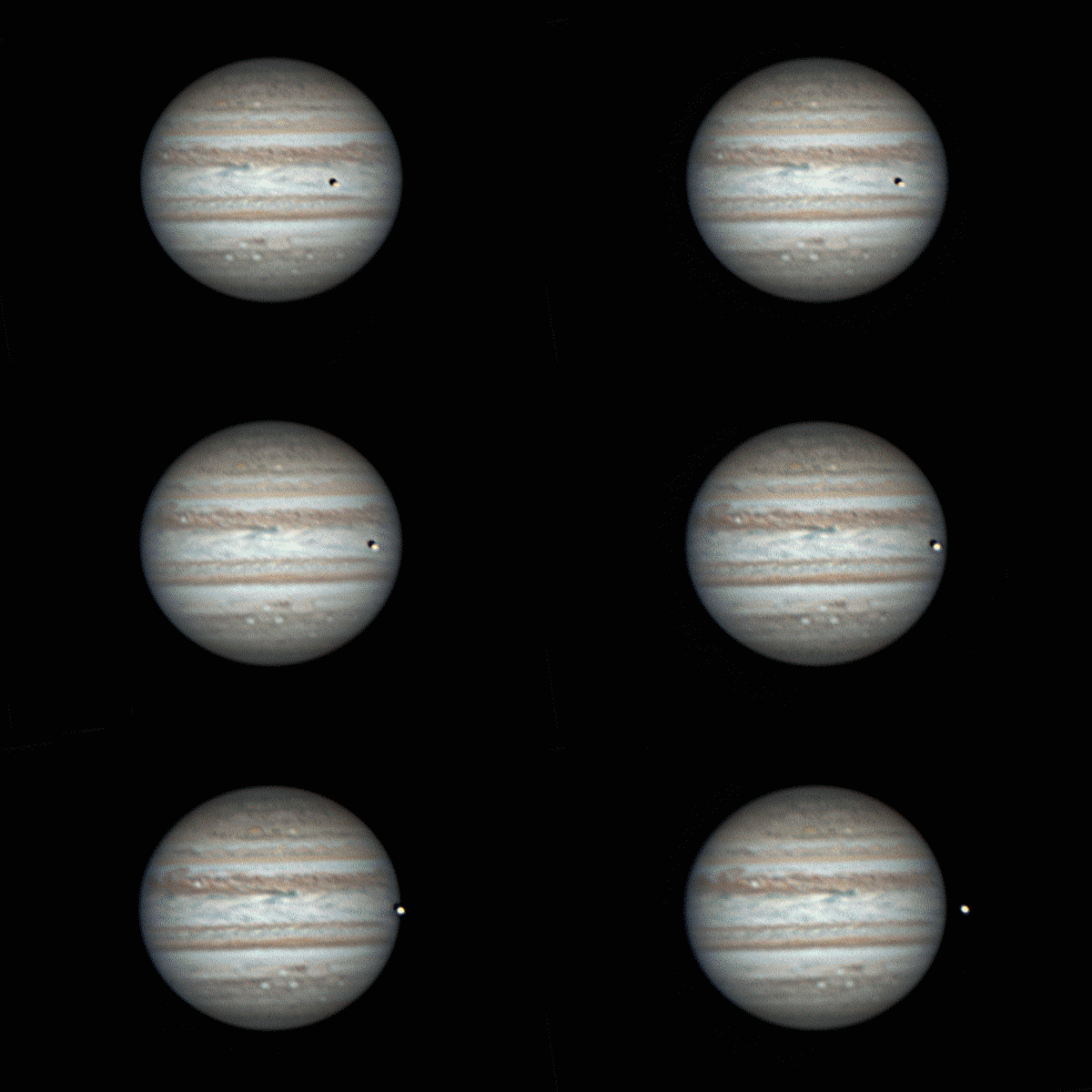
- Spaceweather has a wonderful animated gif of Jupiter’s moon Io crossing its disk at opposition, meaning that Io’s shadow is immediately below it on Jupiter’s disk and gives a 3-D effect to the photo that you generally don’t see.
- And if that weren’t enough, the same site has an animated gif of Io’s shadow passing over Ganymede!
- Here’s a Web site I could have used back when the Lord of the Rings film trilogy was in the theaters: RunPee.com, which makes suggestions as to when you might miss less of the film by taking a bathroom break. Very important for certain old guys with certain oversized glands.
- How did Benjamin Frankin manage his time on a typical day? Here’s a page out of his daily scheduler, though Outlook was still a couple of centuries in the future. Ben’s day is amazingly like my day, save that I generally stay in bed a little longer. But I too hit the sack at 10 PM or before–been doing that for five decades and then some. Thanks to David Stafford for the link.
- And in in reading about Ben’s day I found this article by Paul Graham, about the differences between managers’ schedules and what Paul calls “makers’ schedules.” Definitely worth reading. The two cultures need to understand one another, and generally don’t, with much anguish and lost productivity resulting.
Odd Lots
- Sleep seems to be key in allowing the brain to infer big-picture relationships from scattered facts–and by implication, memories. I’ve never been a strong sleeper, and I wonder if some of the “fails” in my older memories stem from inadequate deep sleep.
- Also from Wired Science: People who don’t get enough sleep are touchy and angry. (Not like that’s news to anyone who’s prone to sleepless nights.) Could this explain the peculiar unpleasantness of the political blogosphere? I’ll vouch for the fact that peace, love, and tolerance of people who disagree with you is much easier on nine hours’ sleep than five.
- If you’ll forgive the expression, here’s a long, beefy article on why everybody thinks animal fat is a bad thing (hint: it’s because a Right Man cherry-picked his data to confirm his hypothesis) and why, to the contrary, animal fat may be very, very good for us.
- Maybe this will bring the issue of bad patents to the top of the queue. (Thanks to Pete Albrecht and numerous others for the link.)
- From Jim Strickland comes a link suggesting that your family dog may be smarter than the average toddler. (Your dog, maybe. Mine, probably not.)
- I was wrong about it coming from a Kum & Go store; while sorting my charge card receipts I discovered that Fat Dogs (see my entry for August 7, 2009) is a small chain of Conoco-franchised gas station/convenience stores limited to Western Nebraska. They had some water private-labeled by Sandhills Water, and put their wry corporate motto on the top of the label.
- Lileks takes on the Sears Catalog for 1973. I remember that catalog. Fortunately, my clothes came from Goldblatts. And did real, human, breathing girls wear these things? Maybe the girls in Hoffman Estates did. In my neighborhood, well…no.
- From the Words I Didn’t Know Until Yesterday Department: juiceboxer, a young, arrogant, high-status preppie-type. Their parents got their juice from bottles. And their grandparents mostly got it while it was still inside the fruit. Juice as a product is a relatively new thing; keeping juice from fermenting is difficult and one of the unappreciated miracles of our modern age.
Odd Lots
- Yes, I’ve been lax on posting, but we’ve taken a short vacation with Carol’s family, and I’m reading PDFs of the finished pages in my book, for reasons that I don’t need to go into here. I have lots to post about, but little time or energy to do it. Bear with me.
- Our new puppy now weighs five pounds and is going on eleven weeks old. He still hasn’t told us his true name, but we’ve suggested Dash, Pascal, Dover (think “White Cliffs of”) and two dozen other things, and all he wants to do is chew on Carol’s slippers. At least he’s learned to use the potty pad, a trick Aero never quite mastered.
- You can help classify galaxies from the Sloan Digital Sky Survey over at the Galaxy Zoo, which is one of the coolest crowdsourcing apps I’ve ever seen. You don’t have to know anything about astronomy to classify galaxies, but people who are passionate about galaxies may find the process less boring.
- Anyone who has ever killed time with Conway’s Game of Life has got to see this video, of a spaceship gun: a large, complex GoL pattern that generates moving “spaceship” automata that then crawl away toward the right. The gun seen from a height looks stable and in its own way beautiful, but at higher magnification it’s full of furious activity, almost like a chaotic Pac Man game. How such things are designed escapes me completely, but this makes me wonder what larger and even more complex GoL structures exist and have not yet been designed. (Discovered?) Thanks to David Stafford for the link.
- David’s hot this week: He also sent a link to an extremely intriguing article suggesting a different sort of cosmic cycle: After the Big Bang, time began running, but then gradually slows down until it stops. At that point, what had been the time dimension becomes a new space dimension, and (presumably) the whole thing blows up again with a brand-new time dimension, as a richer and in some respects more mature cosmos. Shades of Stapledon’s Star Maker.
- Although we’re still seeing TV spots by the late, great (ok, loud) Billy Mays, Mays has an heir-apparent: Vince Offer, who has begun to saturate off-peak Weather Channel ad space with pitches for Sham Wow and the resurrected Blitzhacker, now unfortunately called Slap Chop in the US. (Carol and I had one thirty years ago, and it was indeed useful.) Mays had a certain goofy warmth about him. Vince, well, he’s just…scary.
- “Sheesh, this thing is ancient! If it breaks, where am I going to find another?”
Odd Lots
- Probably because I don’t work that much in the realm of historic images, I did not know that scanned or photographic copies of public-domain images are also in the public domain, at least in the US. I’ve been gathering scans of pre-1923 artwork for possible use on book covers for several years now, but the uncertain origin (and thus the copyright status) of most of the copies themselves has given me pause. I guess it’s time to end the pause and hit Play.
- We’re currently in peak season for noctilucent clouds, which are high-altitude ice-crystal plumes of mysterious origin. Because they’re so high, they reflect sunlight long after the land beneath them is in night-time darkness. NLCs are appearing farther south recently for reasons not understood; predictably, it’s been ascribed to global warming, but some research indicates that southward excursions of NLCs are a proxy for low solar activity, which we’ve certainly been seeing the last couple of years. (Spaceweather has been covering NLCs a lot in recently weeks, with good photos.)
- Here’s an R2D2-shaped toilet paper cozy. Hey, why is this any weirder than the crocheted teal-yarn poodle-nose cozies that my Aunt Josephine used to keep her toilet paper in?
- I have a strong affection for Nebraska, and here’s an interesting article about abandoned farmsteads and structures in the western Great Plains portion of the state. (Thanks to Pete Albrecht for the link.)
- A chap named Julian Beever may be the real master of 3-D sidewalk art. (Thanks to Roy Harvey for putting me on to him.)
- We’ve now had cheap desktop CD-R burners for at least ten years, and the lifetime of the media is supposedly about that. Here’s a reasonable article on optical disc longevity that isn’t from an industry source. Has anybody noticed any burned (not stamped) data discs from the 90s going bad yet?
- When we lived in Arizona, I used to climb an elderly neighbor’s thirty-foot-tall grapefruit tree to help her get the high-hanging fruit. I was in my early forties and that was the last time I ever climbed trees on a systematic basis. If I had to do it again, I would probably stay on the ground and build something like this.
- Has Bucky Fuller’s Cloud 9 cities concept ever been used in SF? There’s not much to be found online about them, but in brief, he was talking about geodesic spheres as much as several miles in diameter, each containing whole cities that could float via thermal lift by virtue of as little as a degree or two of temperature delta between inside and outside. I’ve been imagining Cloud 9 spheres made of drumlin parts (with possibly a Hilbert drive ring around the sphere’s equator) and I’m a little surprised that I haven’t already seen the idea used in fiction, given that Bucky wrote about it in 1960.
Odd Lots
- Here’s a nice, high-school physics level lab demonstration of an aluminum air battery, made from aluminum foil, aquarium charcoal, salt water, and a paper towel. A few of these in series will run a simple solid-state radio. It would be fun to figure out how to expand the concept into something a little more durable, with thicker aluminum plates, in some kind of container that will confine the messy materials and yet admit oxygen to sustain the reaction.
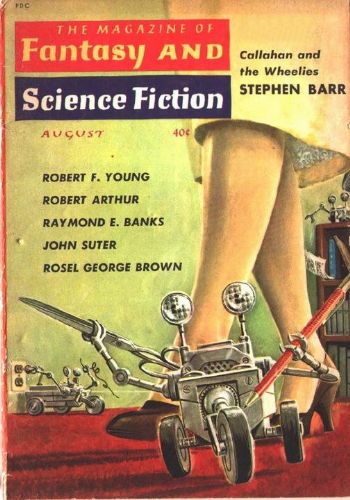
- Damned if the photo of this beambot doesn’t remind me of the Ed Emshwiller F&SF cover for “Callahan and the Wheelies,” a 1960 story by Stephen Barr that I blatantly imitated in my own high-school fiction.
- When I first got into computing in the midlate 1970s I had a number of CPU green cards, but was always a little puzzled that none of them were…green. (The COSMAC green card was blue, and the 8080 green card was white.) In truth, I didn’t know at the time why everybody called them “green cards,” and if you still don’t know, here’s a site where you can see the real deal. (Thanks to Richard Haley for the link.)
- And from Richard’s own hand comes a list of instruction mnemonics that you won’t find on most green cards, of whatever color. My favorite is EMW, Emulate Maytag Washer, which the crotchety frontloading 3330 disk packs back at Xerox building 214 were very good at doing, except that they were in the spin cycle all the damned time.
- Google Books has mounted most (if not quite all) of a fascinating book called Hi There, Boys and Girls! which is a history of local children’s TV programming in the US. The book is organized by TV markets around the country, and the Google Books version is intriguing for how much material is actually available for free. The Chicago material is available, and excellent, if not as detailed as Jack Mulqueen’s full-book treatment in The Golden Age of Chicago Children’s Television, which has a much more limited Google Books preview.
- We are getting close to the release of Michael Arrington’s Crunchpad Internet tablet, but little or nothing has been said about the only thing I really want it for: a large-display ebook reader. It needs an SDHC slot (which I think it has) and some decent ebook software (anybody’s guess) but given those two things, it could remake the ebook biz. July is flying. Wherezit at, Mike?
Odd Lots
* From the Words I Didn’t Know Until Yesterday Department: “Forcemeat” is meat ground sufficiently fine to make it cohere with a fat base, and mixed with spices and sometimes other ingredients before incorporating in patés, stuffings, and sausages.
* The Weather Channel is running saturation-level advertising for a “3D chalk” product from Crayola, which is apparently a selection of very bright, almost day-glow colors of sidewalk chalk, plus a pair of 3-D glasses with which to view your sidewalk artwork. Done correctly, the warmer colors seem to float above the sidewalk a little. It’s almost impossible to think of this product and not flash on the sequence in Disney’s Mary Poppins in which the gang jumps into Bert’s sidewalk chalk drawing.
* The venerable Alfred Morgan borrowed some of the circuits found in his boys’ books on electronics. I found the phono oscillator circuit from The Boys’ Second Book of Radio and Electronics in a 1943 Meissner data book, and now Peter Putnam sent me a link to a 1955 article in Popular Science showing something very close to the diabolical Geiger counter circuit that I tried and failed to build (out of the same book) in 1964.
* There are fake high-capacity USB thumb drives going around. (Thanks to Frank Glover for the link.) Nobody’s making 128 GB thumb drives yet (though they will eventually) so don’t fall for it.
* Also from Frank comes a link to an interview with Eric Lerner, the man who claims to have developed a new kind of fusion reactor he calls “focus fusion.” I’m not enough of a particle physicist to know whether this is a scam or not (though it sure smells like one) and I hope that my readers who are particle physicists can tell me whether the physics is as dicey as the business plan.
* Our long, long sunspot drought may be coming to an end. Spot 1024 is the largest seen yet of the new Cycle 24, and the largest sunspot seen in almost a year. I guess I better start shielding the fire alarm sensor wires, so I can get on 10 meters!
Odd Lots
- One of the most remarkable photos of a volcanic eruption ever taken apparently happened by sheer chance, when the ISS passed over the Kuril Islands just as the Sarychev Peak volcano let loose. The rising plume literally punched a near-circular hole in the cloud cover.
- Just in case you happen to see a nuclear weapon go off, having one of these in your pocket would be handy to quantify things. (Thanks to Pete Albrecht for the pointer.)
- From Bruce Baker comes a pointer to a NYT article about the perils of being an outsourcee for an unscrupulous publisher. And so much for our textbooks being created by experts with advanced degrees.
- John Cleese’s lighthearted but still informative documentary “Wine for the Confused” can now be seen on Hulu, at the cost of a few Toyota commercials. I’m good with that–and in complete agreement with Cleese that knowing good wine from great wine is not automatic, and in fact knowing good wine from bad takes more effort than most would think. Don’t miss it. (Thanks to Roy Harvey for letting me know it was there; I saw it on TV a couple of years ago and much enjoyed it.)
- We may gasp at 64 GB thumb drives now, but storage technologies coming to market in the next few years will make 1 TB thumb drives not only possible but commonplace. (Thanks to Frank Glover for the link.)
- The annual amateur radio Field Day event happens this weekend, from 1800 zulu on Saturday to 2100 on Sunday. I’ve got the radios boxed up, and will be experimenting with a interesting rotatable dipole made from a pair of AN-45G collapsible military whip antennas, on top of a pipe mast made of four 5′ sections of 3/8″ pipe mounted on my ancient telescope pipe base. The rotator is my right hand, turning a greased 2″ pipe joint on its own threads. I’ll describe the dipole with photos if it works; if it doesn’t work I’ll admit failure and quietly forget about it. But if you’ll be on the air, I’ll be working solo from a nearby campground as K7JPD. Listen for me.
- From the Too Weird To Be True but True Anyway File: The woman who may well become our first Hispanic supreme court justice stated quite flatly in her Princeton University senior thesis that “…in Spanish we do not have adjectives. A noun is described with a preposition.” I’m a Polish-German-Irish-French ubermongrel who last took Spanish in 1973, and even I know better than that. So…can I be on the Supreme Court instead?
Odd Lots
- Pete Albrecht alerted me to Collecta, an interesting twist on a general Web search engine, in that it gathers news being posted Right Now, and displays it item by item on the screen in realtime While You Wait. Alas, most of what it seems to index are tweets, which may just barely count as information, for small values of “information.”
- And yet another stab at the same concept.
- Kingston has just announced a 128GB flash drive. Figuring an average MP3 is 5 MB in size, that’s 25,600 MP3s. And if the average MP3 runs 4 minutes, that’s 71 days of music running 24/7 with no repeats.
- Rich Rostrom sent me a link to a (pretty dense) medical research paper suggesting another possible benefit of low-carb diets: ameliorating schizophrenia. A 70-year-old schizophrenic woman went on a low-carb diet and after eight days ceased experiencing hallucinations. Not any reasonable cause-effect here in this one case, but boy, this suggests a promising avenue of research. (Steak, cheese, and fish are way cheaper than designer drugs.)
- It’s gotten cold enough in Brazil this year to allow Brazilian vineyards to make the first-ever Brazilian ice wine. (Babelfish translation of the original Portuguese.) Ice wine is a dessert wine delicacy made from grapes that are allowed to remain on the vine long enough to freeze in the first cold nights of autumn. Trouble is, there are almost never enough freezing nights in autumn in Brazil to make ice wine. (Most ice wine comes from places like Austria.) Ice wine is great stuff: I’ll continue to worry about global cooling but damn, I’ll buy a bottle!
- Ten years or so ago at Coriolis, we had an underwear policy. We did not, however, have an open wounds policy. HR gets more complex all the time…
Odd Lots
- Have been reading copyedits and catching up on any number of things after five weeks away from home. We’re going to have real books out of the bindery on or about October 1. For the time being, I’ll be glad to just Not Be Doing Book anymore. (And that should be on or about June 30.)
- Some twit (maybe twits) wrote Twitter apps that store unique tweet ID numbers in signed 32-bit integers. The tweet count since startup is approaching the magic number 2,147,483,647. After that, tweet IDs become negative, and hilarity reliably ensues. Should be tomorrow; let’s watch.
- In other recent software fails, Ubuntu 9.04 broke Skype out here, and made sound support work a little weirdly generally. The Mute button gets checked all by itself for no apparent reason. This is evidently not a problem I’m having all by my lonesome, but time to fix it has been scarce.
- A 14-year-old boy got hit by a meteorite, albeit a smallish one. He got a 3-inch scar on the back of his hand, which (once the bandanges come off) will be the most interesting conversation piece he is ever likely to own, since he evidently had to give up the meteorite itself.
- Building this must have been a picnic. (But I’ll bet the view’s to die for.) It’s a tourist thing, like the tchochke shop atop Pike’s Peak, but way cooler. And yet another reason I have to get back to France someday.
- If everything goes well and the IC-729 still works, I may be out in the (pacified) woods somewhere working Field Day on June 27-28. (I hate to haul my IC-736 into the wilds, but I will if I have to.) I have an RV with a generator, an AH-3 antenna tuner, and an obscene amount of wire. I know I can’t use an RV park’s electricity, but can I use their water pipes for an RF ground?