- Watch out when upgrading to Skype 4: The upgrade installs a Firefox/IE extension called Browser Highlighter that slows the browser down significantly, and I sure don’t remember it showing me a checkbox to uncheck or in any other way refuse the install. This install-without-warning has gotten people more than a little het up. Like Skype, Browser Highlighter is owned by eBay and appears to facilitate online price comparisons. To get rid of it, execute the uninstaller via Start | Programs | Browser Highlighter. Don’t just disable it in the browser; it must be uninstalled from Windows like any app or it’ll just show up in your taskbar tray again when you reboot.
- From the Words-I-Didn’t-Know-Until-Yesterday Department: An acnestis is an itchy place that you can’t reach to scratch. (Thanks to Larry Nelson for the suggestion.) I use a 24″ slide rule to scratch my acnestes. Very accurate; gets to precisely the right spot!
- The Arrington Crunchpad may be in trouble. Dayum. I had high hopes for this one, not so much for Web or cloud work as for an ebook reader.
- Here is a fantastic archive of scanned Radio Shack catalogs, browsable page-by-page. I had a lot of these from the midlate 60s to 1980 or so, and intermittently since. (Thanks to Bernie Sidor for the link.)
- From Bill Cherepy comes word of a managed PC built into a network jack. It’s unclear how well this would run desktop software, but for cloud computing it could be useful, and in a cube farm setting would not be easily picked up and walked away with.
- In addition to Green River and Diet Green River, there was at one time Green River Orange Soda, and Pete Albrecht reminds me that there was yet another (unrelated) Green River: The Whiskey Without a Headache. I’ll believe that when I feel it. (But I can’t stand whiskey, so don’t wait up for me to do the experiment.)
- And if “whiskey without a headache” sounds a little unlikely, then say hello to the robotic cow rectum.
Odd Lots
Short items presented without much discussion, generally links to other Web items
Odd Lots
Odd Lots
- The University of Utah has a fascinating animation demonstrating the relative sizes of very small things. Starting at the scale of a coffee bean, you can zoom down by pushing a slider past single cells, various viruses, proteins, until you reach the carbon atom. Won’t take but a minute, and has plenty of wow factor, especially if you can’t picture things clearly at nanoscale.
- For all the beautiful weather and the fact that school was out, this year’s Halloween saw no trick-or-treaters here on Stanwell Street until almost 5 PM. Summer from around the corner and her third-grade friends arrived in a mob at 6:30, and Dash got plenty of girl-attention, but that mostly exhausted the supply of local grade-schoolers. A few young teens came by between 7 and 8, but that about was it. The neighborhood has a fair number of teens, but we were told they were all having at-home parties, and we’re good with that, though I have a mass of Milk Duds here that would probably go critical if placed in a single sufficiently large bowl.
- Carol and I went over to our next-door neighbors later in the evening. Carol wore her footie jammies and put her hair up in huge 70s rollers. I cobbled up a Ben Franklin outfit that wasn’t half bad, and I carried the small pink kite tethered to a balloon stick with about two feet of string. When we walked in, the guy down the street commented, “Lost some weight, huh Ben?” “Yup,” I replied. “Low-carb and all that.”
- Want to haunt a house? Hire a team of scientists and an architect. Real ghosts just never show up for work when you need them.
- This is the smallest packaged PC I have ever seen. Not worthwhile, given that it lacks digital audio out, is Atom-based, and stuck on Ubuntu 8.04 (!!) but it is small.
- And if you’ll settle for something only a little bit bigger, the AOpen MP45D will do a lot more.
- I may have linked to this once years ago, but it’s worth running through again: The Museum of Unworkable Devices, which is bestiary of perpetual motion machines, with careful explanations of why they don’t work. Lots of links to even more of the same.
- NASA has calculated the “average color of the universe“…and it’s the color of my livingroom walls! (Thanks to Pete Albrecht for the link.)
- Finally, don’t forget the contest I posted yesterday once it goes down under the fold! Keep those shortie filk schticks coming!
Odd Lots
- It was inevitable: Be the Balloon Boy for Halloween. However, as the ad says, don’t get carried away… (Thanks to Pete Albrecht for the link.)
- I downloaded an Xubuntu 9.04 LiveCD, and (interestingly) the OS does not appear to be able to identify my Samsung 1600 X 900 display, and thus defaults to a 4:3 something too narrow and a little too high. More interestingly still, it shows a blank field for the current display resolution in the Settings dialogs. Ubuntu and Kubuntu 9.04 have no trouble with the display, and I’m wondering if the xfce resolution is hardcoded. Either way, it didn’t leave me with an especially good impression of Xubuntu.
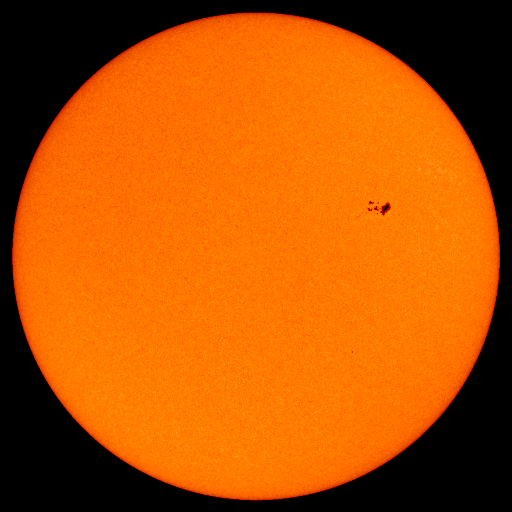
- There’s something telling about my feeling it necessary to tell you that there’s a spot on the sun! I’ve done screen-projection sunspot observations at, um, spotty intervals since 1970, and until quite recently, sunspots were more or less always there when you wanted to look. Not so for the last two or three years, when sunspots–and band openings–have become something of a novelty.
- Heath-Zenith still exists. They make doorbells. (Thanks to Bp. Sam’l Bassett for the link.)
- Use your deordorant and become a better person. (Clean the catbox, ditto.) I’ve sometimes wondered what odors are actually for, and whether there’s an evolutionary reason that humans are so much lousier at detecting and discriminating among them than other mammals.
- Oh, and you may be more productive with your shoes on. (If that’s true, how the hell have I ever gotten anything done?)
- Wired Magazine has a cover story on the antivaxers, and whatever your views on the issue (mine are so strong as to be essentially unprintable, so don’t look for them here) it’s worth reading.
- The New Yorker always has clever covers, but this is the best one I’ve seen since the Mullahs on Segways.
- Recommended Obscure Halloween Reading for 2009: Jonathan Carroll’s The Land of Laughs, which was published in 1980 but can still be had for cheap on the used book sites. The biographer of a legendary (deceased) author of children’s books travels to the small Midwestern town where the author once lived and finds that fantasy is blurring into reality in some odd and very creepy ways.
- Is there a more modern technical term for those jokes/inspirational/polemic notes that people email out to their entire address book, with instructions at the bottom to send this to 10 people / 20 people / everyone you know? I call them chain letters, but wonder if their email incarnation has a geekier term attached to it.
Odd Lots
- There appears to be a new online scam that is a first cousin of scareware: Driver updaters. Drivers ride with hardware, and install with hardware, so unless your hardware changes or you do a major OS upgrade, drivers do not need to be updated. Every such updater I’ve researched appears at best to be adware and often much worse. Get your drivers from the hardware manufacturer (or built into the OS) and nowhere else.
- While trying to determine if Chicago had ever had a radio station WYNR (it did, briefly, from 1962-1965) I ran across this exhaustive list of all broadcast radio stations that have ever operated in Chicago (both AM and FM) with brief discussions of their history.
- There’s a downside to modern optical drives that spin discs at 50X Not all discs can take it–and when they go, they turn into daggers. I know it took the Mythbusters guys awhile to detonate a CD by spinning it on a Dremel tool, but one wonders if a disc accumulates stress fractures over time and one day just…lets go. (Thanks to Pete Albrecht for the link.)
- Among other things that Carol and I have been using since we were married in 1976 are a Realistic STA-64 30W tuner/amp, a Rival crockpot, and a Sunbeam 16-speed blender. Admittedly, we don’t use them as often as we use our flatware, but we use them regularly, and they all work basically as well as when they came out of the box, way back when I still had all my hair.
- While not as old as our Rival Crockpot, I still have and use my TI-30 SLR scientific calculator, which I bought in 1983. Won’t do hex, but it’s handled every other piece of math I’ve ever thrown at it.
- A nameless source in the filesharing community tells me that MP3s of every pop song that has ever charted on Billboard will fit on a single $50 500 GB hard drive. I have no way to verify this, but if true, it’s a good demonstration of what the music industry is facing, and perhaps why they’re as nuts as they’ve gotten in recent years. (I already have an external 320GB USB hard drive that slides into my shirt pocket–and disappears. For $125, I could have one containing 500GB. All of pop music hiding in one shirt pocket. Egad.)
- From the Wines-To-Avoid-At-All-Costs Department: Pepperwood Grove Pinot Noir 2006. A whiff of galvanized iron is not a plus. (Dumped it.)
Odd Lots
- Gizmodo has a decent overview of the jungle of Intel CPU chip families. Core, Atom, and old reliable Pentium are compared and contrasted. Good short brushup, even if you’ve been following along as best you can. (I cop to not paying as close attention to Core i7 as I should have been.) My one objection: Late-build Pentiums are not nearly as bad as the author suggests.
- With 225 sunspotless days, 2009 just edged past 1867 in its climb up the Most Spotless Years Since 1849 hit parade. 2009 is now in position 11. Two more spotless weeks and we’ll overtake 1855 and enter the Top Ten. 2008 was a killer, now standing at #4, with 266 spotless days. Will 2009 beat that? Unlikely; there are only 77 days left in the year, and while the Sun is sleeping, the old guy isn’t dead. (He throws up a few sunspecks now and then just to keep his hand in.)
- An article in today’s Wall Street Journal reminded me that American author/poet Stephen Vincenet Benet wrote the postarmageddon short story “By the Waters of Babylon” in 1937, before even the possibility of nuclear weapons was understood by the general public. It stands in my mind as one of the finest SF shorts of all time, and certainly one of the most prophetic. (The story’s been posted on the Web and is easily Googleable, though how legal those postings are is unclear.)
- Very nice summary of what we know about the second-largest asteroid Pallas here. Interestingly, Pallas has its own “death star” astrobleme, which can be found on most of the smaller bodies of the solar system, suggesting that during the solar system’s formation everybody got pounded, and the biggish moons that survive just barely missed being turned to gravel. (Thanks to Frank Glover for the link.)
- Google just clarified its plans (a little) for Google Editions, an ereader-agnostic ebook store that will offer ebooks in a universal format based on HTML. Books will be readable offline. One suspects that Google Gears will be involved, but what sort of DRM will be slathered onto the binaries is still an open question, and in a lot of people’s minds (including my own) that’s the only significant question there is.
- From Michael Covington comes the suggestion (from one of his grad students) that if a coral snake were a resistor, it would have a value of 24 ohms at 20% tolerance. (Determining the snake’s power dissipation we leave as an exercise for the grad student.)
Odd Lots
- If like me you stand amazed at the precision of the English language (which is distinct from the precision of the people who use it, which is all over the map) do visit Obsolete Word of the Day. Many of the citations are old slang and many words do double duty: A slype is slang for a man who talks much about seducing women but lacks the courage to do so. Its formal use is architectural: the connection (often a covered but not enclosed passage) between the chapterhouse and the rest of a church complex. Much more there; you can sink hours on this one. (Thanks to Pete Albrecht for the link.)
- Here’s a gatherum of peculiar or downright gross sodas from around the world. Yogurt-flavored Pepsi, anyone? Or (urrrp) Placenta? Alas, Inca Kola is not mentioned, though it should be. (Thanks to Bob Calverley, via George Ewing.)
- The title on this article is wrong (or perhaps some people understand the term “hyperdrive” differently than I do) but it describes a new twist on an interesting and mostly forgotten 1924 speculation of mathematician David Hilbert: that a stream of particles moving at greater than half the speed of light could accelerate a nearby stationary object without subjecting that object to inertial forces. That wouldn’t be a true hyperdrive, but a genuine inertialess drive would almost seem like one if we limit the frame of reference to the starship. (I.e., we could go from here to sunlike star Zeta Tucanae in a week or so from our perspective, though 28 years from the universe’s perspective.) This is mighty exotic physics, and if there’s anything to it, we may learn more once Felber’s hypothesis is tested using the LHC, or perhaps the Tevatron.
- I saw a trailer on what may be an interesting new film comedy: The Boat That Rocked , which had been originally (and I think more appropriately) titled Pirate Radio. It’s about the 1960’s offshore radio pirates operating just outside the UK’s territorial waters, something that’s always fascinated me. I’ve been taking notes on a novel I call (or called, sigh) Pirate Radio, exploring the notion of untraceable Internet broadcasting through large-scale powerline networking, and that research brought the old UK high seas radio pirates to mind. Probably won’t write the novel, but it’s been a good excuse to read up on things I haven’t looked at since I read them in Popular Electronics in the 1960s.
- Don’t miss the Steampunk Genre Fiction Generator. Stumbling through it with no malice (or anything else) aforethought, I came up with: “In a leather-clad Aztec empire, a young farm boy with dreams stumbles across a talking fish, which spurs him into conflict with murderous robots with the help of a cherubic girl with pigtails and spunk and her discomfort in formal wear, culminating in convoluted nonsense that squanders the reader’s goodwill.” Somebody else write it and I’ll pay a quarter for that!
- The ice melt across Antarctica during this past Antarctic summer (2008-2009) was the lowest ever recorded in the satellite era. I’d worry a little less about rising oceans swallowing New York City, as much as I sometimes find myself wishing for them to do so.
- I used to wonder how corn mazes are made (and still do, for older mazes) but if you’re doing one today, you’re basically going to need a lawnmower and a GPS receiver, and a way to overlay a drawing onto a GPS-enabled map display. Oh, and a large field of corn that you’re willing to seriously mess with.
Odd Lots
- Here is the entire sky projected on a plane, and zoomable. (LINK REMOVED–SEE COMMENTS.) That doesn’t do it anything like justice. Cruise the image a little and gasp. (Give the site time to refresh; it’s newly slashdotted.) Read the rest of the page too–it’s fascinating, and full of great photos. Chile looks a great deal like Mars in some places.
- There is apparently a correlation between sleep loss and amyloid tangles in the brain, which are a key element in Alzheimer’s Disease. Causation is still a little unclear, but I find it significant that in our era of Anything But Sleep, the incidence of various dementias is exploding. Be in bed by 10:00PM and keep your brain. Now there’s a deal I can live with.
- Wired has an interesting retrospective on tablet computing, which I found worthwhile mostly for the mention of a steampunk-era electromechanical handwriting encode-and-transfer device, which ferdam sounds like what Sherlock Holmes would use to IM Watson.
- Here’s another worthwhile perspective on the Google Books Settlement.
- A chap who calls himself the Jolly Pirate wrote to tell me that the Pirate Party is alive and well in the US (I was under the impression that it was a European thing) and some interesting links may be found on its site, many of which have nothing to do with piracy. Now, would an American instance of the Pirate Party lean left or right? (Or would it be port and starboard?) I’ll be damned if I can decide…
- It’s been a bad season for big-time wine critics, who can’t seem to find a business model and keep getting busted in conflict-of-interest scandals. The Internet allows the crowdsourcing of critique of all sorts of things–why should wine be any different?
- Pertinent to the above: What we need is the wine implementation of the “People who liked this also liked…” mechanism I see (and use) in the book world. I very much like Campus Oaks Old Vine Zinfandel, though the 2007 vintage now in stores is a pale shadow of 2005. What would be a wine similar to that? (If you know of such a system for wine, please share.)
- There are candy Legos.
- The charger for my Kodak pocket camera is a thin little slab with two 110V power plug pins that swivel out to plug into the wall, and then swivel back into hiding when they’re not needed. Why can’t they build that mechanism right into the back of an ebook reader? (I was without my Sony Reader for a couple of months after I lost the charger.)
- After an unexplained absence of several weeks, Fort Carson’s cannon is back. (See my entry for September 15, 2009.) Maybe the cannon was broke and they had to send it back to the factory for repairs…
Odd Lots
- Maybe I thought of it first. I don’t care. This guy did a great job. What He Said.
- I was wrong about the Alice programming environment: There is in fact a version for Linux, though the developers admit it’s a little buggy and largely “proof-of-concept.” (Thanks to xuwande on LiveJournal for the tip.) To me, Alice looks a lot like the primordial Alto-based Smalltalk environment described in the seminal 1977 Xerox publication, Personal Dynamic Media, and I’ll install and explore the product (probably under Windows) as time allows.
- And even though this is mostly a research project (with no promises or even strong hints that it will ever become a product) the Microsoft Courier looks mighty good to me from an ebook reader standpoint. The interface is a little busy for my tastes, but we’ll see how it goes. Maybe it would be a waste of the device to use it for nothing but reading ebooks, but I consider it my prerogative to waste whatever part of a device I don’t consider useful.
- Maybe it’s not just me. As much as I like the Kodak EasyShare pocket cameras (Carol and I each have one) the EasyShare software is hideous and has given me nothing but trouble. This seems to be a trend. Can you imagine a new Mac app from a major vendor that still needs PowerPC emulation? Egad.
- I guess it’s better for a church to be full of books than empty of prople, and these guys did not do a bad job.
- Suddenly we have not one but two large sunspots visible at once, a situation not seen for over a year. Alas, I spun the dials earlier this morning, and 15 meters isn’t any livelier than it usually is here, which is to say, dead.
- The Google Books Settlement may well be dead on legal grounds, something that doesn’t surprise me at all. What Google needs to do now is just publish an open invitation: “Anybody who holds rights to a printed work and wants the work to be posted on Google Books under the terms below, fill out this form. We’ll handle the scanning.” I’d be first in line in what I’m pretty sure would be a stampede that would sooner or later bring in all the the stubbornest skeptics. The key: I’m willing to admit that my out-of-print works aren’t worth much. 1% of a loaf is still better than no loaf at all.
- ADDED 9/24/2009: Here’s a guy saying something that isn’t often said: Google Books is a fantastic research tool, and far from being evil, the Google Books settlement was just the first (now aborted) effort at something that simply has to be done.
Odd Lots
- When I was a (much) younger man, I wanted a ’59 Chevy. Having seen this, I guess it’s just as well that I didn’t get one. (Thanks to Todd Johnson for the link.)
- Micropayments may not allow small creators (like me) to make money. They may not allow big huge monstrous media outlets make money either. They may not allow anybody to make much money at all. Bummer. I did have hopes…
- Oh, and the Long Tail may not be as long as we thought. Double bummer.
- Has anyone reading this ever played with the Alice language/GUI system for teaching programming? (Alas, no Linux version. Triple bummer. ) Any opinions? I have nieces who are growing up so fast…
- From Pete Albrecht comes word that Chicago’s Kiddieland is closing. My father took me there in 1955 while my mom was working. We had pizza and I went on all kinds of rides. That night I puked my guts out, and my mom thought I was coming down with polio. (They don’t call it the Scrambler for nothing.)
- Here’s another thing I thought I might have imagined: World Of Giants , a b/w TV show from 1959 that went into syndication and used to run just before the 4:00 PM monster movie on Channel 7 in Chicago, circa 1965. At least two people must have watched this, and the other one must have been Irwin Allen. (And the guy who created the show must have read Richard Matheson.)
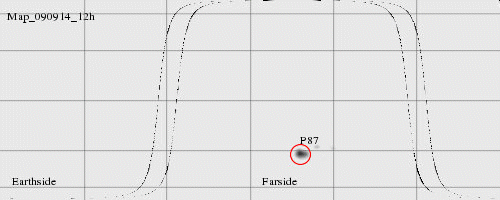
- Although the sun’s face has been devoid of sunspots for 18 days running (and 212 days this year) there is a major sunspot on the other side of the Sun, which may rotate into view sometime tonight. I boggle a little to think that we can image a sunspot on the far side of the Sun. How this is done is interesting, and has little or nothing to do with light. Flying cars or no, we are living in the future!
- From the Not Too Clear on the Concept Dept: I just nuked a spam message pitching “herbal testosterone.” Right.
Odd Lots
- What the Hell: Some researchers at the University of Michigan have created an 8-bit processor incorporating pneumatic gates, pointing toward a computer that doesn’t require electricity at all. Make sure you watch the videos. It’s not going to beat your local Beowulf cluster on the speed side, but if you find yourself on a planet where nanomachines eat electrical conductors (as they did in my novel The Cunning Blood) such a machine might well come in handy.
- The Make Blog aggregated probably the best writeup of a homebrew railgun that I’ve ever seen. Make sure you prowl around the site, and make double sure you see the pictures and watch the videos!
- Bill Cherepy sent me a link to a short writeup on the still-hypothetical Asus 2-screen ebook reader. You can use it as a netbook, with one screen doubling as a touch keyboard, or you can use it as a facing-pages ebook reader display. Now, displays are probably the most expensive part of devices like this, so I doubt a 2-screen model will be the low cost leader. Still, it’s an idea that’s well worth a try. (And please, guys, make the card slot XDHC compatible, ok?)
- If you ever loved whole milk and wish you could go back to it, read this. And then go back to it. No guilt. No apologies. And yes, no heart attacks.
- Back in the ’50s there was a product called Siz that was (I kid you not) foaming Napalm in a spray can. It was for starting charcoal. Lileks does a wonderful riff on it. (They had such indescribably cool toys in the ’50s.)
- On the other hand (with Lileks always there to remind us) they did some ungodly weird stuff in the ’50s too.)
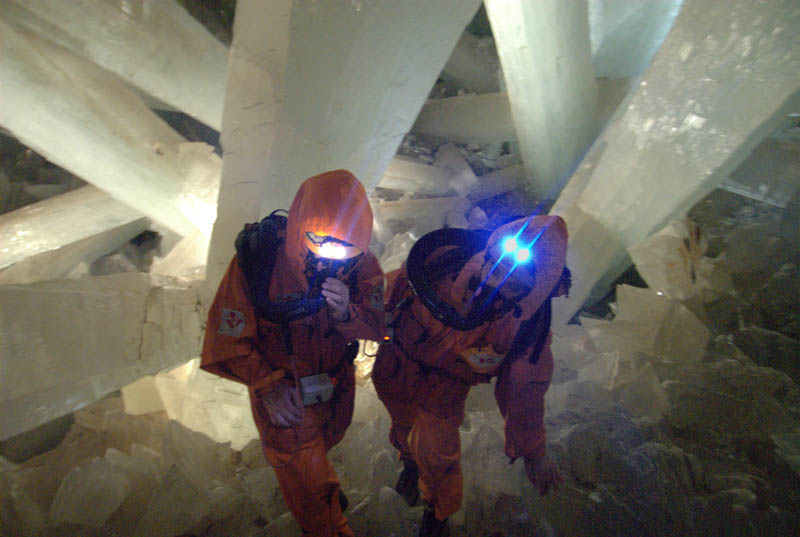
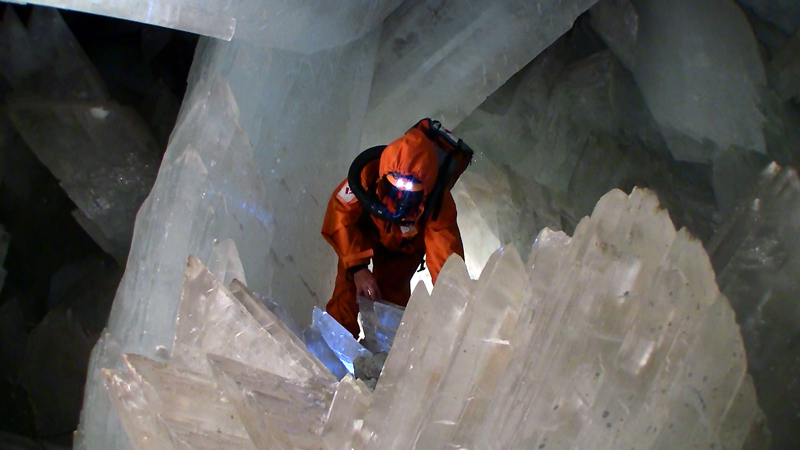
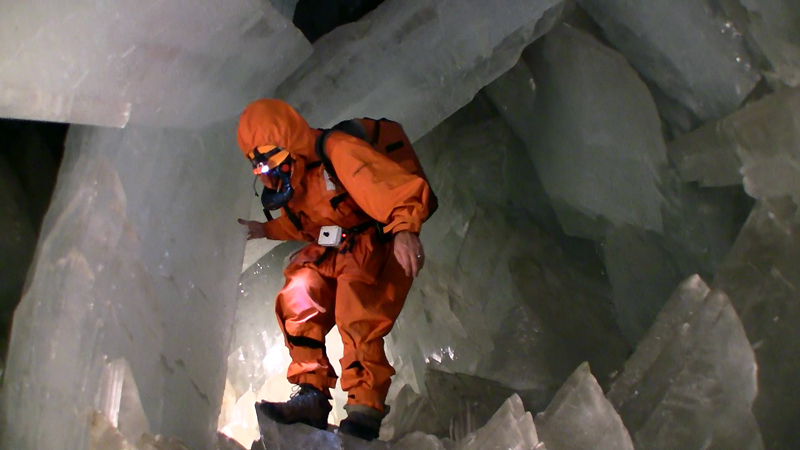
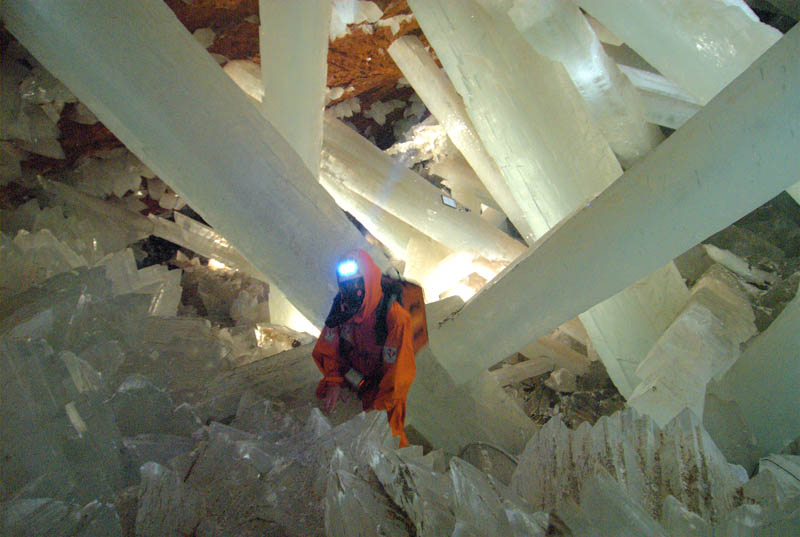
- When I was a kid, Verne/Wells films were all the rage, and by far my favoriate was Journey to the Center of the Earth . Small boys aren’t equipped to appreciate Arlene Dahl, but I was quite the fan of James “Nemo” Mason, and was willing to tolerate Pat Boone even though my older cousin Diane thought he was “dreamy.” The film was dazzling in 1959, especially the “cave of crystals,” which flooded out when dreamy Pat Boone got too agressive with a geologists’ pick. Well, some years ago Mexican miners discovered a real cave of crystals 1200 feet beneath Naica, Mexico that makes those old 1959 movie sets look sick. National Geographic has more textual coverage, and it’s worth noting that the cavern is unliveable without life support suits, being at a constant 122 degrees and 90% humidity, which is worse than Houston, if that were possible.