My sister complained a year or two ago that most of Katie’s and Julie’s toys talk. Some talk and sing songs, though a few–I remember a circus train that was one of Katie’s first toys–actually play classical music. When most of your day is spent in the company of toddlers and their toys, I’m guessing silence is in short supply, because when the toddlers aren’t make noise themselves, their toys pick up the slack.
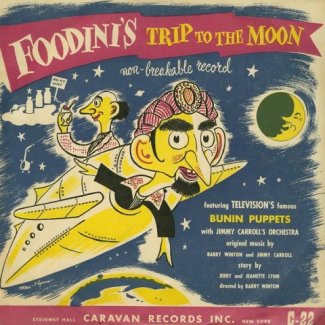
Which brings me back to 1957. My parents had a record player, though it was old and cranky and built into a piece of furniture. I’m sure they didn’t want me messing with it, so they bought a small, portable kiddie phonograph of my own. I had a few kid records, some that told stories, some that played songs, and some–like the Maury Bunin Puppets’ “Foodini’s Trip to the Moon” that did both. (Alas, none that I recall played classical music.) I enjoyed the phonograph a lot, and given that the single active component was a 117L7 tube (capable of 0.85 watts into a 4,000 ohm load) it didn’t generate enough volume to bother my folks much–until I discovered the speed lever.
 Like most record players in that era, it could do 33 1/3, 45, and 78 RPM. Most of my records were 45s. (The older ones, including Foodini, were 78s.) Playing a 45 at 33 1/3 was interesting for a moment but ultimately boring: Small children run at inherently higher clock rates than adults, and slow music is not a big draw. 78, now: I had a Disney extended-play 45 containing music from the 1955 “Lady and the Tramp” and I loved it a lot. One cut in particular was my favorite: “Lady,” the instrumental theme for the female cocker spaniel lead. It was bouncy (like me) and I quickly learned how to pick up the needle and drop it again at the beginning of the track, playing it again and again. And when that got boring, I nudged the speed lever up to 78.
Nirvana! I still remember the sped-up recording clearly, and I think it may well beat Khachaturian’s “Saber Dance” as the most manic single piece of music in my experience. I got bored with the item before my parents could sell me to the gypsies (maybe–I wonder if the 45 simply disappeared one day) but I continued my experiments with the speed lever.
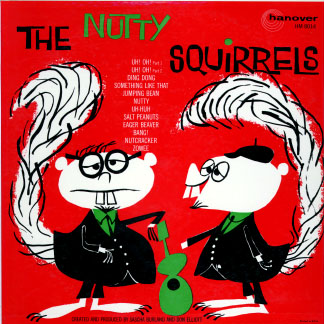
We had the 45 of David Seville’s “The Chipmunk Song” (1958) and when I cranked the lever down to 33 1/3, I realized to my six-year-old astonishment that it wasn’t chipmunks at all, but ordinary guys singing the song reeeeeeeeeeeal slow. My cousin Diane had another similar 45, of The Nutty Squirrels doing a scat song called “Uh-Oh.” Same deal: Dial down the speed and it was just a couple of guys singing slower than I could imagine–or tolerate.
 This was a fad in the late 1950s, starting with Sheb Woolley’s “Purple People Eater,” which had a couple of sped-up spoken vocals (“I wanna get a job in a rock and roll band…”) but no sped-up singing. That was a Seville invention, with his 1958 song “Witch Doctor,” setting the stage for The Chipmunks at Christmas time that year.
The Nutty Squirrels (basically, jazz musicians Don Elliot and Sascha Burland) had their own TV cartoon show, which came out about the same time as Rocky and Bullwinkle but was not as brilliantly silly and by now is mostly forgotten. Their music was better, and not as kid-centric as the Chipmunks always were, which I’m sure doomed them.
I’ve often wondered how one learns to scat-sing at half-speed without muffing the tempo for the sped-up version. Of all the peculiar and now-forgotten human skills that you might name, that may be the most peculiar of all.
 We moved here from Arizona in 2003, and (as usual) it took us literally years to unpack everything. Some stuff was not meant to be unpacked, really–I left my vinyl collection and 8″ reel-to-reel mix tapes in boxes on the big shelf in the mechanical room, knowing they’d be there if I needed them but not actually expecting to need them. (I admit, I’ve gone looking in the boxes for a vinyl album a couple of times.) But there’s one box on the high shelf here in my office, containing stuff that was in odd places in my Scottsdale office, stuff that I wasn’t really sure where to put or what to do with. Every so often I sift through the box for an hour or so, trashing some stuff and filing some stuff and putting the rest of it back in the box. It’s only about 1/4 full now, so I guess I’m making some progress. It should be empty by the time I’m 80.
 Lora Heiny sent me a note this morning to tell me that her brother Loren had died during the night, after a four-year struggle with cancer. He was 49. Loren was an early expert on Tablet PC technology, and most of what I learned about it after I got my X41 in 2005 came from
 I finally got a Millard Fillmore dollar at the bank today. I’ve been meaning to ask for one for a long time, but I hate to bother the poor tellers for silly things like that when there’s a line. Today, for whatever reason, the Wells Fargo branch at Safeway was empty and staffers were standing around BSing, so I asked. And I got.

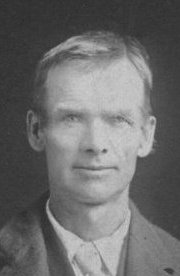 Not much. But it’s an interesting sort of detective work, this family resemblances stuff. I do know that my great-great grandfather Heinrich Duntemann 1843-1892 had four brothers, all of whom long survived him, who died of an infection from a farm injury at 48. I have photos of two of his brothers, William Duntemann 1849-1921 (left) and Hermann Duntemann 1859-1933. (right). William’s photo was taken when he was in his sixties, as best I know. Hermann’s was taken when he was 26. If I had to guess, I’d say that the leftmost man in the group photo was William, and the rightmost was Hermann. The remaining man may have been Louis Duntemann 1851-1928. I can’t tell, as I’ve never seen a photo and know very little about him.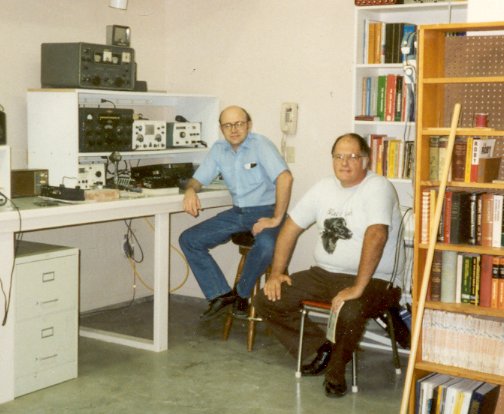
 I first ran into George at the Clarion SF Writers’ Conference in East Lansing, Michigan, in 1973. That’s him on the right margin of the photo at left, holding a camera. (The other two workshoppers shown are Alan Brennert, far left, and Seth MacEvoy, center. There’s a chap between Seth and George whom I don’t recognize.) As WN9MQY, I had thrown my novice ham station into the trunk of my Chevelle and taken it with me, imagining running a wire from a third-floor dorm room out to one of the campus’s abundant trees. No luck; we were in the basement of Mason-Abbot Hall, and the only thing outside my room window were yew bushes…and a copper downspout. Hmmm. I poked a run of coax out the window and ran around outside to see whether I could somehow match into the copper pipe…and found another piece of coax in the dirt, coming from the next window over from mine. That’s when I met George Macdonald Ewing WA8WTE. Neither of us ever got a good match into the downspout, but that was all right. He became a close friend and my staunchest ally at the conference (which was a continuous low-key war between the Techs and the Orteests) and we were never out of touch for long after that.
 Like me, he was a hands-on techie and hard SF enthusiast, and we brainstormed SF ideas and critiqued one another’s fiction frequently both at Clarion and afterward, in letters (later electronically) and in person. He was encouraging but also honest: In 1977, while visiting us in Chicago, he persuaded me to abandon a novel I was working on, and kidded me goodnaturedly about some of its more juvenile aspects for years thereafter. He sent a newsletter/fanzine to our Clarion class for the rest of the 70s, run off on the ditto machine of the rural Michigan high school where he taught. Alas, the termites made a colony out of my box of fanzines and APAs in the late 90s, and they’ve all perished, but George’s Post-Clarion Carrion was nicely done and often hilarious, especially his off-the-wall SF movie reviews. He attended our wedding in 1976 (above) and we saw him at SF cons regularly over the years. He and I were among the founders of the SF/tech fan group General Technics, a group that persists to this day.
 George was a published writer in both the SF and nonfiction worlds. His first story, “Black Fly,” appeared in Analog in September 1974, followed by semiregular publication there, in Asimov’s, and other places. He sold numerous articles into the electronics/ham radio market, many focused on scrounge technology. In 1983 Wayne Green Publications published George’s book Living on a Shoestring, which was a Ewing brain dump on how to do more with less and repurpose what you and I might call junk into the raw materials of a comfortable (if eccentric) life. It’s as close to a memoir as we’ll ever have, as those who knew him will attest. He was always doing this stuff, and developed a sense for outside-the-box make-do technology that served him well both personally and in his fiction. He was Pro Guest of Honor at Nanocon 8 in Houghton, Michigan, in 1996, and the Houghton SF group published a short reprint volume of his fiction for the con. He played tuba in his high-school band, and considered tuba one of his iconic traits. I never actually saw a tuba in his hands, but he drew cartoons of himself playing one on regular occasions–often standing atop unlikely things like abandoned military radar antennas.
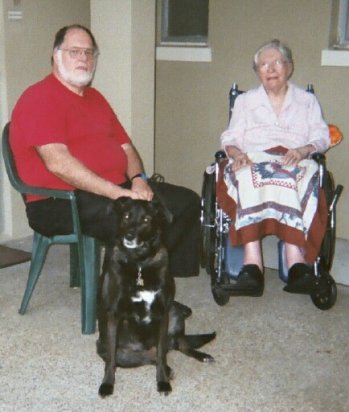 I don’t have many good pictures of George. What’s here is all there is. The photo at the top of this entry was taken in 1995, in my then-new Scottsdale workshop. Sure, he’s peeking out from behind other people in various convention group shots, but mostly we see half of his head and one arm. The photo at left is the most recent I have, from 2004, with his mother June and his dog Tazzy. He didn’t think people were that interested in seeing his image; he sent me this photo only because he thought Tazzy looked like my old dog Smoker. (She does.) That was a key George Ewing characteristic: He was not full of himself. He was courteous, jovial, a good listener, generous with his time and ideas, and extraordinarily social. He was always willing to assume the best about other people, and never engaged in the sorts of poisonous arguments and personal attacks that have made so many others (including far too many in my acquaintence) look like brain-damaged twelve-year-olds. He scolded me only a couple of times, but always in private, and in every case for abundant good reason.
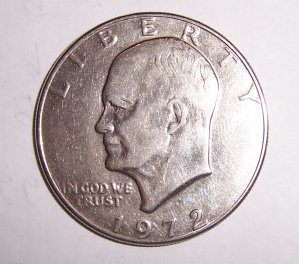 Life is full of little weirdnesses, and here’s yet another: Shortly before we left for Hawaii last month, my lucky dollar turned up missing. That’s the very one at left, though it’s shinier and more worn now than it was when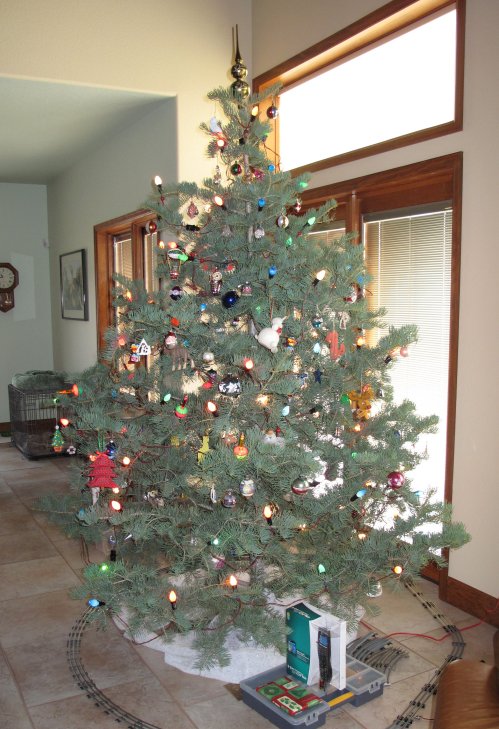
 There was some stress on Tuesday night when Carol’s mom fell at her home outside Chicago and was taken to the hospital. She didn’t break anything, fortunately, but had to spend Christmas in a hospital bed. To cheer her up I put an SX270 system on the coffee table by the Christmas tree and set up a Skype video call with my nephew Brian. The hospital has Wi-Fi in the rooms, and Brian set his new laptop up on Delores’s bed tray. So by virtue of my Phillips ToUCam and Brian’s built-in Webcam, she could see us, the dogs, and the Christmas tree. Delores was delighted, and it’s a technique to keep in mind if you find yourself in such a situation. Skype is very good with detecting and autoconfiguring Webcams, and there was no fussing involved. I plugged in the ToUCam, made the call, and video happened. It’s not exactly a flying car, but it’s definitely one of those odd Sixties dreams fulfilled, mostly when nobody was looking.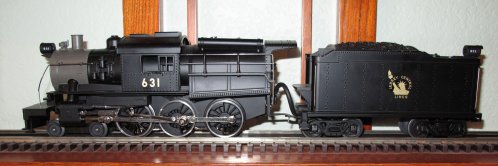
 tracks, yapping furiously at it until he got bored. Pete Albrecht unexpectedly sent me a rare artifact indeed: An original Lionel 275W ZW dual-control transformer (right) that was probably made in the midlate 1950s. It works great, and can control two independent track sections and two independent sets of accessories.