Jeff Duntemann's Contrapositive Diary Rotating Header Image

Memoir

Remembrances of things past, in my own life and those near to me

Revisiting the Monsters of My Youth…

…on YouTube. I’ve been poking around on YouTube in my odd moments, looking for tutorials, music videos, cartoons, and anything else that popped into my head that might be sound and/or video. The other day, I went looking for monsters. And not just any monsters. What I searched for were the monsters I saw on TV when I was quite young. Some of them scared the hell out of me when I was 8 or 9. Some of them were so cheesy that I laughed at them even then. The really scary thing about this YouTube adventure is that I found every last one of them. (Or at least their trailers.) On YouTube. Most were free to watch in their entirety–not that I did.

First on my list was The Creeping Unknown, (1955) which in the UK was called The Quatermass Experiment. This got a lot of play when I was in grade school, and my father, having seen it on the family-room TV a few too many times, dubbed it The Creeping Kilowatt Crud. You can see the whole thing on YouTube. I wasn’t expecting it to be remastered to film resolution, which makes it look way better than it did on any of our TVs. I didn’t watch all of it. I mostly ran the slider across until I found “the good parts;” i.e., where they actually show the monster or at least the cool Heinleinian spaceship it rode in on. I vividly recall my annoyance at seeing most monster movies having a lot of talking and running around and (occasionally) some kissing (yukkh!) but…not much monster. The Creeping Unknown was better than most in that regard, though the monster was a not-quite-a-blob creature who was originally an astronaut who brought back an alien infection from…somewhere…and gradually turned into the monster. It crawled around and was eventually electrocuited on a repair scaffold somewhere inside Westminster Abbey, hence my father’s nickname for it.

I remembered the monster badly; I thought it was a true blob monster, but hey–at late 1950s TV resolution, it might as well have been. If you like period pieces, watch the whole thing. For the monster genre, it was surprisingly well done.

Not all were. For a true blob monster (which were a sort of Hollywood cottage industry in that era) I had to dredge up X the Unknown (1956.) It was an obvious ripoff of The Creeping Unknown, done on the cheap. The monster was a big black tarry glob that bubbles up out of a hole in the Scottish highlands and starts eating people. The monster didn’t get much screen time, but I remember one very well-executed shot of the monster rolling toward a town. I recognized the technique immediately: They had mixed up something viscous but cohesive, colored it black, and photographed it rolling down a sloping miniature set, with the camera in the plane of the set. On screen, it was a house-sized blob monster rolling down a country road on its merry way. Well-done, and scary in spots, even if the seams were often visible.

Much scarier in a body-horror way is a blob movie called Caltiki, The Immortal Monster (1959.) (Italian titles; dubbed in English.) A sort of spaghetti monster movie, it came from Italy and scared the crap out of a lot of young Americans, myself included. A researcher in Mexico discovers that the Mayans didn’t just disappear; a blob monster ate them. And sunuvugun if the monster isn’t still there, and still hungry. The monster gets a reasonable amount of screen time, especially toward the end. And yes, it looks like a livingroom’s worth of bad ’70s carpeting dyed black with a couple of extras underneath it, pushing it around in bloblike ways. The scary parts are seeing what it does to the unfortunates it latches onto. Even when I was ten, I could tell the dialog did not match the lip movements of the actors. I didn’t care. Monsters are a language in and of themselves.

Sure, I watched it (back in the Sixties) but the less said about The Unknown Terror (1957) the better. I’ll give you a rank spoiler here and say that the monster looks a lot like…man-eating soapsuds.

Oddly, I never saw The Blob (1958) when I was a kid. Maybe the local TV stations thought it was too scary. Dunno. If it had been on Chicago’s Channel 7 (as most monster flicks were) well, I would have seen it. You can watch the whole thing (this time in color) at the link above. Lots of footage of the pinkish-purple Blob eating people, though as blobs go it was kind of featureless and, given the color they made it, did not carry much sense of menace.

So much for blobs. There are doubtless other blob movies that I haven’t heard of. (Got any?) Blobs, are, well, cheap, compared to dinosaurs or aliens. Now for a much better monster; indeed, one of my all-time favorites: 20 Million Miles to Earth (1957; the link is to a monster-rich excerpt) has a Ray Harryhausen animated monster. And, weirdly, the scriptwriter was the older sister of the nice lady who lived next door to where I grew up. Charlott Knight (1894-1977) used to come visiting from Hollywood circa 1960, and she would sit on the front porch of her sister’s house and tell stories to the neighborhood kids, including me. She told us she wrote 20 Million Miles to Earth, (which we had seen on TV more than once) and I admit I didn’t believe her at the time. It wasn’t until IMDB appeared that I could look her up, and…yes. That was her. She also played bit parts on Pettitcoat Junction. The monster in the movie (which Charlott called a “Ymir,” though the word is not used in the film itself) was the first I’d seen with a sympathetic edge. Astrononauts took an egg from Venus, brought it to Earth, and hatched the poor thing into a world its kind had never known. It grew quickly, though as best I recall the only thing it ate was sulfur. (The full movie, being a Harryhausen, is still being marketed and is not available on YouTube.) It gets loose in Rome, fights a hapless elephant, and is harrassed by the Italian military as it climbs around on the Colosseum, making a mess. By the end I felt sorry for it. Sympathetic monsters have since become a thing, but this is the oldest example I can think of. And I knew the person who thought it up, wow.

Now, I recall a childhood fear of robots. I dreamed once that a gigantic metal robot foot stomped on the Weinbergers’ house across the street. Where that came from is a bit of a mystery. Scary robots were less common than other monsters, and the ones I remember seeing weren’t all that scary. Gog (1954) starred two mini-tank robots built to ride a rocket into outer space. The robots were cool, though we don’t actually see them until half the film is over. In truth, they got very little screen time at all, and were not in fact the actual villains in the story. In Tobor the Great (1954) the robot was the good guy, as was Robbie in Forbidden Planet (1956).

For a real robot bad guy from my childhood, I have to cite Kronos (1957). The premise is stone-dumb: Aliens somewhere are running short on something, so they send a sort of gigantic robot battery to Earth to suck up all our electricity and take it home–so that the aliens can convert that energy into matter. (They must have run out of asteroids.) The robot itself, however, was unlike anything else in monster cinema: It consisted of two huge cubes connected by a neck, with a dome and a pair of antennae on top. It was several hundred feet tall. It had four cylindrical legs that went up and down, and some kind of rotating force cushion beneath it, or something. It lands on the Mexican coast, and marches north toward LA, stepping on Mexicans and sucking up energy from any powerplant it encounters. It even inhales the energy of a nuclear bomb, dropped on it by an actual B-36. Eventually they decide to short it out, and like any battery with a sufficiently low internal resistance would, it melts. Dumb as the premise was, Kronos the robot had considerable novelty value: It was not just some guy in a robot suit. The models and the opticals were pretty decent for 1957. It’s good enough to waste an hour and a half on the next time you catch a bad cold, though with a warning: There’s…kissing.

So, apart from Kronos, I’m not sure what gave me robotophobia as a five-year-old. Mutant dinosaurs like The Giant Behemoth (1959; nice 1080p rip) and Godzilla (1954) didn’t do much for me. Ditto Rodan (1956) and Gorgo (1961), though Rodan had his moments. Dinosaurs were already scary; making them even bigger did not make them any scarier. Mothra? (1962) A giant…moth? ummm…no. For real chills and grade-school nightmares, nothing in that era could compare to… The Crawling Eye (1958).

The film was made in England, and called The Trollenberg Terror over there. Mountain climbers in the Trollenberg (a German mountain range) start getting their heads torn off up at the summit. Cold-climate aliens are holed up in the crags somewhere, trying to get ahead. (Sorry.) When the supply of mountain climber heads thins out, they start edging down the mountain, looking for more.

I had literally not seen the film in fifty-odd years, and remembered the monsters badly. They were huge fat octopus-like things, with lots of squirmy tentacles and one great big bloodshot eye in the middle of it all. In 1965 or so, I thought the special effects people had cheaped out and painted a pupil on a beachball for the eye. It was better than that. You don’t have to take my word for it. And you don’t even have to watch the whole damned movie. Somebody with a serious monster fetish has copied out all the scenes that actually show the monster, and you can see it here. Got three and a half minutes to waste? That’s all it takes. Way back in the Sixties, we watched the whole thing for three minutes of monster. My research tells me that that’s not an aberration. That’s how the monster genre worked.

There were a lot of other monster flicks in that era. The ones I cite here are the ones I remember most vividly. The ones more easily forgotten had cheesy monsters or almost no monsters at all. Curse of the Demon was originally filmed without a visible monster. They put one in because everybody wanted to see the Demon. It was cheesy as…hell, heh. It was onscreen for maybe a minute and a half. I saw it once and that was plenty. I saw The She Creature, but it was a cheap ripoff of The Creature from the Black Lagoon and I confess I don’t recall anything but the fact that the monster was visibly female. The Monolith Monsters were gigantic crystals that grew and spread before the good guys do…something. (I forgot what.) My only clear impression is that the crystals would be relatively easy to outrun.

Oh, there were lots more. The Amazing Collosal Man (1957) and its way dumber sequel, War of the Collosal Beast (1958.) Reptilicus (1961) which I saw at an outdoor theater in Green Bay, with my cousins. The monster was a puppet; kind of like Cecil the Seasick Sea Serpent, with fangs. The Giant Claw (1957.) It looked like an enormous turkey buzzard. I already knew what turkey buzzards looked like. Making one huge only made it look silly.

And on and on and on. We have better monsters these days, including some really scary robots, like AMEE from Red Planet (2000). (AMEE may be the scariest robot in any movie, ever.) And, of course, Alien/Aliens (1979/86), Predator (1987), Cloverfield (2008) and numerous others. The big difference is that I wasn’t ten years old when I saw Alien. (I was 27.) As I wrote here some years ago, monster movies are how young boys learn bravery. It was certainly true for me. Now, I can look back at the whole silly-ass genre…and laugh.

That was a lot harder in 1962, trust me.

Frank W. Duntemann’s 100th Birthday

Frank&Alex - Cropped - 500 Wide.jpg

Today is my father’s 100th bithday. For newcomers: No, he’s not still with us. He died 44 years ago, after a hideous nine-year battle against smoking-caused cancer. I was 16 when he was diagnosed, and my sister only 12. As you might imagine (especially if you’ve had loved ones struck by cancer) our family life was never the same after that.

I’ve already told most of the good stories about him in this space, and I’ve posted nearly all of the good photos I have of him. He was the photographer in the family, so in most cases when things were going on he was on the other side of the camera. The photo above is not my scan and isn’t terrific. But it represents one of his stories that I don’t think I’ve yet recounted here: When he was in high school, one of his father’s friends sent him a baby alligator while she vacationed in Florida. Alex was a real alligator, and family legend holds that when he grew big enough to be a hazard, ate a neighbor’s cat. The family then donated Alex to the Lincoln Park Zoo, and, according to my father, they went to see him now and then.

A few years ago I told the story about how, when he returned from the War, he smuggled home a mongrel puppy that the GIs at an experimental radar base in Mali had adopted. He was never without a dog (or sometimes two) after that.

So, with all the stories told, what more can I say? Something I can say in only two words, which I will put in big bold type so that nobody can mistake them:

Fathers Matter.

Why? Fathers civilize us. Mothers have a role there too, but (especially for boys) fathers teach us how to put our killer-ape genes on a leash and contribute to the peace and prosperity on which our very uneven world depends.

In my first 16 years my father taught me a great many things, but what I consider his most important lessons are these:

  • That girls are not playthings, but colleagues, friends, and…soulmates. “If you’re lucky and smart, you’ll marry your best friend. I did.”
  • That the best part about being smart is the ability to teach yourself new things. “The most important subjects in school are English and Math. Ace those, and you already know everything else. You just have to read the books and work the problems.”
  • That fighting is a last resort. “If other kids laugh at you, laugh with them. Life demands a sense of humor. Then walk away. But if some SOB ever corners you, hit him where it hurts.”
  • That responsibilities must be met. “A man provides for and protects his wife, his kids, his animals, and his property.”
  • Finally, and most crucially, that life demands energy and enthusiasm, but also discernment: “Kick ass. Just don’t miss.”

Thanks, dad. I never learned to love beer or baseball, but what I learned from you turned out to be most of what counts in life. Godspeed.

Aero’s 15th Birthday

Today is Aero’s 15th birthday. He was our first show dog, and became an AKC champion in 2010, under Carol Duntemann’s expert handling. The photos below are of Aero when we first got him in 2006, and from the 2009 Bichon Frise National Specialty show in St. Louis.

He’s still reasonably spry for a dog that old, though he doesn’t see very well and gets confused now and then. Given that he’s now 105 in dog years, I’m very happy he’s still with us and still running around.

We’ll be giving him his usual birthday “cake” of raw hamburger a little later today after supper. Everybody gets some–and sometimes I think it’s gone in nanoseconds. But however he wants to enjoy his birthday is fine by us. He’s been a terrific dog, loved the show ring, and brought us a great many ribbons. If he mostly sleeps in one of the (many) dog beds scattered around the house these days, that’s ok. He’s earned it.


100_0951 - 500 Wide.jpg


IMG_0275 - 500 Wide.jpg

My Great-Grandmother’s 150th Birthday

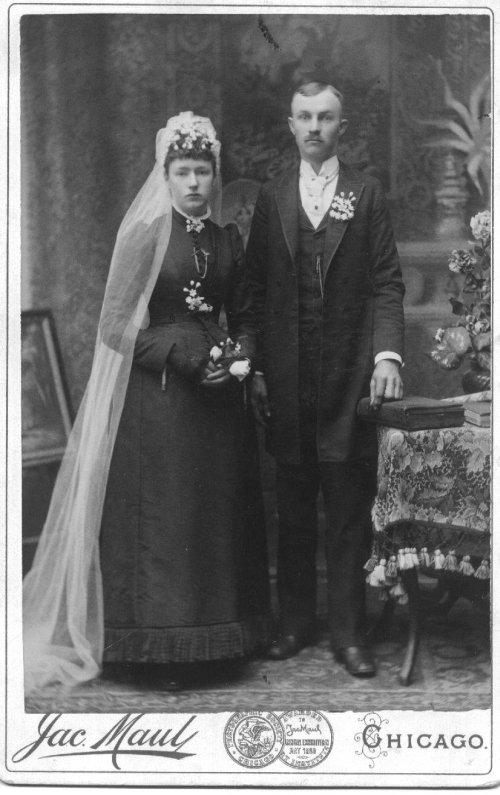
FrankMarthaWedding - 500 Wide.jpg

I was adding a couple of new names to my Family Tree Maker 2019 database last week when I realized that Martha Winkelman Duntemann’s 150th birthday was coming up. Today’s the day, and for me it’s worth some modest celebration. Martha (who died in 1967) is now 150 years old–and I knew her. That seems odd, bordering on the impossible somehow.

But it’s true. Martha was born on a Bensenville, Illinois farm on April 10, 1871. I have a scan of an old plat map somewhere with the names of the farmers on their acreage. I believe the Winkelman farm was on land now part of O’Hare Field. The Duntemann farm certainly was. In fact, I discovered with a little mapwork that the Duntemann farmhouse was almost directly where the airport’s boiler plant is. You see it from the freeway coming out of the main terminal on your right. Interestingly, my father was the gas company liaison engineer to the city when they built the gas-fired boiler plant in the early 1960s. He never knew (as best I recall) that his great-grandfather’s farm was right there.

Martha married Frank W. Duntemann on January 31, 1892. She was 19; he 24. They had two sons: Harry George Duntemann, born on October 20 of that year, and Elvin Frederick Duntemann, born July 16, 1895. Harry was my grandfather, and Uncle El was a jolly, goodhearted man whom I saw less often than I should have. Martha’s husband Frank died in 1936. My father was named after him. The family photo shown below is undated, but by the ages of the boys I’m guessing 1900.

Frank Martha Duntemann Boys - 500 Wide.jpg

Frank did not go into farming as most of his four brothers did. Instead he established a general store in the little railroad town of Orchard Place, Illinois, roughly where Higgins Road crosses the Soo Line railroad. Soon after the store opened, Frank got the job of Orchard Place postmaster, which he held until a year or two before he died.

OrchardPlaceTableaux - 500 Wide.jpg

The family lived over the general store. Martha shut the store down after Frank died and Des Plaines took over the mail processing. By 1936 she was 65, and did not want to tend the store on her own. Her son Elvin took some of the inventory and created a coal and building materials dealership in a new, larger building up the road a ways, which was in business well into the 1950s. The store was converted to a separate first-floor apartment. Martha lived the rest of her life on the second story, alone, for another 30 years.

Orchard Place met its end in the mid-1950s. The Feds literally dropped an Interstate on it. The NW Tollway was built over what little “main street” the town had. Before the toll road was built, many of the old houses, including the General Store building, were moved a few blocks north into what by then was a Des Plaines residential neighborhood. The old store building is still there on Curtis Street, and is now owned by one of my cousins, a grandchild of Uncle El.

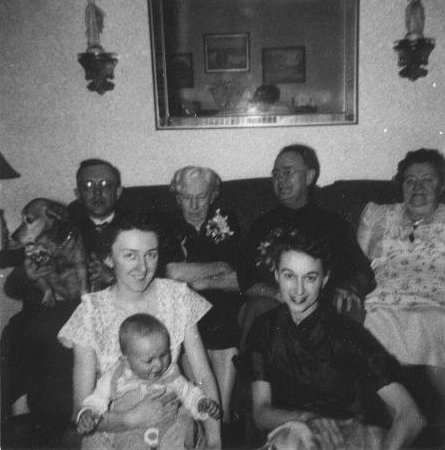
Martha was less alone than you might think. There were several Duntemann families on the same block, including Elvin and his three children and their families. When we went out to visit when I was a kid, I played with my cousins, but always went upstairs to say hi and get a hug from my great-grandma. I have a grainy b/w photo from 1954 or 1955 (below) including four Duntemann generations: Martha, her son Harry and his wife, Harry’s son Frank (my father), my mother, my Aunt Kathleen, and…me. Oh, and two dogs, Willie and Rebel, who didn’t particularly get along. Rebel is cut off at the bottom of the photo, held firmly in place by my mother. Willie, on my dad’s lap, apparently wanted to be anywhere else but there.

4GenDuntemanns.jpg

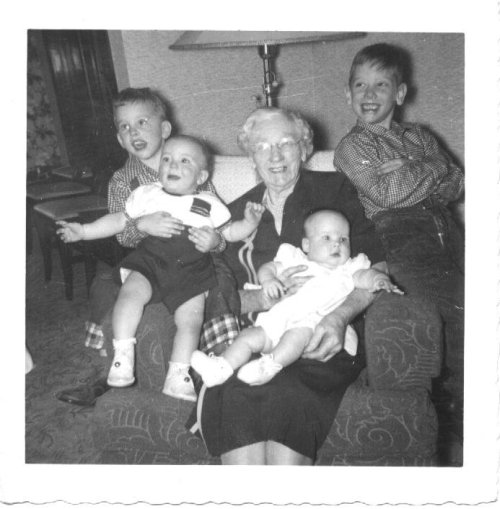
Martha was rail-thin, energetic, and spry to the end of her life. She had 19 great-grandchildren and often had a pile of my younger cousins on her lap:

Martha Duntemann and Kids - 500 Wide.jpg

She went up and down the stairs to her apartment unaided until three weeks before she died at age 96, and never missed church on Sundays. She is buried beside her husband Frank at Town of Maine Cemetery, Park Ridge.

Obviously, I wish I had known her better. But she lived out in the burbs, and died when I was 14. Remarkably, she outlived all four of my grandparents (including her son Harry) who died when I was 2, 4, 12, and 13. I wished I’d known them better too–granting that my mother’s parents were Polish immigrants who didn’t speak English.

So here’s to you, Great-Grandma! Happy 150th Birthday! You carried the flame of life down to me (and by now, hordes of others including my sister’s girls and my cousins who now have kids who have kids, yikes!) and it was an honor to know you even as little as I did. You are my link to a time when trains ran on coal and Chicago’s suburbs were mostly cornfields. Until we meet again…go with God, and rest assured that the gift of life you gave us has not been wasted.

Bringing the 10″ Scope Back to Life

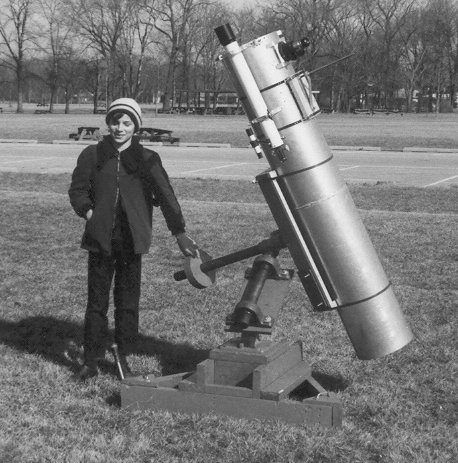
Joe Lill and 10 Inch Newt - 3-8-1970 - Cropped.jpg

When I was 14, I took an opportunity and started out on a very large project: A friend of mine bought an Edmund Scientific mirror-making kit, decided he didn’t have the time to pursue it, and sold it to me. The kit included a 10″ Pyrex mirror blank, a plate glass tool blank, and all the abrasives needed to grind and polish it. I did most of the grinding in my basement, using a defunct round wringer washer as a grinding station. I followed the instructions in the kit, along with whatever I could find in the library, and though it took a couple of months, in time I had a Pyrex blank with a smooth curve, focusing at about 67 inches. My goal was 70, so I came pretty close, and in truth, 67″ would make for a shorter and somewhat lighter tube.

Now, grinding is only half the job. Polishing the ground mirror surface took sophisticated methods to gauge the accuracy of the curve, which has to be a parabola to focus items at infinity (like stars) to a sharp image. I decided I was over my head, and did the sensible thing: I enrolled in a class at the Adler Planetarium on Chicago’s lakefront, which took up most of the summer that I turned 15. They had an optical shop in the basement that included the required Focault tester, plus a superb teacher, Ken Wolf, who helped me get the polishing done and mirror curve accurate. They were also able to aluminize it, and by that fall, I had a 10″ F6.7 parabolic telescope mirror accurate to 1/25 wave, which was bogglingly accurate for a first shot by a 15-year-old.

The rest of the scope took another two years and change to complete. A friend’s father made me a tube out of sheet aluminum. I built a tube saddle out of scrap wood and hardware-store aluminum stock. I had no tools more sophisticated than my dad’s circular saw and saber saw. And that was for woodworking–for metal I did it all with a hacksaw and files. I had some help from my high school machine shop teacher, who dug up a piece of iron that he said was hull metal from a scrapped battleship. He cut it to size on the big bandsaw for me. I spent many study hall hours in his shop on one of the lathes, boring out 2″ pipe fittings and making numerous small parts. I owe Mr. Brinkmann a huge debt of gratitude. Without his help and the use of his machines, I could not have finished the scope.

It was going to be a big scope, and a much heavier one than the 8″ Newtonian I had built from a Sam Brown book the summer I turned 14. I turned my attention to building a base. There was a lot of scrap lumber in the crawlspace. I had the notion of building a cement form out of scrap lumber and pouring a solid triangular concrete shape 36″ on a side with bolts embedded in the top for the battleship-metal mount.

So I built me a cement form.

Whoops. Doing some math and library research showed me that the concrete base would weigh at least 400 pounds. Yes, I could make it–but once I made it, I had no idea how I would move it. So I was left with a scrap lumber cement form…

I.D.E.A!

FirstDateSketchTelescope - 325 Wide.jpgThe form was made entirely from 2″ dimensional lumber, from 2X4s to a scrap of 2X12. I could carry it around with only a little puffing. So I would use the cement form as the telescope base.

A lot more work and allowance money would go into the telescope before I finished it–more or less–in the fall of 1969. On an early date with a pretty 16-year-old girl I had met in church, I told her about the project and drew a picture of it on her little spiral notebook. (See left. She enjoyed talking about science. So did I. She married me in October 1976, and our flag still flies.)

I used that scope a lot, even though it was bulky and heavy and awkward to cart around. In 2000, I (finally!) poured a concrete base for it at our house at the north end of Scottsdale. (See below.) I bought a large plastic trash can to put over the scope to keep the weather off it, and enjoyed it tremendously. Well, we moved to Colorado in 2003. When I went behind the garage to fetch out the now-retired wood base, I discovered that the local termites had been feasting for a couple of years, and there was nothing much left.

I haven’t had the 10″ assembled since. And it’s now about damned time to get to work.

10 inch with Michael Abrash - 2001 - 500 Wide.jpg

I’ve spent a couple of weekends messing with it. Yesterday I bolted the aluminum tang to the base, and although there will be some refinements, what you see below is pretty much what you’ll see when it’s in service.

New 10 inch wood base 1- 500 Wide.jpg

The equatorial head is still workable, though tremendously heavy. I hope to build a new one out of aluminum. In the meantime, I see no reason why I can’t have it up and working by the time of the Great Conjunction of Jupiter and Saturn on December 21. The two giant planets will appear just 6.1 arc-minutes apart, close enough to see in the same eyepiece field, and closer in the sky than they’ve been since 1623. A conjunction of this sort is said by some to be the Christmas Star that the Three Wise men followed to Bethlehem. Miss that? No way!

More on the 10″ scope project as it happens.

The Odd Lots Project

Every so often someone sends me an email to ask, “Is there any place I could find your story ‘Our Lady of the Endless Sky’? I read it years ago and it was a really good story. I’d like to read it again.” Swap in the title of any of several other stories or idea pieces that I published in PC Techniques / Visual Developer what seems now like decades ago–because it is. Some of my idea pieces and humor from the magazine are already up, linked in an archive page that you can find here.

Still, it’s only a few of them, mostly because for those few I still had the original word processor files. Most of those files have been lost. All that remains are the magazines themselves.

Five or six years ago I sketched out an idea for a book containing some of the old BEGIN / END / The Vision Thing / Breakpoint pieces, plus some of my better Contra entries. For almost four years I was occupied with my new novel Dreamhealer. (The paperback edition is now for sale on Amazon, so that project is finally complete.) With Dreamhealer out of the way, a week or so ago I started building a TOC and searching out files for as many pieces as I still have. Some had to be scanned and OCRed from the magazines. Some were buried in odd folders in my data drive. All of them needed cleaning up. Quite a few I have only in WordPerfect format. Fortunately I can convert these using a handy utility called QuickView Plus. The Contra entries are copy’n’paste.

I work on it when time permits. I now have 45,000 words in the master Word file. My target is 75,000 words. There’s still plenty of scanning and OCRing to do, plus introductions to put all this ancient stuff in context.

The book will have seven sections:

  1. Essays and Editorials
  2. From Contrapositive Diary
  3. Poetry (maybe)
  4. Parody
  5. Memoir
  6. None of the Above.

The Poetry section may not happen. I’ve only written three poems in my life that I would show to the general public. Two of them are e.e.cummings pastiche and one Robert Frost pastiche. When God was handing out poetry genes I was standing in the Whimsical Tutorials line. (Fortunately, it was a short line.)

One thing that won’t be included in Odd Lots is “STORMY vs. the Tornadoes,” which appears in my AI SF collection Souls in Silicon . There are a few items that fall in the forbidden zone between fiction and nonfiction, which is what the “None of the Above” section will capture.

I will publish it in both Kindle ebook format and trade paperback. I don’t have a timetable yet, but in nice round numbers I’d like to see it laid out and ready to publish by the end of the year. When I flesh out the TOC a little more, I’ll post it here, and if you remember something that you liked but don’t see in the TOC, let me know in the comments.

The biggest task for now is simply reviewing Contra to remind myself what I’ve done. This is a challenge, as I’ve been publishing Contra now for 22 years and have about 5,000 entries. I’m working on that. So stay tuned. This will be fun. I don’t expect to sell thousands of copies. Mostly what I want to do is put a lot of my mostly-forgotten work back in the public eye. This’ll do it.

Flashback: Getting Past Nagasaki

I ran the first Contrapositive Diary Flashback in February, and I’m doing it again. I won’t do it a lot, but with August being the 75th Anniversary of the end of WWII, I want to re-post a few pertinent things I wrote fifteen years ago that bear saying again. Some of you have seen this before, back in 2005. Many of you haven’t. This entry is a particularly grim one, but human history hands us grim sometimes. We don’t get the history we want. We have to deal with the history we get.


We’re approaching the 60th [now 75th] anniversary of the end of World War II. I have something odd and upbeat to post on VJ-Day, assuming I can find the files. [I did. You’ll see them.] If not, I have some scanning and OCRing to do again, sigh.

Sigh, indeed. Yesterday was the 60th [now 75th] anniversary of our dropping a nuclear weapon on Hiroshima. Many or even most people who are not completely ignorant of the history of WWII or totally wigged out by nuclear weapons understand the necessity of Hiroshima. The world stood stunned as the smoke cleared, and against a threat like that, Imperial Japan would have caved in days. Then there was August 9. Why did we have to do it again?

First of all, avoid the temptation to second guess and judge the people who lived the era and bore the responsibility. People were dying across the world, not by hundreds or thousands, but by millions. Whole nations and peoples were virtually wiped off the planet. How well would you have handled it?

I’ve been boning up on my 20th century history lately, through several books like The Great Influenza, The Fall of the Dynasties, and The War Against the Weak, along with a quick flip through the marvelous 1966 American Heritage Picture History of WWII, though I wept when I read my father’s notes in the margins. Good God, he was there, in the thick of all that hell, dust, and death. He, at least, got back alive, as a man named Robert Williams, who might otherwise have been my father, did not.

I think I understand Nagasaki. I don’t like the understanding I have, but I understand: WWI ended scarcely twenty years before WWII began. The death-stink of Verdun remained vivid in the memories of those who survived it. (They are still digging unexploded ordnance from those now-peaceful fields!) The world seemed to be recognizing a pattern: Every generation, a strange psychosis reached some sort of critical mass, and erupted in increasingly deadly conflicts between nation-states that (by 1945) should long have known better. Even as Nazi Germany collapsed, I think that forward-looking people were charting the line between 1870, 1914, and 1939, and did not like the shadow they saw ahead. The points were growing closer, and the death toll higher, each time that the world went to war. Patton knew what Stalin was, and although he was forbidden his plan to take Moscow, I think his superiors came to understand Patton’s insight. I’m almost certain that the next European war would have come by 1955, and a nuclear-powered Soviet Union would have reduced much of Europe to sizzling ash.

Instead, we took Nagasaki. One might have been a fluke, or good luck. Two in four days was a statement that could not be ignored. In a sense, the American leadership was telling the rest of the world, Stalin and every other emerging nationalist psychopath who might be watching: This..nonsense..will..stop…now.

I mourn for Nagasaki, as I mourn for the Jews, and the Russians, and the Ukraine, and my mother’s high-school sweetheart. It’s been quiet now for sixty years. There has never been another nuclear attack. In my view, there has never actually been another war. (Those who consider Iraq I or II or even Vietnam a “war” need to read more history.) The world turned a corner in 1945. We stopped connecting the dots, and there is some hope that the horrible line between 1870, 1914, and 1939 will not be drawn again. 75,000 people died at Nagasaki, but had they not died, 100,000,000 would almost certainly have perished the next time the world erupted.

Remember: There is no such thing as pacifism. Doing nothing is doing something. There is no escaping responsibility. There are no good choices. All we can do is bless our dead for what their lives have purchased, and move on.

Delphi Turns 25

Today (or maybe tomorrow, depending on who you talk to) is the 25th anniversary of Borland’s introduction of the Delphi RAD environment for Object Pascal. Delphi changed my life as a programmer forever. It also changed my life as a book publisher for awhile. The Delphi Programming Explorer, a contrarian tutorial book I wrote with Jim Mischel and Don Taylor and published with Coriolis, was the company’s biggest seller in 1995. We did a number of other Delphi books, including a second edition of the Explorer for 32-bit Windows, Ray Konopka’s seminal Developing Custom Delphi 3 Components, and others, including Delphi 2 Multimedia Adventure Set, High Performance Delphi Programming, and the ill-fated and much-mocked Kick-Ass Delphi. We made money on those books. A lot of money, in fact, which helped us expand our book publishing program in the crucial years 1995-1998.

It took OOP to make Windows programming something other than miserable. I was interested in Windows programming from the outset, but didn’t even attempt it while it was a C monopoly that involved gigantic switch statements and horrendous resource files. With OOP, you don’t have to build that stuff. You inherit it, and build on it.

There is an asterisk to the above: Visual Basic had no OOP features in its early releases, and I did quite a bit of Windows BASIC work in it. Microsoft flew a team out to demo it at the PC Techniques offices in late 1990 or early 1991. A lot of Windows foolishness was exiled to its runtime P-code interpreter, and while a lot of people hate P-code, I was used to it from UCSD Pascal and its descendents. What actually threw me back in my chair during the Thunder demo (Thunder being VB’s codename) was the GUI builder. That was unlike anything I’d seen before. Microsoft bought the GUI builder from Tripod’s Alan Cooper, and it was a beautiful and almost entirely new thing. It was Visual Basic’s GUI builder that hammered home my conviction that visual software development was the future. Delphi based its GUI builder on OOP, to the extent that Delphi components were objects written within the VCL framework. I enjoyed VB, but it took Object Pascal within Delphi to make drag-and-drop Windows development object-oriented from top to bottom.

People who came to OOP for the first time with Delphi often think that Delphi was the first Borland compiler to support OOP. Not so: Turbo Pascal 5.5 introduced OOP for Pascal in 1989. Although I wasn’t working for Borland at the time, I was still in Scotts Valley writing documentation for them freelance. I wrote about two thirds of the Turbo Pascal OOP Guide, a slender book that introduced OOP ideas and Object Pascal specifics to Turbo Pascal 5.5 users. A little later I wrote a mortgage calculator product using BP7’s OOP features, especially a confounding but useful text-mode OOP framework called Turbo Vision. I licensed Mortgage Vision to a kioskware vendor, and in doing so anticipated today’s app market, where apps are low-cost but sold in large numbers. I cleared $17,000 on it, and heard from users as late as the mid-oughts. (Most were asking me when I was going to start selling a Windows version. I apologized but indicated I had gone on to other challenges.)

I mention all this history because, after 25 years, a lot of it has simply been forgotten. Granted, Delphi changed the shape of Windows development radically. It did not, however, come out of nowhere.

One of the wondrous things about Delphi development in the late 90s and early oughts (and to this day, as best I know) was the robust third-party market for Delphi VCL components. I used to wander around Torry’s Delphi Pages, marveling at what you could buy or simply download and plug into Delphi’s component palette. I have all of TurboPower’s Delphi VCL products and have made heavy use of them down the years. (They’re free now, in case you hadn’t heard. Some but not all have been ported to the Lazarus LCL framework.) I’ve also used Elevate’s DBISAM for simple database apps, and Raize Software’s DropMaster for drag-and-drop data transfers across the Windows desktop. Those are simply the ones I remember the best. There were many others.

I don’t use Delphi much anymore. I still have Delphi 7, and still use it now and then. The newer versions, no. It’s not because I don’t like the newer versions. It’s because what I do these days is teach “intro to programming” via books and seminars, and I can’t do that with a $1,000 product. Well, what about the Delphi Community Edition? I tried to install that in 2018. The binary installed fine. But the registration process is insanely complex, and failed for me three times for reasons I never understood. Sorry, but that kind of nonsense gets three strikes and it’s out. On the other hand, if I were actively developing software beyond teaching demos, I’d probably buy the current version of Delphi and go back to it. I’m willing to deal with a certain amount of registration kafeuthering, but I won’t put my students through it, especially when Lazarus and FreePascal can teach the essentials of programming just as well.

Nonetheless, Delphi kept me programming when I might otherwise have given it up for lack of time. It allowed me to focus on the heart of what I was doing, not on writing code for user interface elements and other mundane things that are mostly the same in all applications. Back when Delphi was still a beta product, Project Manager Gary Whizin called Delphi OOP programming “inheriting the wheel”. That’s where the magic is, and Delphi is strong magic indeed.

Green Grow the Russians, Oh!

A song got stuck in my head the other day, but I had forgotten the words. No, wait: I never entirely knew them to begin with. They made no sense, but that didn’t matter, as for the most part they were unintelligible. About all I could clearly recall at first was the line:

I’ll sing you five-oh; green grow the Russians, oh!

And with that, a whole dumpster of brain sludge emptied out into my forebrain. It is a tale (probably) worth telling.

Ok. In the summer of 1963, I went to Boy Scout Camp for the first time. I was 11. It was at Camp Owassipe, the big Scout reservation inland of Muskegon, Michigan. The camp at that point was 11,000 acres huge, and that first year we were at Camp West, one of several camp centers within Owassipe. Camp West was for tent camping (no cabins) and was a CCC project from the ’30s that had not been well-maintained and after thirty years was falling apart. But it was right on a lake and we loved it.

Part of the Camp West experience was eating three meals a day in a big log-lodge mess hall that must have held two hundred tweener boys. The food was hot dogs and hamburgers. We didn’t care; we were lower-middle-class upstarts and had no issues with hot dogs and hamburgers. I don’t remember there being any green vegetables, and I was good with that.

But one thing none of us had ever experienced before was singing songs after meals. There were several college-age junior scoutmasters at Camp West, and they led the digesting masses in several rousing pieces before sending us on our way. I remember only two of the songs, and only one clearly: Rise and Shine. One of the mess hall song leaders was a junior scoutmaster named Jory, so as you can imagine, most of us sang:

Rise and shine and give God your glory, Jory!

Being tweener boys, it was funny even after singing it seventeen hundred times. Fortunately for us, Jory was a good sort, a little overweight and very much the showman. For all we could tell, he was singing it too.

Now, the other song. Our Scout troop was based at our Catholic church, and what we sang at school were either Catholic hymns or odd little songs in songbooks published by the Sisters of Providence, which were more or less junior Catholic hymnals with some kid stuff tossed in for seasoning. (Gregorian chant wasn’t the sort of thing you sang at Scout camp.) I’m guessing that most of the other kids were Protestants, because they knew the songs and we didn’t. The song leaders assumed that we all knew the songs, and didn’t take time to teach them. We learned them by listening to the other kids. Except this time, the lyrics were nowhere near as clear–especially with half the boys horsing around and generating plenty of QRM. Ladies and Gentlemen, I give you the weirdest kid song ever. This has “Baby Shark” beat all cold: Meet Green Grow the Rushes, Oh!

It was a counting song, like “The Twelve Days of Christmas,” which gave us some clues, at least. It started out with a grammar puzzle:

I’ll sing you one, oh; green grow the rushes oh!

What is your one-oh?

One is one and all alone and evermore shall be it so.

First of all…rushes? This was pre-Vatican II, and although we were taught Bible stories, we did not read them from the Bible, even baby Moses in the rushes. (This was a Catholic peccadillo that ended with the Council.) The word “rushes” was not in our working vocabulary. We knew them as “cat tails.” However, the Russians loomed large in almost every part of life in that era. They were the emblematic Bad Guys of my grade school ’60s, who we were sure would first beat us to the Moon and then kill us all with nuclear missiles. So we insulted them at every opportunity. Swapping in “Russians” for “rushes” made no objective sense, but it made perfect sense to Cold War era tweener boys.

Alas, we couldn’t quite parse the clause “evermore shall be it so.” Sister Marie Bernard would have circled that in red and taken points off. So we sang “and evermore shall be a stone.” It was a good guess, and better still, we could diagram it if we had to.

Some of the others were obvious, like “Twelve for the Twelve Apostles.” Which made this a God song, just like “Rise and Shine.” Ditto “Ten for the Ten Commandments.” “Eleven for the Eleven Who Went to Heaven” was also obvious, in part because not much rhymes with “eleven” but “seven” and “heaven.” (The word “leaven” was not yet in our vocabulary books.) Were there only eleven people in Heaven? Kind of a lonely place. Our Mass books were crusty with saints, and we had to wonder where they all ended up.

After ten it got a little freaky. “Nine for the Nine Bright Shiners?” What were they? God’s baseball team? “Eight for the April Rainers?” I remember singing this as “April Rangers.” Maybe the April Rainers were God’s farm team. Farmers like rain, no?

“Seven for the Seven Stars in the Sky.” As with the saints in Heaven, this figure seemed a little short, especially since you could see every star there was in rural Michigan night skies in 1963. Maybe the songwriter lived in Chicago, where you might see seven, if you were lucky and had good eyes.

“Six for the Six Proud Walkers.” I believe I heard this one correctly, but that didn’t prevent us from singing “Six for the Six Loud Talkers.” Given that talking in class was a sort of secular mortal sin, we assumed these guys were not among the eleven in Heaven. Besides, Pride was a Capital Sin.

“Five for the symbols at your door.” Hmmm. I heard that word as “sinfuls” which while wholeheartedly Catholic seemed off somehow. Maybe it accounted for the semiregular visits by the Jehovah Witnesses, who much annoyed my very pious mother.

“Four for the Gospel makers.” I’m pretty sure everyone was singing “Gospel Writers,” which at least made sense numerically, and we were back to God territory. (Every writeup admits that some of the lines came in multiple versions.)

“Three, three, arrivals.” Huh? I swear, the first time we sang the song, this came to me as “Please clean the rifles.” “Three, three survivors” was what we ended up singing, lacking any strong clue as to who had survived, nor what trials they had undergone. Without being able to name them, I recalled the three guys who got thrown in a furnace by the Babylonians but survived because Jesus was in there with them, and you did not mess with Jesus.

“Two, two little white boys, dressed in all their green-oh.” I’m also pretty sure this is what everybody was singing, even though the definitive version is “lily-white boys.” Supposedly this is about the two main stars in Gemini, which on bad nights might well be the only stars you could see in Chicago. As for dressing a star in anything, well, you dress the star of your choice. I’ll watch–from a hundred million miles or so.

One, as mentioned earlier, was a stone. If it was all alone, it should have ducked down a Chicago alley, which in 1963 were gravel-paved and where most of our stones came from.

My following two years at Boy Scout Camp were at a much newer campground, which did not have a mess hall. They delivered hot food in giant thermos bottles from a jeep, and we ate at picnic tables. We sang some songs around the central campfire in the evenings, but beyond a somber item about Chief Owassipe none of them have stuck even a little.

Considering “Green Grow the Rushes, Oh”‘s cloudy origins and multitude of verse variations and interpretations, I can’t say we did it much violence. After all, see this, from the song’s entry on Wikipedia:

“The musicologist Cecil Sharp, influential in the folklore revival in England, noted in his 1916 One Hundred English Folksongs that the words are “so corrupt, indeed, that in some cases we can do little more than guess at their original meaning”.

We were from Chicago. Corruption there was so ubiquitous that most people didn’t even notice it. As for guessing, well, we guessed, and our guesses were as good as anybody’s. If it came back to me fifty-five years later, I’d say its evolution as an earworm was very robust. Plus, it propelled me to a long and motley career of writing silly lyrics to well-known songs.

As for the Russians, they were the wrong color, unless they were like bell peppers. You never can tell with Russians.

Flashback: Synchronicity and the Combinatorially Exploding Penny

Heads-up: I’ve never done a Contra flashback before, but given my post yesterday about pennies, this seemed to be a good time to republish a Contra entry I wrote back in 2005. I could have posted a link, I guess, but I wanted as many people to see it as I could manage, as it is just the…damndest…thing. Fifteen-ish years later, I’ve not encountered synchronicity anything like this boggling. I may do flashbacks again with older entries that I consider significant, especially if I’m in the middle of a dry period time/energy wise. Oh, to be 50 again…


penny1923.jpgSynchronicity (meaningful coincidences of preposterous unlikelihood) is something that doesn’t interest people very much until such a coincidence happens to them. I can point to three instances of synchonicity in my life: One marginal, one peculiar, and one that just floored me. The marginal one was the Exuberant Cross, which is an excellent example of seeing symbolism in the ordinary, though there is some peculiarity in seeing it the first morning I was living in Colorado. The peculiar one we’ll leave for another time. But then there’s the big one…

Back in 1996 I went down the road aways from the office to get a sandwich. This was unusual to begin with; I usually ate lunch with Carol, but she wasn’t at work that day. I was in a bad mood, a little depressed from thinking too much about my father. As I’ve said too often here, he died young and in a gruesome fashion, and there was unfinished business between us. I was only beginning to work through the issues in the mid-1990s. Now and then I rage at his memory; most of the time I just miss him. I turned on the car radio and the oldies station was playing something obnoxious, so I hit the country button. After the concluding seconds of some cowboy song and a few seconds of DJ chatter, another song started up.

I’d heard it before: It was Colin Raye’s “Love, Me”, an otherwise unremarkable country tearjerker thing about a boy whose grandma dies. Carol always turned the radio off when it came on. There are times when I can listen and times when I just punch another button. This time I listened, and boy, the song worked as designed. Read the lyrics; they’re clever. (Ignore the sappy formatting.) The first line is significant:

“I read a note my grandma wrote, back in 1923…”

I had failed out of engineering school while my father was dying, and I felt for many years like I had let him down, just like I did when I had failed to love baseball as a ten-year-old. He could not imagine how a writer could make a living, and I could not imagine how an engineer could smoke himself to death. As a young man, I often wanted to say, Don’t give up on me. And all my life it was a private point of honor for me not to let him down. (I didn’t.) So there were some connections there, in that stupid song.

It wasn’t that far to the sandwich place. When I parked I mopped my eyes and turned the radio off in exasperation, feeling like it had suckered me in to an unnecessary sentimental tate. Shaking my head, I went into the shop and ordered my usual ham and swiss. The soda-and-sandwich lunch special came out to $4.99. I handed the guy a fiver. He dug in the drawer and pulled out a penny, which he slid across the counter to me. It looked pretty beat up, and when I picked it up I flipped it over and took a closer look.

The date on the penny was 1923.

Hoo-boy.

So. What are the chances? I got one coin in change. I hadn’t seen a penny that old in change in probably twenty years. I didn’t listen to country music all that often. And it was maybe a five-minute ride to the sandwich place, during which that one song alone had begun and played to completion. How could all those things line up so perfectly, on a day when I was already depressed from ruminating about losing my father? A New Ager would say “It’s a Sign. He’s there. He knows you didn’t let him down.”

A part of me wanted to think of it as a Sign. (Another little part still does.) On the other hand, I’m not a New Ager, and the incident forced me to think a little bit about about outrageous coincidences. Here are the major points that come out of the exercise:

  • In 45 years of living, a human being experiences an enormous number of identifiable things, from country songs to birds on the lawn to oddly shaped clouds and everything else that we notice during the 16-odd hours we’re awake every day.
  • Human beings are complex things, with a great many thoughts, memories, cravings, articles of faith, and emotional flashpoints.
  • Something in our mental machinery tries very hard to find meaning in everyday life.

In rolling those three points together I come up with an interesting conclusion: It would be remarkable for someone to live 45 years and not run into a coincidence like that at least once. (My other two experiences of synchronicity are pikers by comparison.) In each life there is a combinatorial explosion of possible alignments of thoughts, feelings, and objective experiences so large as to be beyond expressing. Little alignments happen now and then. (“Just as I pulled into the packed parking lot, somebody was pulling out right in front of me!”) Every so often, an alignment happens that makes us shake our heads in wonder. (I’ll tell you about the “I love you” stone someday.) But sooner or later, everybody is going to run into a whopper.

Keep your eyes open. You wouldn’t want to miss it!