Jeff Duntemann's Contrapositive Diary Rotating Header Image

None Of The Above

Anything that doesn’t fit into existing categories

The Everything Machine Is Live!

Everything

My newest novel, The Everything Machine, is now available on Amazon’s Kindle store. And thereby hangs a tale. A long tale. I don’t think I’ll be able to tell the whole story today. What I’ll do instead is post the book’s description on Amazon:


Carrying 800 passengers and their household goods, agricultural animals, and farm-related supplies to Earth’s first interstellar colony, starship Origen’s hyperdrive self-destructs, marooning its passengers near an Earth-twin planet orbiting an unknown solar-twin star. While settling in, the inadvertent colonists name their world Valeron, and discover that Valeron is scattered with hundreds of thousands of alien replicator machines—but there are no aliens nor any other trace of them.

Each replicator is a shallow 8-foot-wide black stone-like bowl half-full of fine silver dust. Beside the bowl are two waist-high pillars about 8 inches in diameter, one pale silver, the other pale gold. Tap on either pillar, and the pillar makes a sound like a drum, one pillar high, the other low. Tap 256 times on the pillars in any sequence, and something surfaces in the bowl of dust. Simple sequences create simple and useful things like shovels, knives, rope, saws, lamps, glue and much else. Complex or random sequences create strangely shaped forms of silver-gray metal with no obvious use. 256 taps on the pillars can create any of 2256 different things; in scientific notation, 1.16 X 1077.

That’s just short of one thing for every atom in the observable universe.

The artifacts are dubbed “drumlins,” for the sounds the pillars make, and the replicators called “thingmakers.” Drumlins have strange properties. Although virtually indestructible, drumlins can change shape, especially when doing so will protect a human being from injury. Drumlin knives will not cut living human tissue, but they will cut living animal tissue or human corpses. Press a drumlin knife against your palm, and it will flow and flatten out to a disk. Pull the knife away, and it will slowly return to its true form as a knife. Some claim that drumlins read human minds and grant wishes. Others insist they are haunted by invisible and perhaps hostile intelligences.

After 250 years on Valeron, the colony prospers. Starship Origen is still in orbit, and a cult-like research organization called the Bitspace Institute vows to repair Origen’s hyperdrive and return to Earth. With millions of drumlins catalogued using the thingmakers, Valeron’s people live well and begin to lose interest in returning to Earth. This threatens the Institute’s mission, prompting it to launch a covert effort to undermine public faith in drumlins. A low-key war begins between the Institute and those who value drumlins–including farmers, other rural folk, an order of mystical women, and several peculiar teen girls who have an unexplained rapport with the thingmakers and their mysterious masters.


The ebook is $3.99. The 377-page paperback is $14.99. The cover was designed and drawn by artist/author/Renaissance woman Cedar Sanderson.

The storyline defies easy categorization. Looked at from one angle it appears to be hard SF. There are starships. And AIs. From another angle it looks like a space western. The Republic of Valeron resembles America in the early 1890s.  Valeron City, the capital, has just started running streetcar lines down its main streets, powered by a new dynamo on a river upstream from the city. People ride horses. They pack 6-guns. (Or, if you’re in the Bitspace Institute, 11-guns.) Thingmakers and drumlins are everywhere. There are pinlamp drumlins in many different sizes. Lighting is provided by pinlamps. The thingmakers can provide most other household goods as well, although the thingmaker’s size limits its creation of larger objects. The Institute is developing vacuum tubes and 2-way radios. The Grange (a farmers’ organization that might be characterized as rural Masons) has drumlin radios—and keeps them a secret.

I don’t want to spill a great deal more here. There are a lot of ideas, but in truth, what I was striving for in this novel are interesting characters who struggle, learn, and grow. Characterization was always the hardest part of writing my own fiction. I took great pains this time to make my characters come alive, and my alpha readers seem to think I succeeded.

So go get it. And if you like it, please review it—not only on Amazon but on your blogs and social network accounts. The biggest problem indie authors face is reader discovery. I’m going to post notices on X and Facebook and see how things go. My guess is that characterization is a cakewalk next to indie book promotion.

What a Difference Four Years Makes…to KDP

Well, in a couple of days I’m going to flip the switch and ask KDP to publish The Everything Machine, my first novel since 2021—if Complete Sentences really counts as a novel, of which I’m not entirely sure. I’ve already uploaded both ebook and paperback editions, and I’m only waiting for a final proof copy to get here. Amazon says tomorrow—and it’s been bang-on with delivery times for the first two proof copies I ordered across the past month or so.

I knew going in that there would be some changes to KDP. Amazon has sent me half a dozen emails reminding me that as of March 18, KDP will no longer accept mobi files. Mobi has been Kindle’s flagship file type probably as long as there’s been Kindle.I’ve seen no explanation, but after 3/18 only kpf (Kindle Create) epub, or docx files will be accepted. This doesn’t slow me down in the least. The Jutoh ebook editor that I use can export epubs as well as anything else in current use.

What surprised me more was the addition of spell-checking on uploaded ebooks. Out of the novel’s 130,000 words, the spellchecker called out 30-odd items as possible misspellings. Then it was courteous enough to send me an email listing them all. Out of those 30-odd, only four were actually misspelled words. The rest were character dialect or Jeff inventions, including metarhythmic, wubbled, birdoculars, bitspace, rectored, pinlight, fancraft, fauciam (Latin) recursor, bookspring, bitbags, gatherum (without omnium in front of it) and vuldt.

There are some asterisks: Although I invented the word “vuldt” when I was in high school, “Vuldt” is actually a Dutch surname. It must be a very rare surname, since none of the other surnames I used in the novel came up as misspellings. It didn’t like “steerskin,” even though it’s a reasonably common term.

Weirdest of all, it didn’t like the word “leptal.” Why? Because “leptal” isn’t a word. At best it’s the trademarked name of an antiseizure drug. But I was lead-pipe certain that “leptal” is the opposite of “dextral,” a real word meaning right-handed chirality. Alas, the real word for left-handed chirality is “sinistral.” (Recall the two old words from heraldry for right and left: “dexter” and “sinister.” ) As best I can tell, I was reaching for the word for left-handed chirality and inadvertently made up my own.

The spellchecker gave me the option of ignoring any of the highlighted words, which was handy. I fixed the typos in the epub and replaced “leptal” with “dextral,” because it didn’t matter which chirality I called out. The Hilbert stardrive has two chiral cables in its big ring, and which one I cited had no effect on the plot. Later, I fixed the typos in the paperback’s PDF. I uploaded corrected versions of both epub and PDF.

Now, we wait. Trust me, you’ll see the announcement here and a lot of other places when Amazon OKs the uploads and publishes them.

Grok Explains the Weevils

I told a joke on Twitter/X. Although it wasn’t much of a joke, it was subtle, or at least I thought so. Twitter has a new feature called Grok, which is an AI that (supposedly) explains posts. I wondered if Grok would get my joke. I might as well copy’n’paste the whole thing here:


Me:

The US government chooses two boll weevils every four years and leases them to the people. This makes the Feds the lessor of two weevils. And the weevils? They’re having a boll.

Grok:

The term "lessor of two weevils" is a play on the phrase "lesser of two evils," which refers to choosing the less unpleasant of two poor options. This phrase is commonly used in political discourse to describe situations where voters choose between two undesirable candidates.

The "boll weevil" in politics historically refers to conservative Democrats, particularly from the Southern United States, who supported some Republican policies during the Reagan administration. This term draws from the insect’s difficulty to eradicate, symbolizing the political resilience of these Democrats.

Jeff Duntemann’s post humorously suggests that in the U.S. political system, the government essentially leases out these conservative figures (boll weevils) to the public every election cycle, playing on the idea of political figures being somewhat unavoidable or persistent like pests.


It came to me as a silly play on words (“lessor of two weevils”) with the rest built around it to make it an actual joke. I wondered if most readers would understand the word “lessor,” which I don’t see much in my reading and don’t recall ever hearing it used in conversation.

Now, I myself didn’t know that “boll weevils” had once been used as a slur against conservative Democrats. I certainly haven’t read it with respect to modern politics. If I had, I would have created the joke another way. I simply meant to imply that the government chooses a couple of weevils every four years, and leases them to the public. We pay officials with our taxes during the time we “lease” them, but never own them. This makes the Feds a “lessor”.

So Grok didn’t get the joke as I intended it to be gotten, but read it as Reagan-era humor. So it goes. My opinion of AI hasn’t changed. It’s a massive pattern-matcher without any least cognizance that its explanations may simply be wrong.

I’ll play with Grok some more to see how well it “explains” additional posts, mine and others’.

Lots of DDJ’s Text Has Gone Online

Ok, this is probably illegitimate, but it’s one way to get access to literally all my DDJ “Structured Programming” columns, which appeared from 1989-1994. In fact, even I don’t have the files containing the text of many of those columns anymore, so I’m going to download them before circumstances force the poster to take them all down.

My column was distinctive due to a trick I shamelessly copied from Isaac Asimov’s long-running science columns in Fantasy and Science Fiction: Start with a funny but pertinent story. I picked one at random, and it turned out to be one of the better ones. Below is the opener for my January 1992 column, about event-driven programming, which I was studying at the time using Turbo Vision. (I was 39.) It’s just the intro, which lays out an experience I had that most of you have heard of. It really did happen, really. I couldn’t make anything like this up.


Chewing the Wrapper

Jeff Duntemann KG7JF

It was 1971, and I was a college sophomore at a beer bust put on by a fraternity hungry enough for pledges to admit anyone. I was dressed in a bright yellow sweater and bright purple bell-bottoms, trying very hard to grow my hair without realizing the ultimate futility of the effort. (Can you picture me with shoulder-length hair? Sigh. I can’t either.)

As often happens at parties, an impassioned discussion between two people begins to attract a crowd, and before long a considerable fraction of the party was watching me debate some half-sloshed prelaw type on the merits of bringing the United Nations into the Vietnam conflict. Or maybe it was the moral imperative of passing the E.R.A. I forget–because all the while I was half-watching a pretty young woman who was hanging on my every word, following my discourse with this look of unbelieving awe on her face.

Shall we say this was not an everyday occurrence, and her interest inspired me to even greater heights of eloquence. Was it my sweater? My sideburns? Or could it be that at least one girl in this five-and-dime college appreciated the power of brains over biceps?

The prelaw slurred some minor insult at me and slunk away, defeated. The crowd wandered off–but she hung on, eyes like sapphires riveted upon me, and in our single moment of intimacy she breathlessly revealed the secret of her admiration: "You know, you always talk in complete sentences!"

Chewing the Wrapper

My God! She had thrown away the gum and was chewing the wrapper! What about my passion? What about my social awareness? What about my obvious allegiance to the greater good of mankind? No matter–she went home with some football player, and I went home with my complete sentences. I guess in the long run we both got what we deserved. [Note well: By 1971 Carol and I were a very close couple, and I had no interest in the girl as a girl. Her remark just made for a good story.]

There’s a lesson here. Rarely are our creative efforts admired for what we as creators consider most admirable. Isaac Newton wanted to be remembered for his theology–calculus was just a throwaway. The seminal object-orientation of Smalltalk was ignored for 15 years because people were too busy ooh-ing and ahh-ing at its primordial GUI.

I expect this will happen more and more these days, as it ironically grows easier and easier to create a flashy user interface and positively murder to sort out an application’s internals. It’s humbling to keep in mind as you struggle to master event-driven programming under Turbo Vision or Windows: They’re not going to admire the intricate subtlety or robustness of your event loop. They’re going to admire the color coordination of your scroll bars.

My Christmas Story: The Camel’s Question — 99c

CamelCover-500 wide

“Listen, young ones, for I, Hanekh, am a very old camel, and may not be alive to tell this tale much longer. Listen, and remember. If I leave nothing else behind but a spotty hide and yellow bones, I wish to leave this.”


Only 8 more days until Christmas! Please allow me to introduce (again) my Christmas fable about the camels that brought the Three Wise Men to Bethlehem. It’s a short story with a deep history: I wrote it when I was 13 as an eighth grade English assignment, in the runup to Christmas 1965. A few years later I decided to give it to my mother as a Christmas present for Christmas 1972. Problem was, I had lost the handwritten grade school manuscript, so I just sat down and rewrote it from memory. I gave Mother the typed manuscript in a duo-tang binder. She read it, wiped the tears from her eyes, and then kept it in her dresser for literally the rest of her life. My sister and I found it after Mother died in 2000. I took the story home, where it sat in a box for 22 years. In the fall of 2022 I pulled it out, OCRed it to a text file, and then did a certain amount of editing and polishing before uploading it to the Kindle store.

The story is a fable because animals are the primary characters. Two of the Magi’s camels ache for very different things. Then there is Hanekh, who is unlike most camels in that he tries to make sense of the world around him, a world shaped and ruled by human beings. He asks the Christ Child a question, hence the title. All three camels receive what they desire, but Hanekh—

—Well, read the story. It’s only 99c. And keep a Kleenex handy. Or wear long sleeves. It’s not a sad story, but a story of triumph, of both God and God’s creation, camels included. I’ve written a number of stories of triumph and affirmation. This may well be my favorite.

Decorated!

It took us a few days, but we got the great room decorated, including trimming both our artificial and natural (and we hope live) tree to the nines. This may be the best real Christmas tree we’ve ever had as a couple, and our hope is that with careful watering it will keep us until Epiphany.

If we have to take it down sooner, well, the experiment was worth doing. Here’s a shot of our real tree, in the corner by the bar:

IMG_1020

We don’t use the bar for drinking, so it presents a nice place for decorations, this year including our creche and Carol’s Plasticville Farm, complete with farm animals and a corral of giant bichons:

IMG_1021

We’re going to set up the Lionel trains this year, including my father’s 1926 set that is now 98 years old. The venerable #250 electric loco still rips around the track as it doubtless did when my dad was a toddler. We’ll also be running Carol’s Lionel set from the late ‘50s; however, the trains will have to wait until after the cleaning service goes through and mops the tile floor.

I’ll take some pictures of the artificial tree and will post them as time permits. We’ve started Christmas a little early this year, just to see what it’s like to get all Christmas-y on November 29 instead of December 15th or so. Like I said, I’ll keep you posted.

The Long-Horizon Holiday

Happy (belated) Thanksgiving! I’ve talked about Thanksgiving and the things I’m thankful for here several times, and won’t repeat it all here tonight. All that I said then still applies, though the list has gotten longer over the years. We had dinner with friends, starring a roast goose! I know I’ve had goose but it’s been years—nay, decades—since the last time it crossed my plate. Good wine, good food, good friends. That’s a lot of what I’m thankful for, right there, plus the woman sitting beside me, and her 55 years of love and devotion. I am a man much blessed, and appreciate it.

It was a good day indeed. And today, well, it’s Black Friday. People complain sometimes about Christmas starting the day after Thanksgiving. I’m of two minds about it, and Carol and I prefer not to fight the crowds at major retailers. Like it or not, the reality is that Christmas has become a sort of long-horizon holiday. The stores put out Christmas goodies the day after Halloween. Some people start shopping and celebrating on Black Friday, and others continue it until the Epiphany. This year we decided to start on Black Friday, for a reason: Christmas trees.

The Arizona desert is hard on pine trees shipped down from Minnesota or wherever. We’ve had mixed luck finding trees that lived even two weeks in the stand with plenty of water. In Colorado we had one once that lasted so long it began growing. I doubt that would happen here. But Carol and I had a plan. We knew that Whitfill’s Christmas Trees opened for business on Black Friday, so up 64th Street we went, to their usual spot between Bell Road and the Canal at 64th.

We got there about 2PM, and the joint was jumpin’. They had trees that had to be twelve feet high. Not for us. We wanted something shorter, fuller, and greener. I didn’t want something over seven feet high.

It took us approximately 90 seconds to find the tree that we bought.

It’s very green, very full, maybe not quite seven feet high, and smells ever so wonderful. Trees cost down here; I paid $200. This time I think we got our money’s worth. We think it’s the prettiest tree we’ve ever had. The reason for that is probably getting there before the crowds snapped up all the really good trees. We were there early. We got a good tree. Nay, an excellent tree.

We haven’t begun decorating it yet. We brought all our Christmas decor back from the storage unit a couple of days ago. The tree is now in its stand. Tomorrow we begin. We’ll keep you posted.

Odd Lots

  • I asked MS CoPilot a simple question—“How does menthol alleviate pain?”—and let it rip. It ripped. And ripped. And ripped, spinning its spinner for four hours before I finally closed the window without any sort of response. I’ve had tolerably good luck working with CoPilot, but this suggests it still has a long way to go.
  • MIT appears to agree: They are now telling us that generative AIs do not build world-models and thus cannot be counted on to be useful in any arbitrary context. Ummm…did we really need MIT to tell us that?
  • Mayo Clinic researchers have found that stem cells grown in zero-G grow faster and work better in tests than stem cells grown on Earth. The research has only begun, but I could definitely see Elon Musk establishing a stem-cell farm in orbit if that research pans out.
  • Jim Strickland sent me a link to a wonderful NASA animation of Moon photos as the Moon orbits Earth, showing all the phases the Moon goes through, including libration and position angle for the full year 2025. As best I can tell, it doesn’t display lunar eclipses, but there are many other places detailing times for those.
  • Alzheimer’s may not be a brain disease so much as a mitochondria disease. Other theories beyond amyloid plaques are coming up, and this piece presents a nice summary of why we may be wrong about amyloid plaques and what other mechanisms might be behind dementia.
  • There is now reasonable research showing that the infrasonic (very low) sounds emitted by ginormous wind turbines can cause health problems in humans and other animals.
  • I ran across Justapedia about a month ago, and so far it holds up well compared to Wikipedia. The idea is to maintain a MediaWiki-based competitor to Wikipedia, one that is deliberately non-political and less obsessed with notability and various other side issues. Take a look. I’m rooting for them, but beating a competitor as entrenched as Wikipedia is a daunting challenge.
  • UTIs are very common but kidney infections—which you would think are caused by the same pathogens—are not. Here’s an explanation why.
  • When I was a little kid (figure 7 or 8, maybe 9) all the boys of similar age in my neighborhood were allowed to dig a hole in their backyards big enough to sit down in and play with toy soldiers, dinosaurs, or other injection-molded fantasy icons. There’s now evidence that letting kids play in the dirt can train our immune systems to recognize and shake off many more microorganisms than kids living in low-dirt environments like city cores.
  • And it’s not just dirt. A Harvard-trained nutritional psychiatrist confirmed that human brains need a diet rich in meat to support mental health. Let’s put it this way: We did not evolve eating kale—but that said, Carol and I do eat a rainbow salad most nights with our meat course. I’m pretty sure that evolution-wise, the meat came first.

The First Finish Line Of Several

It’s done. The first draft of The Everything Machine. I had a lot of trouble with Chapter 57, but a bit of focus and a couple of false starts got it where I knew it had to go. The first draft is now complete. It came in at 131,000 words, which is more than Dreamhealer but less than The Cunning Blood. I’ll most likely carve a couple thousand words out of it, though I paid more attention than usual to dead end scenes and promises early in the manuscript that the later chapters could not fulfill. There just won’t be as much scrap as there usually is.

The Everything Machine Is set in the same universe as The Cunning Blood. just elsewhere in the galaxy. A starship carrying 872 people plus gene-pool plants and animals for the Erewhon colony does a black fold and instead ends up…somewhere. Part of the mystery of the Metaspace stories is that everywhere there is a Sun-like star there is an Earth-like planet. The black fold destroyed the starship’s Hilbert drive, so there’s no going back. Starship Origen’s people and cargo shuttle down to the Earthlike planet’s surface and struggle to survive.

But…there are these alien…things. Clearly artificial, each consists of a 2-meter wide bowl half-filled with silver-gray dust. Beside the bowl is a low platform and two pillars, all made of some indestructible black stone. A teenage boy discovers that if you tap out a 256-bit binary pattern on the two pillars (one pillar for 0, the other for 1) something will coalesce and surface in the bowl. These (early) artifacts are all composed of a silver-gray metal that doesn’t scratch, bend, melt, or allow itself to be pounded flat in a forge. Some are familiar, like axes and shovels. Some are twisted lumps of silver-gray metal that don’t look like anything humans have ever seen.

The inhabitants of a world the inadvertent colonists eventually dub Valeron initially refer to the items produced by the alien machines as “thingies.” As people get used to tapping on the pillars (which respond with a sound for each tap, one pillar high, the other pillar low) they begin calling the artifacts “drumlins” because you drum on the pillars and drumlins appear in the bowl. Yes, I know that a drumlin is a glacial landform, but I repurposed the word because 95% of humanity have never heard it and it worked well in the story.

Planet Valeron is found to have hundreds of thousands of these machines (which are soon dubbed “thingmakers” because that’s what they do) scattered across the planet’s one big continent. Across over 250 years the population survives and grows, largely with the help of the thingmakers and the drumlins they produce. 261 years in, people ride horses and steam locomotives, but clever folk find a lot of useful things in the thingmakers, and begin compiling an index. Five minutes tapping on the pillars with that index in front of you, and you get a new (and indestructible) something. Shovels, hammers, pipe fittings, lengths of pipe, and much, much more.

Drumlins are peculiar in a number of ways. Besides being indestructible, drumlins will not hurt you. Take a drumlin knife to your dinner and it cuts your lamb chop just fine. Force the point of the same knife against the palm of your hand and the blade flattens out into a disk. Pull it back from your hand and it slowly returns to the form of a knife. How does the damned thing know?

That’s only one mystery of many surrounding the thingmakers. Remember Magic Mikey’s “players” from The Cunning Blood? They’re here. If they want to talk to you, they insert words into your consciousness. Talking back to them is tricky but it can be done, especially by peculiar teen girls.

I introduced the Drumlins World in a novelette called “Drumlin Boiler,” which appeared in IASFM for April 2002 and is in my collection Cold Hands and Other Stories. Jim Strickland and I wrote a double novel about the Drumlins World back in 2011. I adapted “Drumlin Boiler” as the first part of The Everything Machine, because it introduces the thingmakers, drumlins, and several characters who play a major role in the story.

There are truckloads of Jeff Duntemann ideas in the novel, but I took extra care to create characters who made sense and could be understood as human beings who could well be friends and loved ones, facing a phenomenon both mysterious and wonderful. I tossed in a couple of low-key love stories. There are fights, explosions, 6-shooters (and 11-shooters) hydrogen airships, sheriffs, starships built by humans and also by, well, whoever created the thingmakers.

That’s as much as I can tell you right now without getting into spoilers. Note well that I still have a huge amount of work to do. I have to do a continuity pass, and either do or hire someone to do an edit pass. Oh, and a cover. That may be the toughest challenge of all.

There are several finish lines in the craft of writing novels. I just got past the first. Plenty others are waiting in the wings, itching for me to cross them.

I’ll keep you posted on how the game is going.

The End of the Beginning

Whew. That was work. Earlier today, I finished the epilogue to The Everything Machine, the big drumlins novel, which I have worked on in fits and starts (and slogs) since 2006.

The first draft is now structurally complete. It isn’t finished, exactly. I’m still rewriting much of Chapter 57, which just didn’t turn out right. And there is a lot of other work to do. The first draft now stands at 128,000 words. I’m hoping to get it down to 125,000 and probably will. That edit pass is still to come.

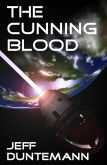
The idea dates back to 1997, when I got the ideas for both The Everything Machine and The Cunning Blood in one bizarre evening. I was sitting on the edge of our pool with Carol when my brain just suddenly boiled over with ideas. I was days taking notes. What I had was a whole new universe to write in and about. I had a little more concept on The Cunning Blood, so I began that novel first, under the original title No Way in Hell. A publishing colleague warned me that bookstores might not shelve a book with “hell” in the title, so I thought of The Cunning Blood and went with it. Not long thereafter, I was in our local Bookstar store (RIP) and while browsing stumbled across a book called F—k Yes! (minus the hyphens) by the unlikely Wing F. Fing. Face-out, already. So much for bookstores being afraid of the word “hell.”

That was ok; I quickly decided I liked “The Cunning Blood” as a title a whole lot more. I finished it in 1999 and tried to shop it to the big NY SF imprints, without any serious luck. (The editor of one press said, “I came real close on this” which at the time made me feel a little better.) While shopping it I wrote a novelette on the other concept called “Drumlin Boiler.” I sold that to Asimov’s SF in 2000, and it was published in April 2002.

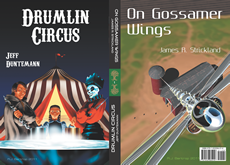
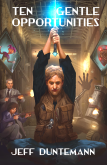
That was about the time that Coriolis went under. I was depressed for a couple of years and didn’t write much fiction. I finally sold The Cunning Blood to a small press in 2005, and it reviewed well in several places, including Analog and Instapundit. In 2006 I started some conceptual work on a novel I called The Anything Machine. I wrote concept scenes and tried to get some momentum going, to no avail. I started Ten Gentle Opportunities about that time, which sucked up most of my creative energy for a couple of years. In 2011 I got together with my friend Jim Strickland and we did a tete-beche double novel with two short novels set on the drumlins planet, as a tribute to the legendary Ace Doubles I had grown up on in the 1960s.

I tried to get a novel-length plot together here and there in the teens, without much success. I published Ten Gentle Opprtunities in 2016, and Dreamhealer in 2020. Finally, on January 5, 2021, I created a new document and got underway. I changed the title from The Anything Machine to The Everything Machine for reasons you’ll understand once you read it. (Keep in mind that I took a year off the project to rewrite my assembly book for X64.)

I used an edited and slightly enlarged version of “Drumlin Boiiler” as the first part of the novel. It introduces the concept of the thingmakers and the drumlins they create, plus several key characters. I drew on the background work I did in Drumlin Circus in 2011, particularly the Bitspace Institute and its three ruling consuls. One consul died in Drumlin Circus, so I was left with Alvah McKinnon and David Orsi. That was enough to light a fire under the main conflict of the book, in which David Orsi goes savagely insane to the point of murdering his own people. Oh, and I threw in airships, because airships are dramatic—and burn spectacularly.

The Everything Machine is by all measure the most complex story I’ve ever told. I had had some faint hopes of writing a whole series of novels about the drumlins world, which I originally named Valinor and later changed to Valeron. (The Tolkien estate has lawyers; Doc Smith (as best I can tell) does not.) But toward the end I got a feeling I didn’t expect: Good as it was, I was getting a little tired of the drumlins concept. I’m 72 and healthy, but I’m also a realist. I don’t necessarily have another 15 or 20 years to slowly reveal the mystery of the thingmakers. So I tossed everything into the pot and across the book explain the whole shebang, with maybe just a couple of minor exceptions that might serve as hooks into future sequels, should I choose to (and are able to) write them.

Today was only the first hurdle of many. I still need to finish rewriting Chapter 57. I then need to do an intensive “continuity pass” to make sure un-shadowed foreshadowings are deleted, names of things don’t change along the way (I spelled McKinnon as MacKinnon here and there) and then timeline problems, yikes. Covers, double yikes. I know what I have to do. I’ve done it before. It will be done.

So the adventure continues. In the meantime, meditate on the number 2E256. That’s roughly the number of atoms in the observable universe. It’s also the number of things that the thingmakers can produce, given a 256-bit binary code tapped on two pillars. That’s a lot of things to make. Where do all those designs come from?

You’ll be surprised. Promise.